Loading...
Done
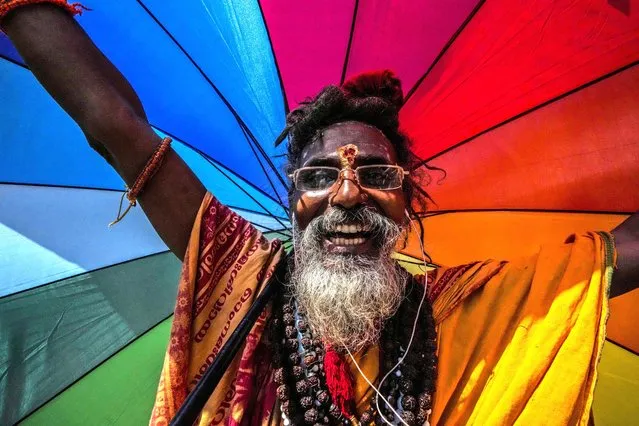
A Hindu holy man shouts religious slogans during a procession to mark 'Krishna Janmashtami' in Srinagar, Indian controlled Kashmir, Friday, August 19, 2022. Krishna Janmashtami marks the birth of Hindu god Krishna. (Photo by Mukhtar Khan/AP Photo)

A Hindu holy man shouts religious slogans during a procession to mark 'Krishna Janmashtami' in Srinagar, Indian controlled Kashmir, Friday, August 19, 2022. Krishna Janmashtami marks the birth of Hindu god Krishna. (Photo by Mukhtar Khan/AP Photo)
Details
16 Nov 2023 05:21:00
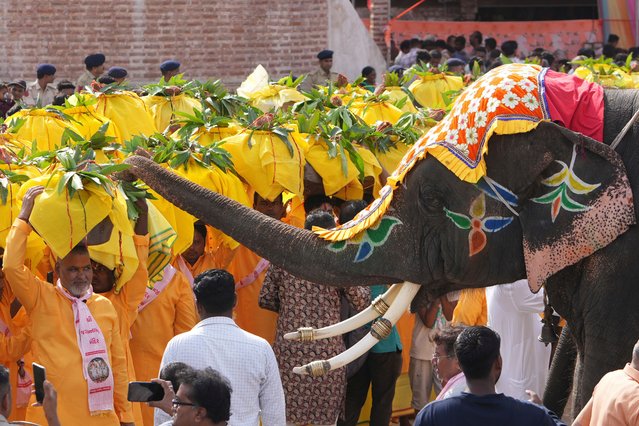
An elephant tries to eat leaves during a religious procession called Jal Yatra, ahead of the annual Rath Yatra, or chariot procession of Hindu god Lord Jagannath, in Ahmedabad, India, Wednesday, June 11, 2025. (Photo by Ajit Solanki/AP Photo)

An elephant tries to eat leaves during a religious procession called Jal Yatra, ahead of the annual Rath Yatra, or chariot procession of Hindu god Lord Jagannath, in Ahmedabad, India, Wednesday, June 11, 2025. (Photo by Ajit Solanki/AP Photo)
Details
17 Jul 2025 03:09:00
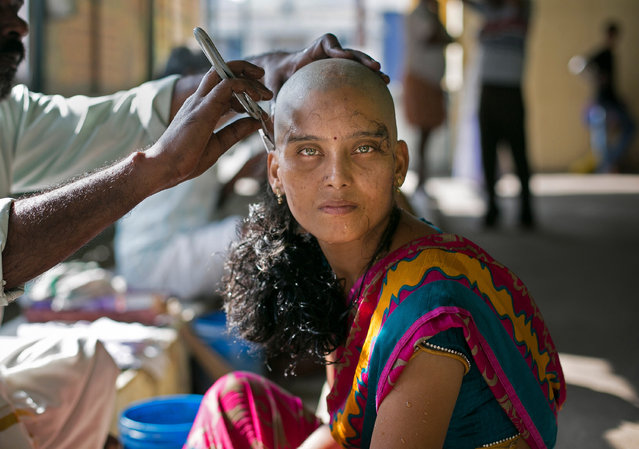
28 year old Rupa has her hair shaven to donate to the Gods at the Thiruthani Murugan Temple November 10, 2016 in Thiruttani, India. Rupa donated her hair with the wish that her daughter's illness is cured. The process of shaving ones hair and donating it to the Gods is known as tonsuring. It is common for Hindu believers to tonsure their hair at a temple as a young child, and also to celebrate a wish coming true, such as the birth of a baby or the curing of an illness. The “temple hair”, as it's known, is then auctioned off to a processing plant and then sold as pricey wigs and weaves in the US, Europe and Africa. (Photo by Allison Joyce/Getty Images)

28 year old Rupa has her hair shaven to donate to the Gods at the Thiruthani Murugan Temple November 10, 2016 in Thiruttani, India. Rupa donated her hair with the wish that her daughter's illness is cured. The process of shaving ones hair and donating it to the Gods is known as tonsuring. It is common for Hindu believers to tonsure their hair at a temple as a young child, and also to celebrate a wish coming true, such as the birth of a baby or the curing of an illness. The “temple hair”, as it's known, is then auctioned off to a processing plant and then sold as pricey wigs and weaves in the US, Europe and Africa. (Photo by Allison Joyce/Getty Images)
Details
21 Nov 2016 10:30:00
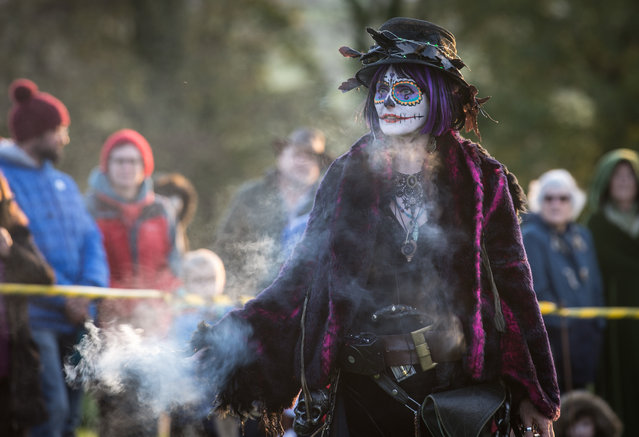
People take part in a sunset ceremony on the lower slopes of Glastonbury Tor as they celebrate Samhain at the Glastonbury Dragons Samhain Wild Hunt 2017 in Glastonbury on November 4, 2017 in Somerset, England. To celebrate Samhain, the Glastonbury Dragons, alongside Gwythyr Ap Greidal, the Summer King and the Winter King, Gwyn Ap Nudd, were paraded through the town to the lower slopes of Glastonbury Tor where the event was marked with ritual theatre, dancing and a fire to honour the dead. The Celtic festival of Samhain, which was later adopted by Christians and became Halloween, is a very important date in the Pagan calendar as it marks the division of the year between the lighter half (summer) and the darker half (winter). Pagans believe at Samhain, the division between this world and the otherworld was at its thinnest, allowing spirits to pass through. Many of the traditions of this ancient Celtic feast of the dead were later incorporated into the Christian calendar and Irish immigrants to America in the 19th century carried their customs, such as the wearing of costumes and masks to ward of harmful spirits and the harvest tradition of carving pumpkins, which have now blended into modern day Hallowee. (Photo by Matt Cardy/Getty Images)

People take part in a sunset ceremony on the lower slopes of Glastonbury Tor as they celebrate Samhain at the Glastonbury Dragons Samhain Wild Hunt 2017 in Glastonbury on November 4, 2017 in Somerset, England. To celebrate Samhain, the Glastonbury Dragons, alongside Gwythyr Ap Greidal, the Summer King and the Winter King, (Photo by Matt Cardy/Getty Images)
Details
07 Nov 2017 07:50:00
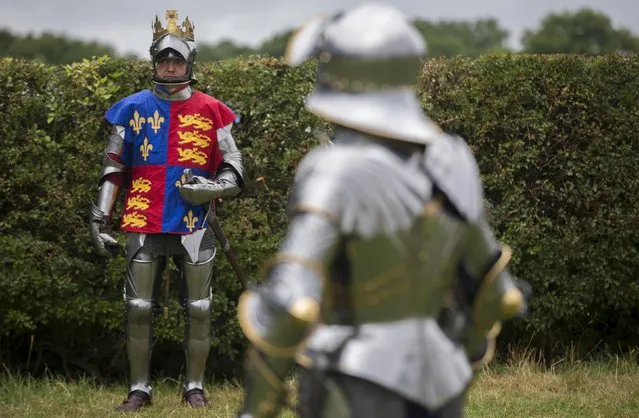
Historical re-enactor Andreas Wenzell dresses as Britain's King Richard the third in a living history camp during an anniversary event for the Battle of Bosworth near Market Bosworth in central Britain, August 23, 2015. (Photo by Neil Hall/Reuters)

Historical re-enactor Andreas Wenzell dresses as Britain's King Richard the third in a living history camp during an anniversary event for the Battle of Bosworth near Market Bosworth in central Britain, August 23, 2015. The Battle of Bosworth took place in 1485 during the War of the Roses between the House of Lancaster and the House of York. King Richard III was defeated by Henry Tudor marking the end of Plantagenet rule and the beginning of the Tudor dynasty. (Photo by Neil Hall/Reuters)
Details
24 Aug 2015 13:11:00
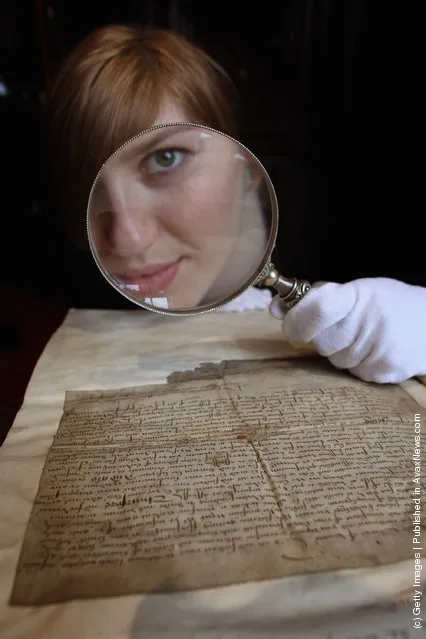
Charlotte Roirdan from Lyon & Turnbull views a letter written by Mary Queen of Scots

Charlotte Roirdan from Lyon & Turnbull views a letter written by Mary Queen of Scots on March 8, 2012 in Edinburgh, Scotland. The 450 year old letter, unearthed in Blair Castle in Ayrshire, has been verified as the hand writing of Mary Queen of Scotts and has been valued at 3,000 GBP. The letter, dated March 20, 1554, relieves the then laird of Blair from his duties due to gout and will be put up for sale next week at an auction in Edinburgh. (Photo by Jeff J. Mitchell/Getty Images)
Details
11 Mar 2012 10:19:00
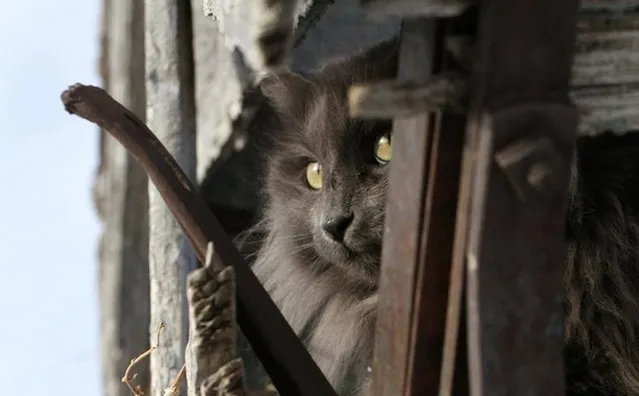
Sygmond The Grey Majestic Cat

Meet Sygmond the grey. He had the face of a king when he was a kitten. This majestic cat is even fluffier today fully grown and whenever he goes, he makes it epic.
Details
01 Apr 2014 14:43:00
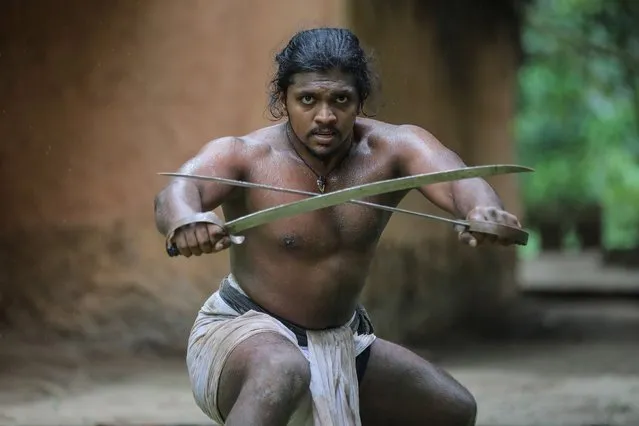
A student of the Sri Lankan ancient martial art “Angampora” performs during a practice session at the angam maduwa or fighting field, in Korathota, a suburb of Colombo, Sri Lanka, 07 September 2022. Sri Lanka's ancient martial art, Angampora, is thought to be thousands of years old. Anga translates to “body parts” and Angampora is a fighting art that uses body parts. Martial arts practitioners in Angampora were mostly in the king's service, and they were tasked with protecting the king and his kingdom. Angampora was practiced in secret for most centuries because the British, who colonized Sri Lanka, banned it in 1818 after seeing it as a threat. (Photo by Chamila Karunarathne/EPA/EFE)

A student of the Sri Lankan ancient martial art “Angampora” performs during a practice session at the angam maduwa or fighting field, in Korathota, a suburb of Colombo, Sri Lanka, 07 September 2022. Sri Lanka's ancient martial art, Angampora, is thought to be thousands of years old. Anga translates to “body parts” and Angampora is a fighting art that uses body parts. Martial arts practitioners in Angampora were mostly in the king's service, and they were tasked with protecting the king and his kingdom. Angampora was practiced in secret for most centuries because the British, who colonized Sri Lanka, banned it in 1818 after seeing it as a threat. (Photo by Chamila Karunarathne/EPA/EFE)
Details
14 Oct 2022 04:47:00