Loading...
Done
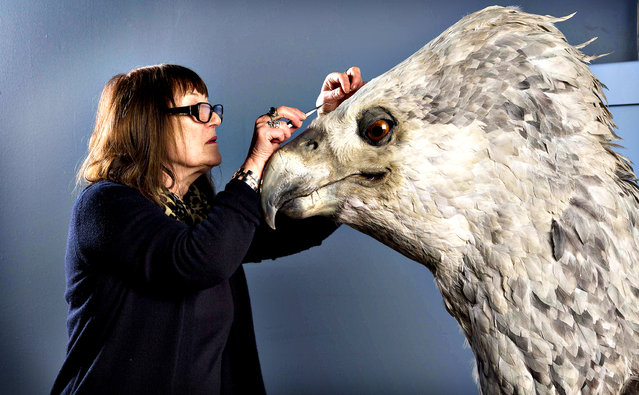
Undated handout photo of Buckbeak, a Hippogriff that lived with Rubeus Hagrid in the Harry Potter series, has his feathers preened and replenished by featherologist Val Jones, as he will feature in the the Feathers and Flight event at Warner Bros. Studio Tour London. (Photo credit should read: Tim Anderson/PA Wire)

Undated handout photo of Buckbeak, a Hippogriff that lived with Rubeus Hagrid in the Harry Potter series, has his feathers preened and replenished by featherologist Val Jones, as he will feature in the the Feathers and Flight event at Warner Bros. Studio Tour London. This is the first make-over Buckbeak has received since the hugely popular Harry Potter film series was made. His intricate coat is created from thousands of individually airbrushed chicken and goose feathers that Val will carefully clean and replenish in time for the start of Feathers and Flight. Val will lead an expert team to demonstrate the techniques that made winged wonders such as Buckbeak and Fawkes the Phoenix a reality on screen. (Photo by Tim Anderson/PA Wire)
Details
22 Mar 2014 13:56:00
Policemen guard Poland's Supreme Court as a protester lies on the pavement in Warsaw, Poland, on Thursday, April 22, 2021. A disputed disciplinary body within Poland's Supreme Court is examining a motion that could result in the arrest of a judge who has become a symbol of the fight for an independent judiciary. The Disciplinary Chamber is due to decide whether to force Judge Igor Tuleya to answer to prosecutors about charges related to a ruling that went against the interests of the ruling Law and Justice party. Sign read in Polish “Illegal ID – SN”, where ID means Disciplinary Chamber and SN means Supreme Court. (Photo by Czarek Sokolowski/AP Photo)

Policemen guard Poland's Supreme Court as a protester lies on the pavement in Warsaw, Poland, on Thursday, April 22, 2021. A disputed disciplinary body within Poland's Supreme Court is examining a motion that could result in the arrest of a judge who has become a symbol of the fight for an independent judiciary. (Photo by Czarek Sokolowski/AP Photo)
Details
23 Apr 2021 09:34:00
Chinese women wear protective masks as they are dressed in traditional clothing from the Qing Dynasty era outside a park on March 29, 2020 in Beijing, China. A limited section of the iconic tourist site was re-opened to the public this week allowing a smaller number of visitors to reserve tickets online in advance and to enter after passing health screening. With the pandemic hitting hard across the world, China recorded its first day with no new domestic cases of the coronavirus last week, since the government imposed sweeping measures to keep the disease from spreading. For two months, millions of people across China have been restricted in how they move from their homes, while other cities have been locked down in ways that appeared severe at the time but are now being replicated in other countries trying to contain the virus. Officials believe the worst appears to be over in China, though there are concerns of another wave of infections as the government attempts to reboot the worlds second largest economy. In Beijing, it is mandatory to wear masks outdoors, retail stores operate on reduced hours, restaurants employ social distancing among patrons, and tourist attractions at risk of drawing large crowds remain closed. Monitoring and enforcement of virus-related measures and the quarantine of anyone arriving to Beijing is carried out by neighborhood committees and a network of Communist Party volunteers who wear red arm bands. A primary concern for Chinese authorities remains the arrival of flights from Europe and elsewhere, given the exposure of passengers in regions now regarded as hotbeds for transmission. Since January, China has recorded more than 81,000 cases of COVID-19 and at least 3200 deaths, mostly in and around the city of Wuhan, in central Hubei province, where the outbreak first started. (Photo by Kevin Frayer/Getty Images)

Chinese women wear protective masks as they are dressed in traditional clothing from the Qing Dynasty era outside a park on March 29, 2020 in Beijing, China. A limited section of the iconic tourist site was re-opened to the public this week allowing a smaller number of visitors to reserve tickets online in advance and to enter after passing health screening. (Photo by Kevin Frayer/Getty Images)
Details
01 Apr 2020 00:05:00
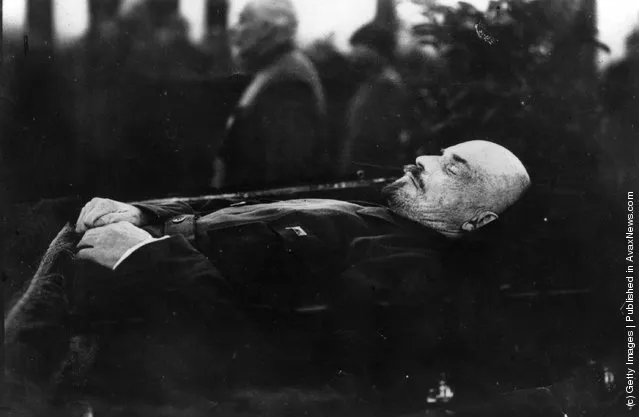
1924:  Vladimir Ilyich Lenin lying in state in the Kremlin

Photo: Vladimir Ilyich Lenin (1870 – 1924) lying in state in the Kremlin. (Photo by Hulton Archive/Getty Images). 1924

Important! For the same article in Russian language click here.

Something quite intriguing is happening within Russian-speaking internet during the last few – should you type a fully academic inquiry (at least, according to Russian academic requirements) in national search engines for "Lenin's mausoleum" – the first thing you get (even in top 10 searches) is website pages talking about black magic and occult. Website authors view this construction differently, but unconditionally agree on one thing: the mausoleum of the "leader of the world proletariat” – the essence of a magical artifact, a sort of “energy vampire”. It was built with a certain purpose: to drain the energy out of miserable Soviet citizens on one hand; and to poison the anthroposphere of one-sixth part of the earth with its vibes (the exact territory that was occupied by the former Soviet Union), depriving the Russian people of will to resist on the other hand. Complete nonsense? No doubt. Nevertheless, an intriguing one. Well, probably because some oddities do exist in mausoleum's history. These oddities are the thing we are going to discuss this time. First, let me refresh you memory on the subject.
Details
16 Oct 2011 11:27:00
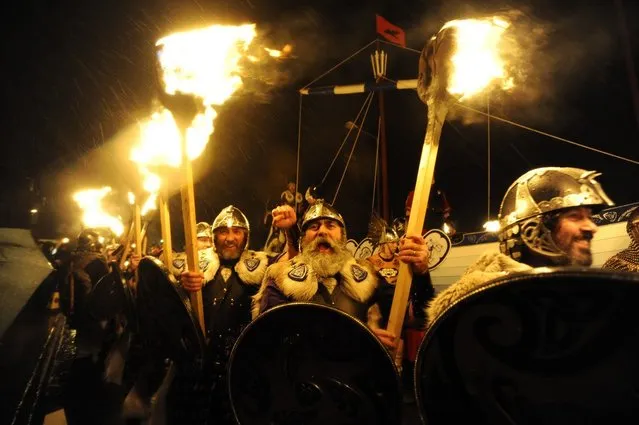
Members of the 2013 'Jarl Squad' take part in the annual Up Helly Aa festival which culminates in the burning of a Viking Galley in Lerwick, Shetland Islands on January 29, 2013. Up Helly Aa celebrates the influence of the Scandinavian Vikings in the Shetland Islands and has employed this theme in the festival since 1870. The event culminates with up to 1,000 'guizers' (men in costume) throwing flaming torches into their Viking longboat. AFP PHOTO / ANDY BUCHANAN        (Photo credit should read Andy Buchanan/AFP/Getty Images)

Members of the 2013 “Jarl Squad” take part in the annual Up Helly Aa festival which culminates in the burning of a Viking Galley in Lerwick, Shetland Islands on January 29, 2013. Up Helly Aa celebrates the influence of the Scandinavian Vikings in the Shetland Islands and has employed this theme in the festival since 1870. The event culminates with up to 1,000 “guizers” (men in costume) throwing flaming torches into their Viking longboat. (Photo by Andy Buchanan/AFP Photo)
Details
30 Jan 2013 09:29:00
Ocean voyage

Do you think that history is a science? Well, not exactly. First, and foremost, history is the state's “legend of wars”, it’s official regalia. Of course, public historians are not interested in scientific truth – quite the opposite. In this respect, any attempt to present a state’s history as altruistic and benevolent as possible is welcomed and encouraged – as opposed to any revisionism attempts that may be more accurate. In this matter, Chinese have surpassed us all – they revised in highly creative manner (but rather shamelessly) the technology already invented by Europeans, a process that resulted in oldest state on the planet. Here is an interesting paradox: ask any sinologist about the Middle Kingdom during second century B.C., and he will describe it to you in such a vivid manner as if he has been living there all his life – but as soon as you will ask him to describe Chinese history in the 19-20th centuries… let's say, his eagerness will be greatly diminished. However, we will discuss China in a different article, and in the meantime we will try to understand how exactly historic “legend of wars” is formed and functions – based on a specific and well-known example. A great example is Ferdinand Magellan's first voyage around the world.
Details
14 Nov 2011 09:11:00
Roof-topping enthusiast Daniel Lau takes a selfie with high-rise buildings down below as he stands on the top of a skyscraper in Hong Kong, China on August 15, 2017. Welcome to “roof-topping”, where daredevils take pictures of themselves standing on the tops of tall buildings, or in some cases even dangling from them, without any safety equipment. A craze that began in Russia has now taken hold in Hong Kong, one of the world's most vertical cities, with dramatic results. “I'm an explorer”, said Daniel Lau, one of the three who climbed to the top of The Center. A student, he said roof-topping was “a getaway from my structured life”. “Before doing this, I lived like an ordinary person, having a boring life”, he said. “I wanted to do something special, something memorable. I want to let people see Hong Kong, the place they are living, from a new perspective”. Mr Lau said he had been inspired by Russian climbers and that he was unafraid of the vertiginous heights he scales. (Photo by ImagineChina/Rex Features/Shutterstock)

Roof-topping enthusiast Daniel Lau takes a selfie with high-rise buildings down below as he stands on the top of a skyscraper in Hong Kong, China on August 15, 2017. A craze that began in Russia has now taken hold in Hong Kong, one of the world's most vertical cities. Mr Lau said he had been inspired by Russian climbers and that he was unafraid of the vertiginous heights he scales. (Photo by ImagineChina/Rex Features/Shutterstock)
Details
16 Aug 2017 07:23:00
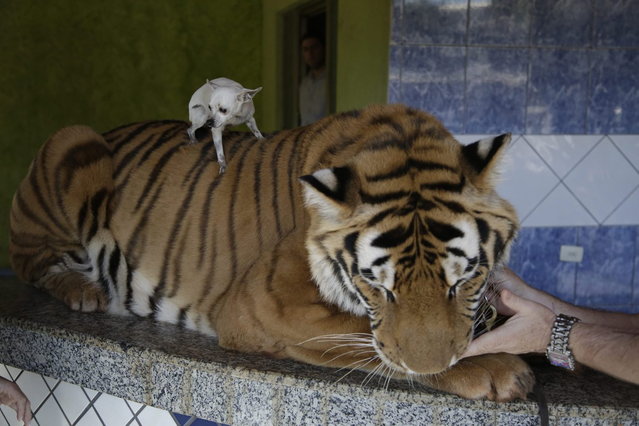
The Borges' family pet dog, Little, is placed on the back of Tom, their tiger, for a photo to be taken, in Maringa, Brazil, Friday, September 27, 2013. The Brazilian family is now locked in a legal dispute for the big cats, they have eight tigers and two lions, with federal wildlife officials working to take them away. While Borges does have a license to raise the animals, Brazilian wildlife officials say he illegally bred the cats, creating a public danger. (Photo by Renata Brito/AP Photo)

“Ary Borges and his family live in southern Brazil like most families the Borges' love animals and have an array of cats living in their home. The only difference between the cats owned by the Borges family and the cat that is cuddled up on your lap as you read this is the Borges' cats weigh over 700 pounds and could kill you just as soon as look at you. The Borges family shares their home with nine tigers, two lionesses, a chimp and a Chihuahua”. – Amanda Schiavo via Latin Times. Photo: The Borges' family pet dog, Little, is placed on the back of Tom, their tiger, for a photo to be taken, in Maringa, Brazil, Friday, September 27, 2013. (Photo by Renata Brito/AP Photo)
Details
04 Oct 2013 11:51:00