Loading...
Done
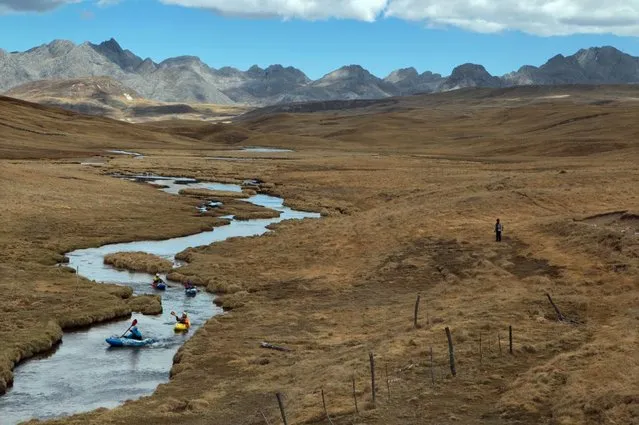
August 19, 2012 – Alpamarca, Peru – Amazon Express white water members Juan Antonio De Ugarte, of Peru, Rafael Ortiz, of Mexico, West Hansen, of the U.S., and Tino Specht, of the U.S., paddle down the Rio Gashan after leaving Lago Acucocha. Lago Acucocha is possibly the dry season source of the Amazon River. (Photo by Erich Schlegel/zReportage via ZUMA Press)

“The Amazon river has a newly discovered source. Completed last year and led by West Hansen and documented by award-winning freelance photographer Erich Schlegel, this is the first expedition to paddle from the furthest source of the earth's largest river to the ocean”. – zReportage. Photo: August 19, 2012 – Alpamarca, Peru – Amazon Express white water members Juan Antonio De Ugarte, of Peru, Rafael Ortiz, of Mexico, West Hansen, of the U.S., and Tino Specht, of the U.S., paddle down the Rio Gashan after leaving Lago Acucocha. Lago Acucocha is possibly the dry season source of the Amazon River. (Photo by Erich Schlegel/zReportage via ZUMA Press)
Details
29 Jul 2013 10:47:00
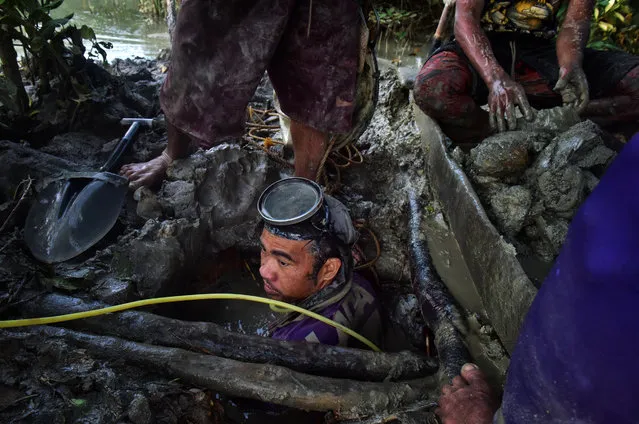
Christian Balderosdasco, 31, is being pulled up a mud pit after diving for 3 hours to look for gold on March 22, 2017 in Paracale, Philippines. (Photo by Jes Aznar/Getty Images)

Christian Balderosdasco, 31, is being pulled up a mud pit after diving for 3 hours to look for gold on March 22, 2017 in Paracale, Philippines. Apart from tunneling and sifting sand, locals dive down murky swamps with the aid of a compressor with air flowing in a small tube for breathing, as they blindly swim under the mud for up to four hours to look for tiny rocks containing gold particles. For decades, local residents at Paracale town work in hazardous conditions scavenging under the earth and diving into tunnels filled with mud using only makeshift tools to mine for gold, often placing their health and lives at risk. (Photo by Jes Aznar/Getty Images)
Details
06 Apr 2017 09:21:00
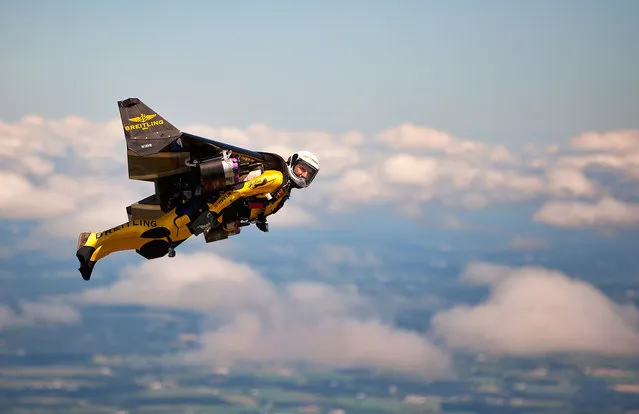
Jetman during a trial flight from Fond du Lac airport on Monday July 29, 2013. While skydiving several years ago Yves Rossy thought it would be cool to not just fall to earth but fly around with a jetpack on his back. So he invented one and will jump out of a helicopter over Oshkosh on Tuesday at AirVenture air and zoom around in his jetpack, his first public appearance in the U.S. (Photo by Mike Shore/Courtesy of Breitling)

Yves “Jetman”, Rossy made his first public performance in the United States on Tuesday during the afternoon air show at EAA AirVenture. As thousands of spectators leaned back and clicked cameras, Rossy jumped out of a helicopter with his 6-foot carbon fiber wing armed with four 45-pound-thrust JetCat engines strapped to his back. Photo: Jetman during a trial flight from Fond du Lac airport on Monday July 29, 2013. (Photo by Mike Shore/Courtesy of Breitling)
Details
31 Jul 2013 13:05:00
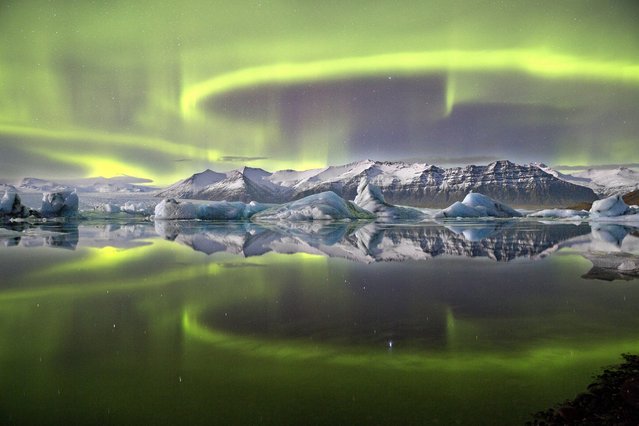
“Aurora over a glacier lagoon”. A vivid green overheaded aurrora pictured in Iceland's Vatnajokull National Park reflected almost symetrically in Jokulsrlon Glacier lagoon. A complete lack of wind and currrent combin in this sheltred lagoon scene to crete an arresting mirror effect giving the image a sensation of utter stillness. Despite theis there is motion on a suprising scale, as the loops and arcs of the aurora are shaped by the shifting forces of the Earth's magnetic field. (Photo by  James Woodend/The Astronomy Photographer of the Year 2014 Contest)

“Aurora over a glacier lagoon”. A vivid green overheaded aurrora pictured in Iceland's Vatnajokull National Park reflected almost symetrically in Jokulsrlon Glacier lagoon. A complete lack of wind and currrent combin in this sheltred lagoon scene to crete an arresting mirror effect giving the image a sensation of utter stillness. Despite theis there is motion on a suprising scale, as the loops and arcs of the aurora are shaped by the shifting forces of the Earth's magnetic field. James Woodend of Great Britain won the grand prize with the image, beating out more than 2,500 other entries. The Astronomy Photographer of the Year 2014 contest is judged by the Royal Observatory Greenwich and BBC Sky at Night magazine. (Photo by James Woodend/The Astronomy Photographer of the Year 2014 Contest)
Details
26 Sep 2014 13:39:00
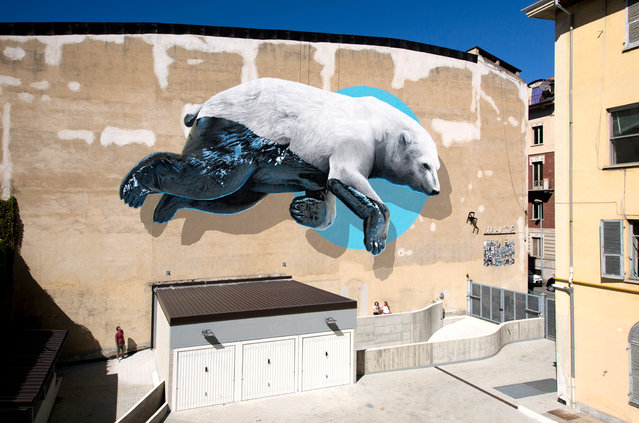
A polar bear whose bottom half is caked in oily black gunk. A whale wrapped in striped fabric: a pseudo straightjacket. These are the messes climate change leaves behind, the things we know are happening but often don’t have the opportunity to see with our own eyes. Swiss street art duo Christian Rebecchi and Pablo Togni, otherwise known as NeverCrew, met in art school when they were 15 and started making work together soon after. As a team, the artists adorn the world with eye-popping and gut-wrenching images depicting the consequences of humanity’s actions on earth. Here: “Black machine” mural painting and installation on the Colosseo theater in Turin, Italy, in September 2015. (Photo by NeverCrew/The Huffington Post)

A polar bear whose bottom half is caked in oily black gunk. A whale wrapped in striped fabric: a pseudo straightjacket. These are the messes climate change leaves behind, the things we know are happening but often don’t have the opportunity to see with our own eyes. Swiss street art duo Christian Rebecchi and Pablo Togni, otherwise known as NeverCrew, met in art school when they were 15 and started making work together soon after. As a team, the artists adorn the world with eye-popping and gut-wrenching images depicting the consequences of humanity’s actions on earth. (Photo by NeverCrew/The Huffington Post)
Details
13 Aug 2016 11:09:00
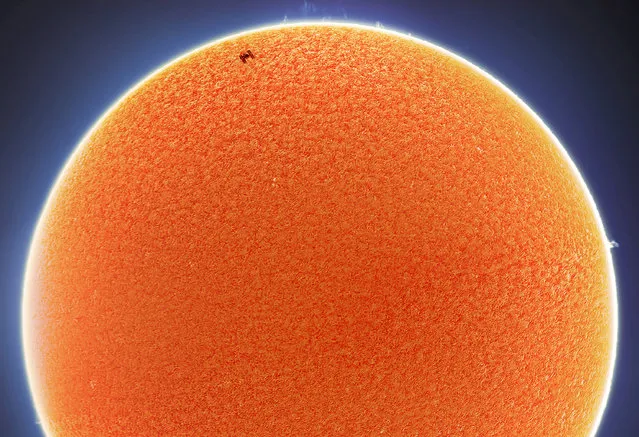
The International Space Station (ISS) moving in front of the sun in November 2020 by astrophotographer Andrew McCarthy. These incredible photos capture the clearest images ever taken of the International Space Station (ISS) moving in front of both the moon and the sun. The photos, taken within days of one another, were captured in the space of less than a second, as the space station could be clearly seen zooming across against the bright backdrops of both moon and sun. Photographer Andrew McCarthy, from California, USA, said the photo of the ISS in front of the sun, in broad daylight, was “one of my trickiest shots ever”. (Photo by Andrew McCarthy/South West News Service)

The International Space Station (ISS) moving in front of the sun in November 2020 by astrophotographer Andrew McCarthy. These incredible photos capture the clearest images ever taken of the International Space Station (ISS) moving in front of both the moon and the sun. The photos, taken within days of one another, were captured in the space of less than a second, as the space station could be clearly seen zooming across against the bright backdrops of both moon and sun. Photographer Andrew McCarthy, from California, USA, said the photo of the ISS in front of the sun, in broad daylight, was “one of my trickiest shots ever”. (Photo by Andrew McCarthy/South West News Service)
Details
28 Nov 2020 00:05:00
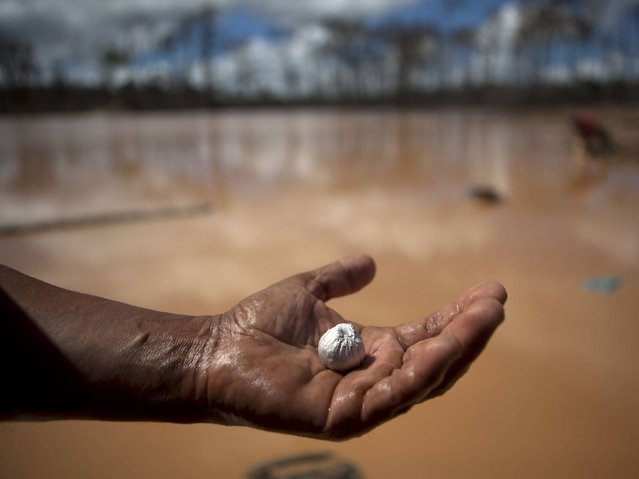
A miner holds an amalgam of mercury and gold he mined after working a 28-hour shift at an illegal gold mining process in La Pampa, in Peru's Madre de Dios region. (Photo by Rodrigo Abd/AP Photo)

In this May 4, 2014 photo, a miner holds an amalgam of mercury and gold he mined after working a 28-hour shift at an illegal gold mining process, in La Pampa, in Peru's Madre de Dios region. Thousands of artisanal gold miners sweat through the long shifts and endure, for a few grams of gold, the perils of collapsing earth, limb-crushing machinery and the toxic mercury used to bind gold flecks. (Photo by Rodrigo Abd/AP Photo)
Details
14 May 2014 10:05:00
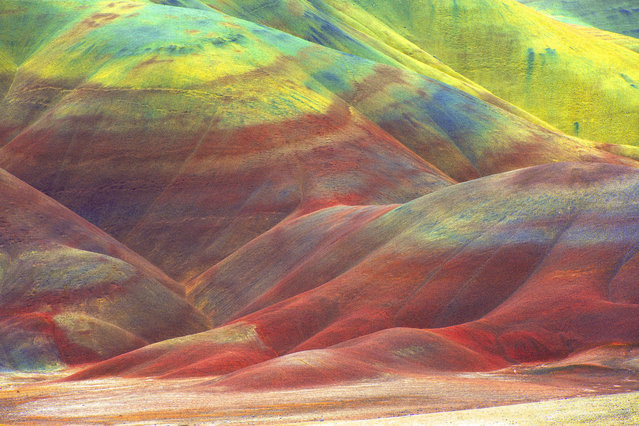
Layers of breathtaking colour streak the rolling hills of this vast desert, making the landscape appear as though it has been tie-dyed. The natural phenomenon, nicknamed the “Painted Desert”, was formed when the area was once a river floodplain. (Photo by Mark Brodkin/Solent News/SIPA Press)

Layers of breathtaking colour streak the rolling hills of this vast desert, making the landscape appear as though it has been tie-dyed. The natural phenomenon, nicknamed the “Painted Desert”, was formed when the area was once a river floodplain. Each colour corresponds to a different underground geological feature – rocks which have seemingly dyed the layers of earth above. Formed from volcanic activity, the hills at the John Day Fossil Beds National Monument in East Central Oregon, USA, are almost bursting with colour. Pictured: The colourful hills at the John Day Fossil Beds National Monument in East Central Oregon, USA. (Photo by Mark Brodkin/Solent News/SIPA Press)
Details
30 Jul 2014 11:00:00