Loading...
Done
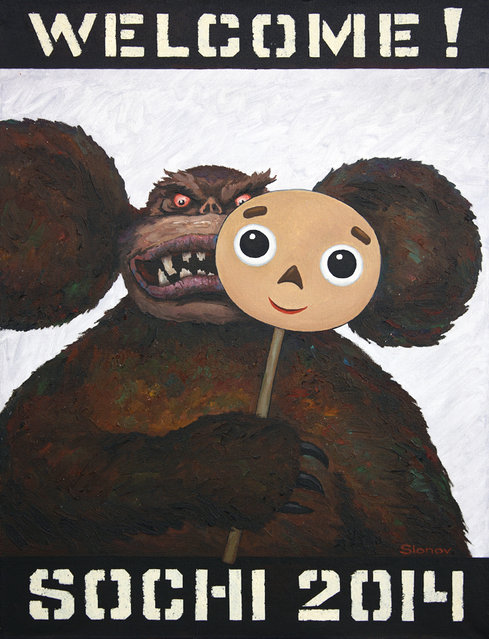
The Dark Side of Sochi Olympics by Vasily Slonov

“Exactly one year before the long awaited Sochi Olympics, Vladimir Putin went to Sochi personally to see how the construction is going. After receiving a report saying the ski jumps that were supposed to be ready in 2011, are not completed still, while their price has sky-rocketed from 1.2 billion to 8 billion roubles, he commented, “Good for you. Good job”, and then fired the vice president of the Olympic committee. Russian artist Vasily Slonov painted his view of the upcoming games, giving a new interpretation to the adored Russian mascot Cheburashka, and combining officially endorsed stereotypes of Russia with grimmer and less accepted ones”. – Ruskie.info. (Photo by Vasily Slonov)
Details
07 Jun 2013 10:24:00
The maid-themed cafe in Hangzhou, China on September 29, 2016. (Photo by AsiaWire)

The maid-themed cafe in Hangzhou, China on September 29, 2016. A cafe has been bringing in droves of new customers after hiring young women to dress up in Frech maid costumes while serving diners. Curious coffee- and coffee-lovers are coming from all corners of Hangzhou, capital of East China's Zhejiang Province, to get a taste of the “maid cafe” experience. The business is said to have been opened by a man surnamed Yu and his friends, all whom are natives or graduates of the city. The all-female staff who donned the black and white French maid outfits are also students currenting living or studying in Hangzhou, allowing them to marry their passion for serving with the part-time job. (Photo by AsiaWire)
Details
30 Sep 2016 09:14:00
“Flashy Lady”. (Photo and caption by Roderique Arisiaman)

Some artists want to convey some deep message through their art, while some are simply satisfied with shocking the audience. Roderique Arisiaman is the latter kind. Though his works do not play on the strings of our emotion, they can pique the interest with their flashy and sometimes humorous appearance. Many of his works have a zombie theme, and are surprisingly well done, especially the one where a man pushes his fingers through his cheek and into his eye. If given the chance, Roderique Arisiaman would probably do a great job of designing a poster for some zombie apocalypse movie. (Photo and caption by Roderique Arisiaman)
Details
18 Mar 2015 09:27:00
Factory landlord Lawrence Taylor (L), portraying a Colour Sergeant from the King's Royal Rifle Corps, part of the Rifles Living History Society, performs a drill with Connor Young (R) of the Queen's Own Royal West Kent Regiment Living History Group as they recreate the life of a First World War soldier at the Eden Valley Museum in Edenbridge in southeast England May 10, 2014. (Photo by Luke MacGregor/Reuters)

Factory landlord Lawrence Taylor (L), portraying a Colour Sergeant from the King's Royal Rifle Corps, part of the Rifles Living History Society, performs a drill with Connor Young (R) of the Queen's Own Royal West Kent Regiment Living History Group as they recreate the life of a First World War soldier at the Eden Valley Museum in Edenbridge in southeast England May 10, 2014. Lawrence has always had an interest in military history and specifically “The Rifles” – his veteran father's WWII regiment. When he became a re-enactor he chose not to re-enact WWII as many of the veterans are still alive, and he felt uncomfortable as he remembers his father would have flashbacks and nightmares about the war. United by a fascination with military history and a fondness for dressing up, groups such as the Rifles Living History Society and the Queen's Own Royal West Kent Regiment Living History Group get together to recreate aspects of life during the First World War. Reuters photographer Luke MacGregor photographed members of the groups, both as they took part in living history events and at their day jobs. (Photo by Luke MacGregor/Reuters)
Details
26 Aug 2014 10:12:00
Camp director and “duck walk” inventor Rodin Gilbert Flores, 2nd R) teaches aspiring beauty queens how to “duck walk” at a beauty boot camp in Manila in this picture taken on March 8, 2015. From wading in muddy Philippine rice paddies, former housemaid Janicel Lubina now struts down runways for the country's top designers, and is poised to be crowned among the world's most beautiful. (Photo by Noel Celis/AFP Photo)

Camp director and “duck walk” inventor (Rodin Gilbert Flores, 2nd R) teaches aspiring beauty queens how to “duck walk” at a beauty boot camp in Manila in this picture taken on March 8, 2015. From wading in muddy Philippine rice paddies, former housemaid Janicel Lubina now struts down runways for the country's top designers, and is poised to be crowned among the world's most beautiful. Lubina is a star recruit in one of Manila's beauty pageant boot camps, where shy, lanky teenage girls from remote farming provinces are transformed into poised Barbie dolls who can preach about world peace in six-inch heels. (Photo by Noel Celis/AFP Photo)
Details
15 Mar 2015 06:51:00
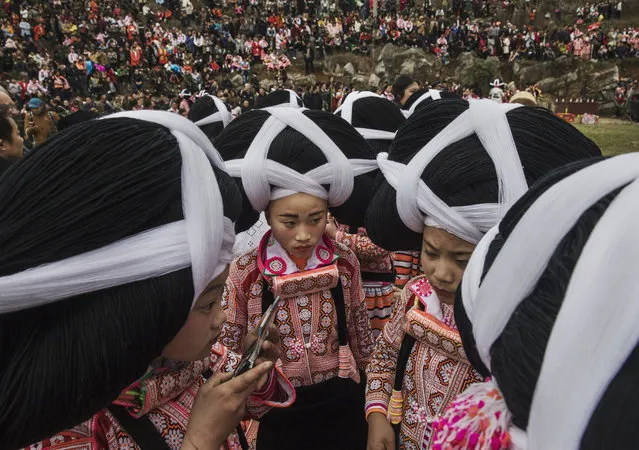
Girls of the Long Horn Miao ethnic minority group wear headdresses as they prepare gather for Tiaohua or Flower Festival as part of the Lunar New Year on February 6, 2017 in Longga village, Guizhou province, southern China. The Long Horn Miao are recognized for their declining practice of wrapping a blend of linen, wool, and the hair of their ancestors around animal horns or a wooden clip to make headdresses. Many young women say they now wear the headdresses only for special occasions and festivals, as the ornaments, which are attached by the horns to their real hair, have proved impractical for modern daily life in a fast changing world. China officially recognizes 56 different ethnic minorities, and statistics show over 7 million Chinese identifying themselves as Miao. But the small Long Horn Miao community counts only around 5000 people living in 12 villages, whose age-old traditions, language, and culture are fading. It is increasingly difficult in a modernizing China, as young people are drawn from remote rural villages to opportunities in bigger cities amongst wide-scale urbanization. Farming and labour remain the mainstays of life for the Long Horn Miao, leaving the area relatively poor in comparison with many parts of China. The government has invested significant amounts into local infrastructure and the tourism industry to try to bolster the local economy. (Photo by Kevin Frayer/Getty Images)

Girls of the Long Horn Miao ethnic minority group wear headdresses as they prepare gather for Tiaohua or Flower Festival as part of the Lunar New Year on February 6, 2017 in Longga village, Guizhou province, southern China. (Photo by Kevin Frayer/Getty Images)
Details
13 Feb 2017 00:01:00
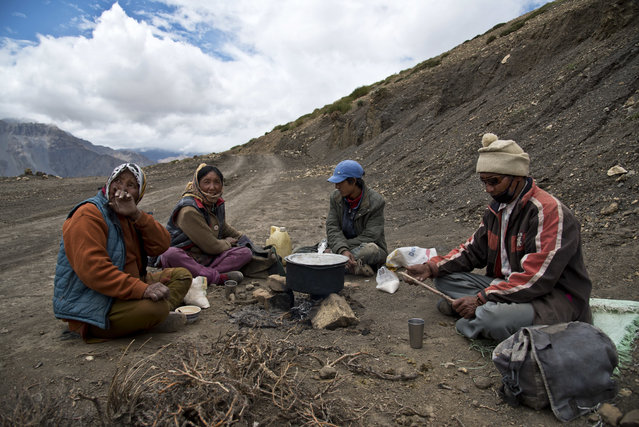
In this August 17, 2016, photo, from left to right, Chhering Chodom, 60, Tashi Yangzom, 50, Lobsang Chhering, 27, and Dorje Tandup, 58, drink milk tea on the side of the road. For centuries, the sleepy valley nestled in the Indian Himalayas remained a hidden Buddhist enclave forbidden to outsiders. Enduring the harsh year-round conditions of the high mountain desert, the people of Spiti Valley lived by a simple communal code – share the Earth's bounty, be hospitable to neighbors, and eschew greed and temptation at all turns. That's all starting to change, for better or worse. Since India began allowing its own citizens as well as outsiders to visit the valley in the early 1990s, tourism and trade have boomed. And the marks of modernization, such as solar panels, asphalt roads and concrete buildings, have begun to appear around some of the villages that dot the remote landscape at altitudes above 4,000 meters (13,000 feet). (Photo by Thomas Cytrynowicz/AP Photo)

In this August 17, 2016, photo, from left to right, Chhering Chodom, 60, Tashi Yangzom, 50, Lobsang Chhering, 27, and Dorje Tandup, 58, drink milk tea on the side of the road. For centuries, the sleepy valley nestled in the Indian Himalayas remained a hidden Buddhist enclave forbidden to outsiders. Enduring the harsh year-round conditions of the high mountain desert, the people of Spiti Valley lived by a simple communal code – share the Earth's bounty, be hospitable to neighbors, and eschew greed and temptation at all turns. That's all starting to change, for better or worse. (Photo by Thomas Cytrynowicz/AP Photo)
Details
15 Sep 2016 09:22:00
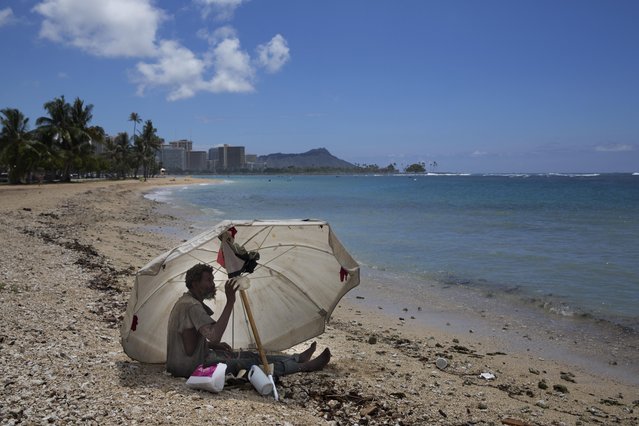
In this Thursday, August 27, 2015 photo, a homeless man drinks water while sitting on the beach at Ala Moana Beach Park located near Waikiki in Honolulu. Homelessness in Hawaii has grown steadily in recent years, leaving the state with the nation's highest rate of homeless people per capita. (Photo by Jae C. Hong/AP Photo)

Hawaii has long been known as a tropical paradise, but in recent years another image has intruded into the state's carefully crafted one of idyllic beaches and relaxing resorts: homelessness. The number of homeless people has grown in recent years, leaving the state with 487 homeless per 100,000 people, the nation's highest rate per capita, above New York and Nevada, according to federal statistics. Many of the homeless, however, defy the stereotype of the mentally ill or drug addicted. They are families, with men and women who work full-time jobs. They are struggling to get a foothold in a place with a high cost of living and low wages. Here: in this Thursday, August 27, 2015 photo, a homeless man drinks water while sitting on the beach at Ala Moana Beach Park located near Waikiki in Honolulu. (Photo by Jae C. Hong/AP Photo)
Details
11 Nov 2015 08:03:00