Loading...
Done
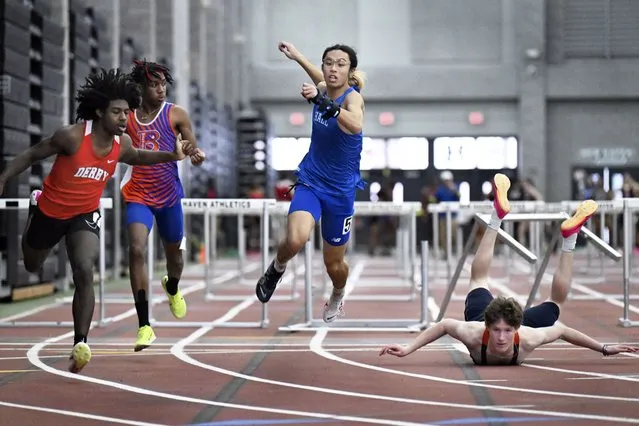
Derby's Byron MacLean, left, edges out Hall's Joe Nham in the boys 55-meter hurdles at the CIAC State Open indoor track championships at the Floyd Little Athletic Center in New Haven, Saturday, February 17, 2024. Lyman Hall's Owen Rich, right, falls after taking down the final hurdle. (Photo by Cloe Poisson/Hartford Courant via AP Photo)

Derby's Byron MacLean, left, edges out Hall's Joe Nham in the boys 55-meter hurdles at the CIAC State Open indoor track championships at the Floyd Little Athletic Center in New Haven, Saturday, February 17, 2024. Lyman Hall's Owen Rich, right, falls after taking down the final hurdle. (Photo by Cloe Poisson/Hartford Courant via AP Photo)
Details
26 Feb 2024 06:48:00
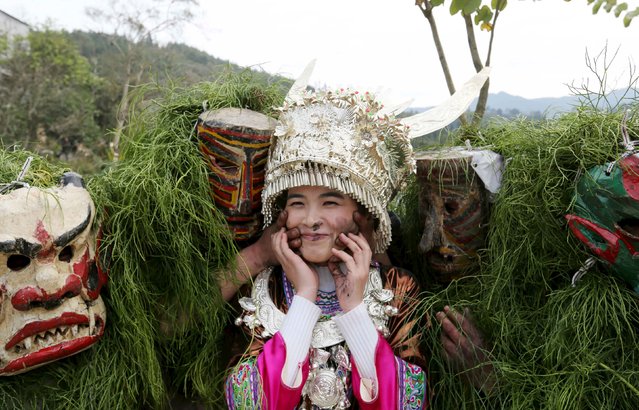
Ethnic Miao men wearing traditional masks smear dust on a woman's face to wish her good luck during local celebration event for Lunar New Year in Liuzhou, Guangxi Zhuang Autonomous Region, China, February 16, 2016. (Photo by Reuters/Stringer)

Ethnic Miao men wearing traditional masks smear dust on a woman's face to wish her good luck during local celebration event for Lunar New Year in Liuzhou, Guangxi Zhuang Autonomous Region, China, February 16, 2016. (Photo by Reuters/Stringer)
Details
19 Feb 2016 13:25:00
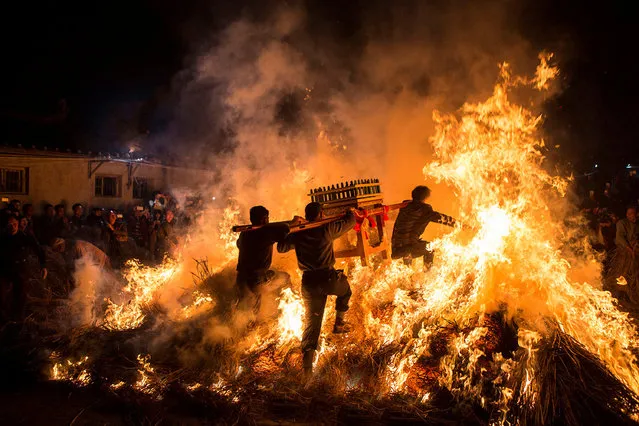
Men carrying a shrine jump over a bon fire, which means a wish for good luck during a traditional Chinese lunar new year celebration in Jieyang, Guangdong province, China, February 2, 2017. (Photo by Reuters/China Daily)

Men carrying a shrine jump over a bon fire, which means a wish for good luck during a traditional Chinese lunar new year celebration in Jieyang, Guangdong province, China, February 2, 2017. (Photo by Reuters/China Daily)
Details
09 Feb 2017 00:06:00
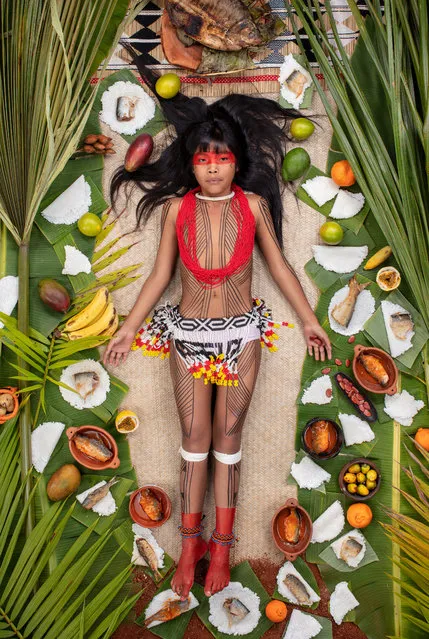
Kawakanih Yawalapiti, 9, Upper Xingu region of Mato Grosso, Brazil, 2018: Kawakanih lives with her tribe, the Yawalapiti, in Xingu national park, a preserve in the Amazon basin of Brazil. The Yawalapiti collect seeds to preserve species unique to their ecosystem, which lies between the rain forest and savannah. Kawakanih’s diet is simple, consisting mainly of fish, cassava, porridge, fruit and nuts. “It takes five minutes to catch dinner”, says Kawakanih. “When you’re hungry, you just go to the river with your net”. (Photo by Gregg Segal/The Guardian)

Photographer Gregg Segal travelled the world to document children and the food they eat in a week. Partly inspired by the increasing problems of childhood obesity, he tracked traditional regional diets as yet unaffected by globalisation, and ironically, found that the healthiest diets were often eaten by the least well off. (Photo by Gregg Segal/The Guardian)
Details
03 Jul 2019 00:03:00
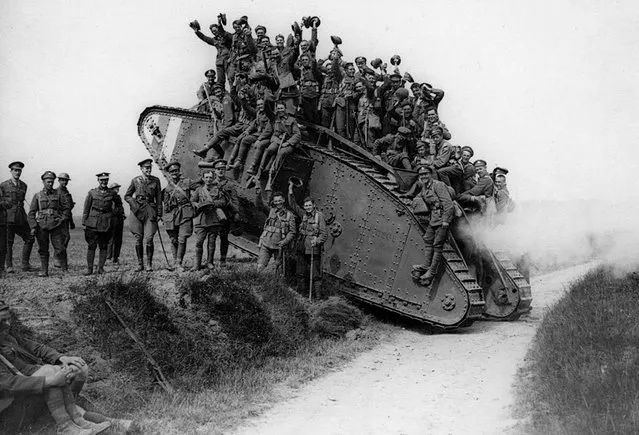
These black-and-white photos are taken from the new book “Armoured Warfare in the First World War 1916 – 1918” by Anthony Tucker-Jones and published by Pen & Sword Military. “Interestingly the British, French and Germans took completely different approaches with varying results”. The British military produced “Little Willie” in Autumn 1915 weighing 18 tonnes, which had a crew of two plus four gunners. “Inspired by a tracked artillery tractor “Little Willie” was referred to as a water tank – hence the name tank – to ensure secrecy”, said Anthony. “This led to the strange looking Mark I with its peculiar rhomboid shape, designed to cross trenches with guns in sponsons on either side. The Germans saw the tank as unchivalrous and were slow to grasp its utility. They favoured the Stormtrooper (specialist soldiers used to infiltrate enemy trenches) and artillery, not the tank”, said Anthony. “However, they didn’t hesitate to make use of captured British tanks. Although the tank helped secure victory and German soldiers dubbed it “Germany’s Downfall” the country was ultimately brought to its knees by the Allies blockade”. Here: British troops hitch a ride on a Mark IV after the massed tank fleet spearheading attack at Cambrai on November 20, 1917. (Photo by Anthony Tucker-Jones/Mediadrumworld.com)

These black-and-white photos are taken from the new book “Armoured Warfare in the First World War 1916 – 1918” by Anthony Tucker-Jones and published by Pen & Sword Military. Here: British troops hitch a ride on a Mark IV after the massed tank fleet spearheading attack at Cambrai on November 20, 1917. (Photo by Anthony Tucker-Jones/Mediadrumworld.com)
Details
23 Feb 2017 00:02:00
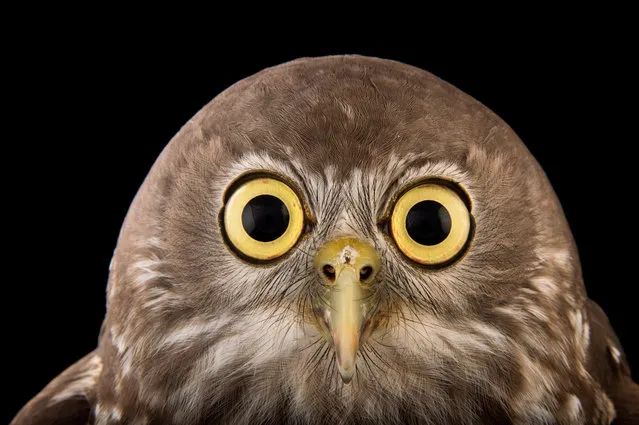
The National Geographic Photo Ark is a travelling exhibition of photographer Joel Sartore’s quest to create a photo archive of biodiversity around the world. So far, Sartore has captured studio portraits of more than 6,000 species – a number that he hopes to double. On 1 July, the ark will open at Melbourne zoo – the first time it has been exhibited in the southern hemisphere. More than 50 portraits will be on display, including many of Australian endangered animals being protected by programs at the zoo itself. These captions have been edited from text supplied by Melbourne zoo. Here: Barking owl. So-named because its call sounds like a barking dog, these birds are native to Australia, Indonesia and Papua New Guinea. In Victoria they are listed as an endangered species, and in 2003 there were estimated to be fewer than 50 breeding pairs. The main threat to the species in Victoria is loss of habitat, especially large trees with hollows in which they can nest and on which many of their prey depend. Apart from a bark, they may utter a chilling scream when they feel threatened. (Photo by Joel Sartore/National Geographic Photo Ark/The Guardian)

The National Geographic Photo Ark is a travelling exhibition of photographer Joel Sartore’s quest to create a photo archive of biodiversity around the world. So far, Sartore has captured studio portraits of more than 6,000 species – a number that he hopes to double. On 1 July, the ark will open at Melbourne zoo – the first time it has been exhibited in the southern hemisphere. More than 50 portraits will be on display, including many of Australian endangered animals being protected by programs at the zoo itself. These captions have been edited from text supplied by Melbourne zoo. Here: Barking owl. (Photo by Joel Sartore/National Geographic Photo Ark/The Guardian)
Details
01 Jul 2017 07:45:00
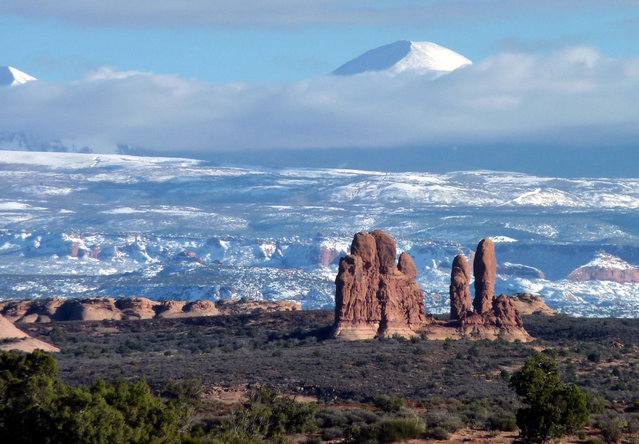
These stunning images look to highlight the amazing natural beauty that can be found across the United States. The U.S. Department of the Interior (DOI) recently released their Best of 2015 list, featuring a variety of animals, weather conditions and landmarks. Included in the list are gleaming auroras, adorable groups of otters and owls, and breath-taking shots across the likes of the Grand Canyon and national parks. (Photo by Caters News)

These stunning images look to highlight the amazing natural beauty that can be found across the United States. The U.S. Department of the Interior (DOI) recently released their Best of 2015 list, featuring a variety of animals, weather conditions and landmarks. Included in the list are gleaming auroras, adorable groups of otters and owls, and breath-taking shots across the likes of the Grand Canyon and national parks. Each of the spectacular shots, all of which were taken during 2015, featured on the Department of the Interiors Instagram account throughout the year, taken by both members of staff and members of the public. Here: Arches, National Park. (Photo by Caters News)
Details
21 Dec 2015 08:06:00
A combination picture shows a voter, casting a ballot at a polling station number 216 (L) and walking with a ballot at a polling station number 217, during the presidential election in Ust-Djeguta, Russia March 18, 2018. The voter, asked by a Reuters reporter to explain why she was voting multiple times, ignored the question and walked away. (Photo by Reuters/Staff)

17 people were photographed by Reuters apparently casting ballots at more than one polling station Sunday during Russia’s presidential election in the town of Ust-Djeguta, southern Russia. Many appeared to be state employees, and some showed up in groups and in mini buses bearing the names of state-provided services. Voting twice is a misdemeanour under Russian law and those caught are heavily fined. But when shown these pictures, election commission member Leila Koichuyeva said: “They could be twins”. Here are a few. (Photo by Reuters/Staff)
Details
22 Mar 2018 06:22:00