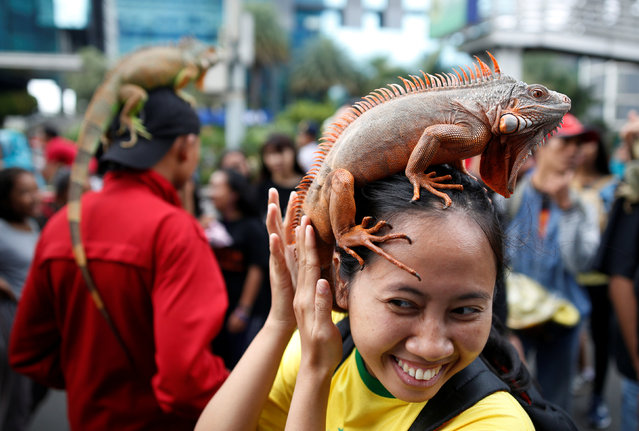
A woman holds an iguana perched on her head at a gathering of a reptile club during a car-free day in central Jakarta, Indonesia February 5, 2017. (Photo by Darren Whiteside/Reuters)
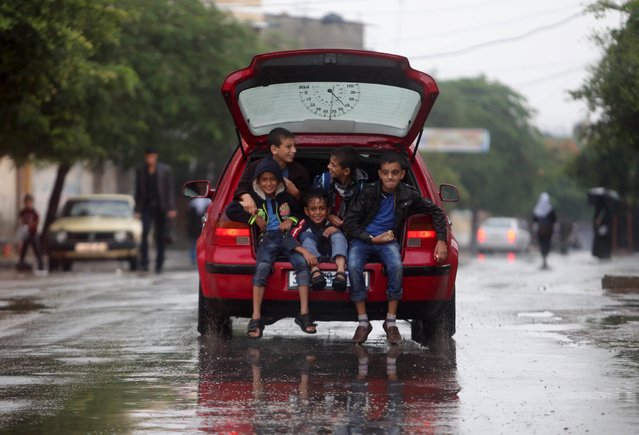
Palestinian schoolboys sit in the trunk of a car as they go to school on a rainy day in Khan Younis, in the southern Gaza Strip, October 7, 2015. (Photo by Ibraheem Abu Mustafa/Reuters)
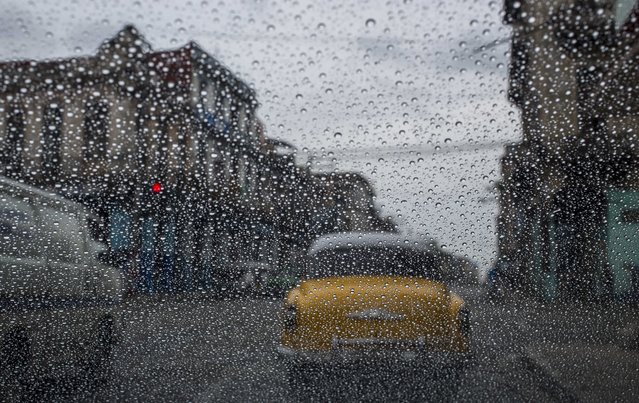
In this May 24, 2018 file photo, rain drops accumulate on a car's windshield as commuters wait at a red light in Havana, Cuba. (Photo by Desmond Boylan/AP Photo)
A tow car for the children's “Grand Prix” races which take place in a parking lot in Livonia, Michigan a suburb of Detroit, circa 1955. (Photo by Three Lions/Getty Images)
A Palestinian boy stands next to a damaged car following an Israeli raid in Tulkarm in the Israeli-occupied West Bank on October 20, 2023. (Photo by Raneen Sawafta/Reuters)
A person stands on a car while looking at Auroras, caused by a coronal mass ejection on the Sun, that illuminate the skies in the southwestern Siberian Omsk region, Russia on November 6, 2023. (Photo by Alexey Malgavko/Reuters)
The Mercedes Simplex concept car, inspired on its original 1903 Mercedes-Simplex, is displayed at the LA Auto Show in Los Angeles, California, U.S. November 20, 2019. (Photo by Lucy Nicholson/Reuters)
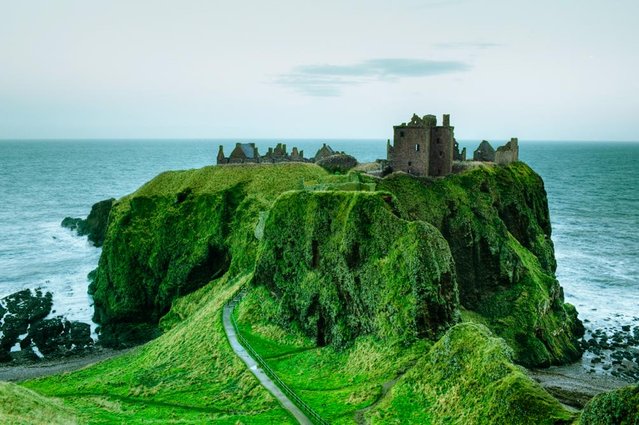
Dunnottar Castleis a ruined medieval fortress located upon a rocky headland on the north-east coast of Scotland, about 3 kilometres (1.9 mi) south of Stonehaven. The surviving buildings are largely of the 15th and 16th centuries, but the site is believed to have been fortified in the Early Middle Ages. Dunnottar has played a prominent role in the history of Scotland through to the 18th-century Jacobite risings because of its strategic location and the strength of its situation. Dunnottar is best known as the place where the Honours of Scotland, the Scottish crown jewels, were hidden from Oliver Cromwell's invading army in the 17th century. The property of the Keiths from the 14th century, and the seat of the Earl Marischal, Dunnottar declined after the last Earl forfeited his titles by taking part in the Jacobite rebellion of 1715. The castle was restored in the 20th century and is now open to the public.