Loading...
Done
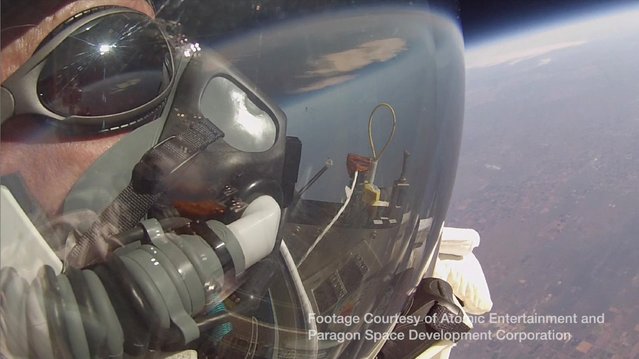
Google's vice president Alan Eustace looks out of his spacesuit into the stratosphere prior to a record-breaking skydive over New Mexico, in this still image taken from video October 24, 2014, a handout courtesy of the Paragon Space Development Corporation. Eustace was lifted up 135,890 ft (41,420 metres) by an enormous balloon while wearing a specially designed pressurized space suit, the Paragon Space Development Corporation said. (Photo by Reuters/Paragon Space Development Corporation)

Google's vice president Alan Eustace looks out of his spacesuit into the stratosphere prior to a record-breaking skydive over New Mexico, in this still image taken from video October 24, 2014, a handout courtesy of the Paragon Space Development Corporation. Eustace was lifted up 135,890 ft (41,420 metres) by an enormous balloon while wearing a specially designed pressurized space suit, the Paragon Space Development Corporation said. Eustace remained in a free fall for approximately 4.5 minutes before landing safely nearly 70 miles (43.4 kms) from his launch point, setting a world record for the highest skydive and breaking the sound barrier in the process. Eustace landed safely on the ground just 15 minutes after he was lifted into the air. (Photo by Reuters/Paragon Space Development Corporation)
Details
26 Oct 2014 12:16:00
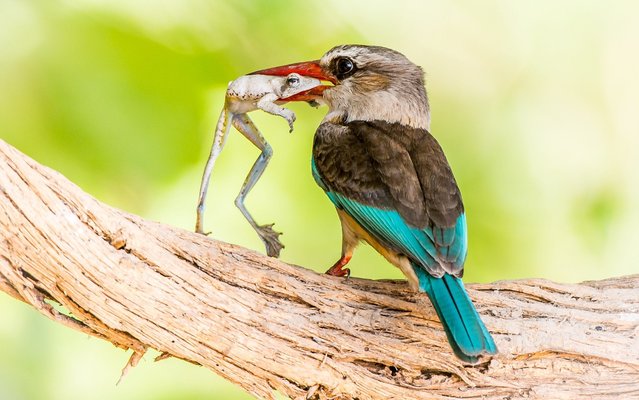
A brown-hooded kingfisher sits on a branch with a freshly caught frog in it's beak. Riaan Marais who took the photo said, “We were doing a boat safari on the Rufiji river in Selous Game Reserve, Tanzania when I spotted the bird with the frog on an overhanging branch on the river bank. It most probably caught the frog in the reeds along the river’s edge as this is where these frogs stay. The kingfisher must have caught the Common Reed Frog just before I took the image, as the frog was still alive, I had a brief moment to take the image before the bird flew off with the frog”. (Photo by Riaan Marais/Solent News and Photo Agency)

A brown-hooded kingfisher sits on a branch with a freshly caught frog in it's beak. Riaan Marais who took the photo said, “We were doing a boat safari on the Rufiji river in Selous Game Reserve, Tanzania when I spotted the bird with the frog on an overhanging branch on the river bank. It most probably caught the frog in the reeds along the river’s edge as this is where these frogs stay. The kingfisher must have caught the Common Reed Frog just before I took the image, as the frog was still alive, I had a brief moment to take the image before the bird flew off with the frog”. (Photo by Riaan Marais/Solent News and Photo Agency)
Details
10 Jun 2018 00:03:00
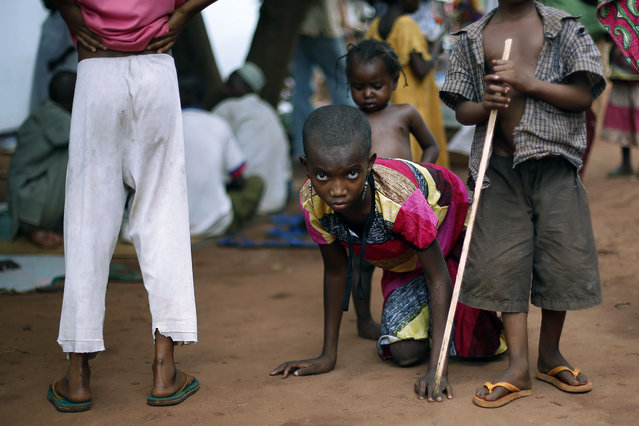
In this April 14, 2014 file photo, Hamamatou Harouna, 10, who lost the use of her legs to polio, crawls to the restroom on the grounds of the Catholic Church where she and hundreds of others found refuge after fleeing violence in her village, in Carnot, Central African Republic. Health authorities on Tuesday, August 25, 2020 are expected to declare the African continent free of the wild poliovirus after decades of effort, though cases of vaccine-derived polio are still sparking outbreaks of the paralyzing disease in more than a dozen countries. (Photo by Jerome Delay/AP Photo/File)

In this April 14, 2014 file photo, Hamamatou Harouna, 10, who lost the use of her legs to polio, crawls to the restroom on the grounds of the Catholic Church where she and hundreds of others found refuge after fleeing violence in her village, in Carnot, Central African Republic. Health authorities on Tuesday, August 25, 2020 are expected to declare the African continent free of the wild poliovirus after decades of effort, though cases of vaccine-derived polio are still sparking outbreaks of the paralyzing disease in more than a dozen countries. (Photo by Jerome Delay/AP Photo/File)
Details
15 Sep 2020 00:03:00
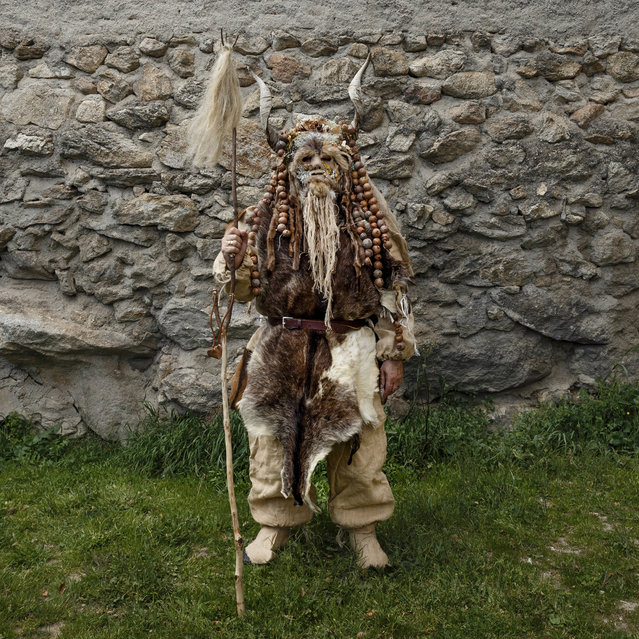
In this April 1, 2017 picture a man dressed as a “Harramacho” a traditional character from the Navalacruz carnival poses for a picture before a traditional Spanish mask gathering in the small village of Casavieja, Spain. (Photo by Daniel Ochoa de Olza/AP Photo)

In this April 1, 2017 picture a man dressed as a “Harramacho” a traditional character from the Navalacruz carnival poses for a picture before a traditional Spanish mask gathering in the small village of Casavieja, Spain. Every spring they come from towns across central and northwestern Spain, clad in elaborate costumes – some as trees, others as bears, still others as monsters who could have emerged from some sort of fever dream. (Photo by Daniel Ochoa de Olza/AP Photo)
Details
10 Apr 2017 08:50:00
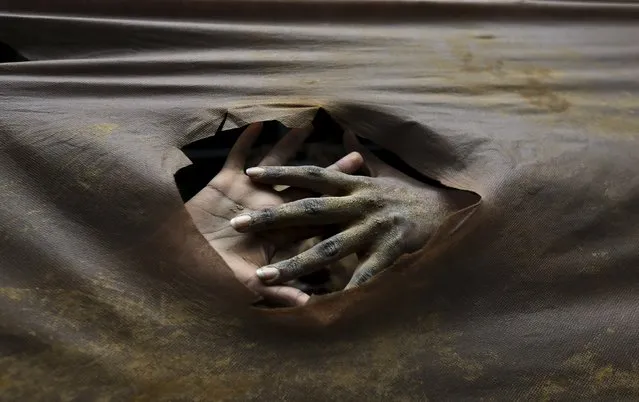
An environmental activist performs during a protest in front of the headquarters of Brazilian mining company Vale SA in downtown Rio de Janeiro, Brazil, November 16, 2015. (Photo by Sergio Moraes/Reuters)

An environmental activist performs during a protest in front of the headquarters of Brazilian mining company Vale SA in downtown Rio de Janeiro, Brazil, November 16, 2015. The collapse of two dams at a Brazilian mine, owned by Vale SA and BHP Billiton Ltd, has cut off drinking water for quarter of a million people and saturated waterways downstream with dense orange sediment that could wreck the ecosystem for years to come. Nine people were killed, 19 are still listed as missing and 500 people were displaced from their homes when the dams burst at an iron ore mine in southeastern Brazil on November 5. (Photo by Sergio Moraes/Reuters)
Details
18 Nov 2015 08:00:00
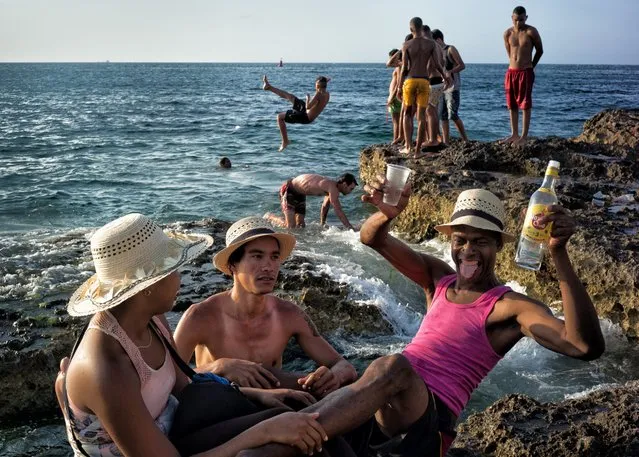
Saguy says that while portraits of Fidel Castro are still found everywhere, they coexist with plenty of foreign brands on subtle display: from Apple logo decals affixed to 1950s Chevys to young people wearing Adidas T-shirts and Converse shoes. Here: Several groups of locals relax on the Malecon in Old Havana, Cuba May 1, 2016. Some chat and drink rum while others dive into the warm Caribbean Sea. (Photo by Dotan Saguy)

Photographer Dotan Saguy visited Cuba expecting to find resentment toward Americans, but he says that, instead, “Every Cuban I met was warm and welcoming despite me being an American”. Here: Several groups of locals relax on the Malecon in Old Havana, Cuba May 1, 2016. Some chat and drink rum while others dive into the warm Caribbean Sea. (Photo by Dotan Saguy)
Details
27 May 2016 12:50:00
Employees stand near an airframe for the second Antonov-225 Mriya plane at Antonov aircraft plant in Kiev, Ukraine, September 7, 2016. Ukraine hopes to attract $500 million of investment from China to complete an updated version of the world's biggest aircraft, the Antonov-225 Mriya, the president of manufacturer Antonov said on Wednesday. The Antonov-225 is a cargo plane designed as part of the former Soviet Union's space programme. The only one completed is still in use and can carry up to 250 tonnes up to 4,000 km (2,485 miles). Work to manufacture a second plane was started in 1988 and never completed, but Antonov has now found a potential investor in the Aerospace Industry Corporation of China (AICC). (Photo by Valentyn Ogirenko/Reuters)

Employees stand near an airframe for the second Antonov-225 Mriya plane at Antonov aircraft plant in Kiev, Ukraine, September 7, 2016. Ukraine hopes to attract $500 million of investment from China to complete an updated version of the world's biggest aircraft, the Antonov-225 Mriya, the president of manufacturer Antonov said on Wednesday. (Photo by Valentyn Ogirenko/Reuters)
Details
08 Sep 2016 10:07:00
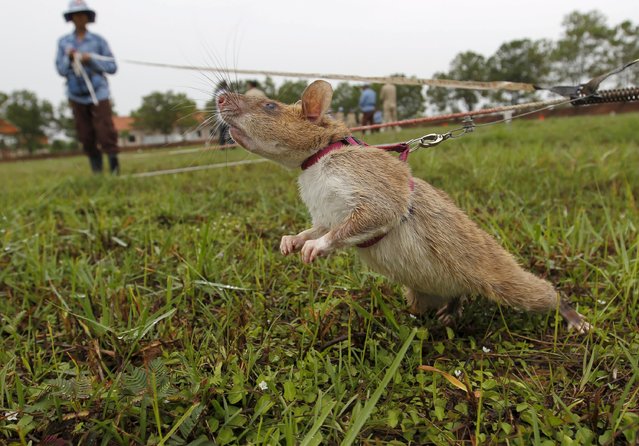
A rat being trained by the Cambodian Mine Action Centre (CMAC) is pictured on an inactive landmine field in Siem Reap province July 9, 2015. Gambian pouched rats were deployed to Cambodia from Tanzania in April by a Belgian non-profit organization, APOPO, to help clear mines. (Photo by Samrang Pring/Reuters)

A rat being trained by the Cambodian Mine Action Centre (CMAC) is pictured on an inactive landmine field in Siem Reap province July 9, 2015. Gambian pouched rats were deployed to Cambodia from Tanzania in April by a Belgian non-profit organization, APOPO, to help clear mines. They've been trained since they were 4 weeks old. Cambodia is still littered with landmines after emerging from decades of civil war, including the 1970s Khmer Rough “Killing Fields” genocide, leaving it with one of the world's highest disability rates. APOPO has used the rodents for mine-clearing projects in several countries, including Angola, Mozambique, Thailand, Laos, and Vietnam. (Photo by Samrang Pring/Reuters)
Details
14 Jul 2015 13:35:00