Loading...
Done
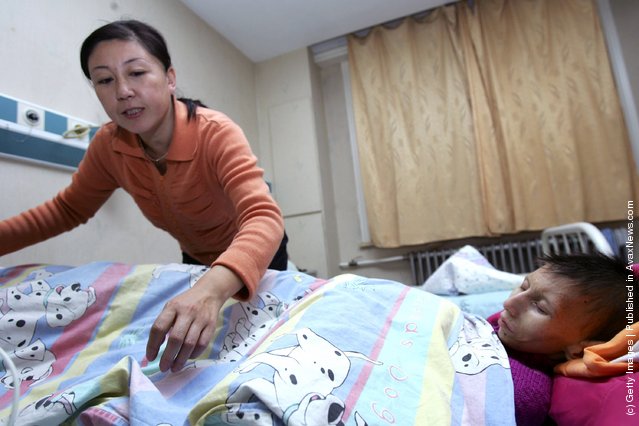
12-year-old Chinese girl Sun Yangyang suffering from Cockayne syndrome

“Cockayne syndrome (also called Weber-Cockayne syndrome, or Neill-Dingwall Syndrome) is a rare autosomal recessive congenital disorder characterized by growth failure, impaired development of the nervous system, abnormal sensitivity to sunlight (photosensitivity), and premature aging. Hearing loss and eye abnormalities (pigmentary retinopathy) are other common features, but problems with any or all of the internal organs are possible. It is associated with a group of disorders called leukodystrophies. The underlying disorder is a defect in a DNA repair mechanism. It is named after English physician Edward Alfred Cockayne (1880–1956)”. – Wikipedia

Photo: Mother of 12-year-old Chinese girl Sun Yangyang suffering from Cockayne syndrome, tends her at the First Affiliated Hospital of Jilin University on November 11, 2006 in Changchun of Jilin Province, China. The disease results in the senile appearance of Yangyang and also causes eyesight, hearing weakness and other problems. Doctors failed to cure the girl... (Photo by China Photos/Getty Images)
Details
08 Aug 2011 11:17:00
This image is NGC 6543 known as the Cat's Eye Nebula as it appears to the Chandra X-Ray Observatory and Hubble Telescope. A planetary nebula is a phase of stellar evolution that the sun should experience several billion years from now, when it expands to become a red giant and then sheds most of its outer layers, leaving behind a hot core that contracts to form a dense white dwarf star. This image was released October 10, 2012. (Photo by J. Kastner/NASA/CXC/RIT)

This image is NGC 6543 known as the Cat's Eye Nebula as it appears to the Chandra X-Ray Observatory and Hubble Telescope. A planetary nebula is a phase of stellar evolution that the sun should experience several billion years from now, when it expands to become a red giant and then sheds most of its outer layers, leaving behind a hot core that contracts to form a dense white dwarf star. This image was released October 10, 2012. (Photo by J. Kastner/NASA/CXC/RIT)
Details
15 Apr 2013 10:09:00
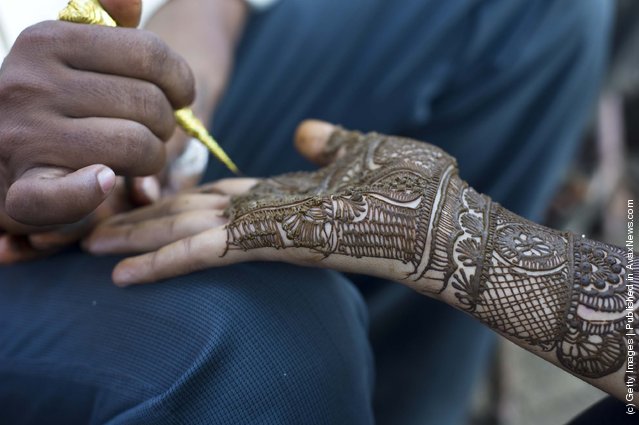
Application of henna or “Mehndi”  to a girls hand in a market in Jaipur, India

“Mehndi or menhdi is the application of henna as a temporary form of skin decoration in India, as well as by expatriate communities from the country. The word mehndi is derived from the Sanskrit word mendhikā. The use of mehndi and turmeric is described in the earliest Vedic ritual books. Haldi (Staining oneself with turmeric paste) as well as mehndi are important Vedic customs as a symbolic representation of the Outer and the Inner Sun. Vedic customs are meant to awaken the “inner light” and so the gold of the inner Sun has an important symbolic function”. – Wikipedia

Photo: Application of henna or “Mehndi” to a girls hand in a market on October 18, 2010 in Jaipur, India. (Photo by Simon de Trey-White/Getty Images)
Details
23 Nov 2011 13:33:00
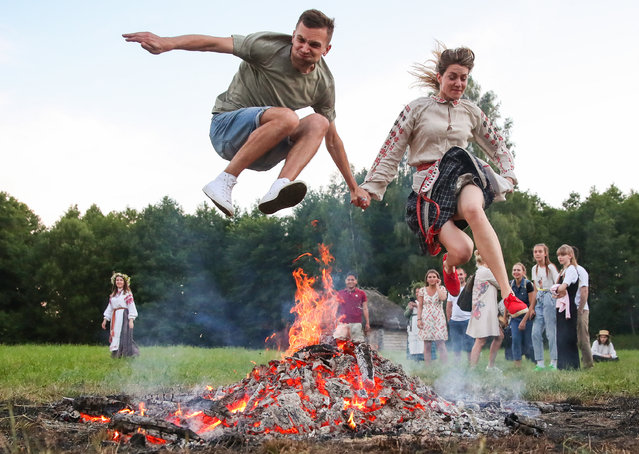
A man and a woman jump over a bonfire during Ivan Kupala Day celebrations held by the Belarusian State Museum of Folk Architecture and Rural Lifestyle in the village of Ozertso near Minsk, Belarus on July 4, 2020. Ivan Kupala Day, also known as Ivana-Kupala or Kupala Night, is a traditional pagan holiday celebrated in eastern Slavic cultures. Various rituals are traditionally performed on Kupala Night, including making flower wreaths, fortune-telling, jumping over bonfires, and burning a wheel-like effigy symbolizing the sun. (Photo by Natalia Fedosenko/TASS)

A man and a woman jump over a bonfire during Ivan Kupala Day celebrations held by the Belarusian State Museum of Folk Architecture and Rural Lifestyle in the village of Ozertso near Minsk, Belarus on July 4, 2020. Ivan Kupala Day, also known as Ivana-Kupala or Kupala Night, is a traditional pagan holiday celebrated in eastern Slavic cultures. Various rituals are traditionally performed on Kupala Night, including making flower wreaths, fortune-telling, jumping over bonfires, and burning a wheel-like effigy symbolizing the sun. (Photo by Natalia Fedosenko/TASS)
Details
23 Jan 2021 09:53:00
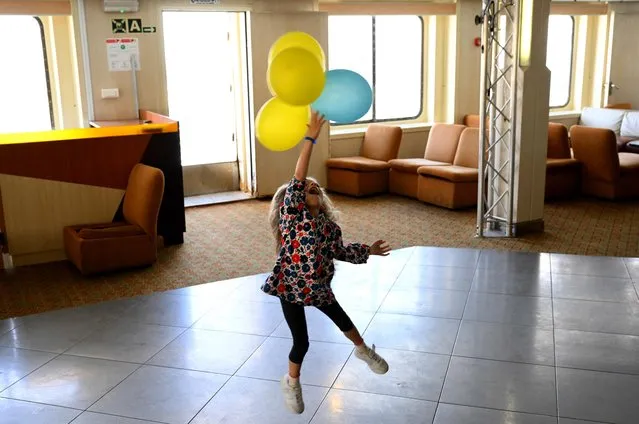
A Ukrainian girl plays with balloons with the colours of her country's flag aboard the Corsica Linea ferry “Mediterranee” in Marseille, southern France, on April 26, 2022. Anna and her children enjoy the sun on the deck of a ferry moored in Marseille: they are not vacationers but Ukrainian refugees who, on this boat, have finally found safety, “like in a village”, with 700 others compatriots. The “Mediterranean” usually serves Algeria, for the Corsica Linea. But it is now docked, at the Joliette ferry terminal in Marseille, with its unusual passengers. (Photo by Nicolas Tucat/AFP Photo)

A Ukrainian girl plays with balloons with the colours of her country's flag aboard the Corsica Linea ferry “Mediterranee” in Marseille, southern France, on April 26, 2022. Anna and her children enjoy the sun on the deck of a ferry moored in Marseille: they are not vacationers but Ukrainian refugees who, on this boat, have finally found safety, “like in a village”, with 700 others compatriots. The “Mediterranean” usually serves Algeria, for the Corsica Linea. But it is now docked, at the Joliette ferry terminal in Marseille, with its unusual passengers. (Photo by Nicolas Tucat/AFP Photo)
Details
28 Apr 2022 05:49:00


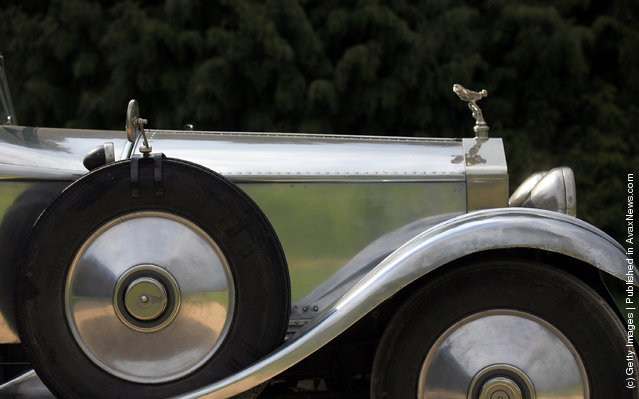
The sun catches on the panels of a 1928 Rolls Royce Phantom at Northington Grange, the summer home of the Grange Park Opera, on April 16, 2011 near Winchester, England. The English Heritage Grade 1 listed Greek Revival style property was the setting for the inter-war Rolls Royce20-Ghost Club members which was founded in 1949 by a group of owners of vintage Rolls Royce cars. (Photo by Matt Cardy/Getty Images)
Details
17 Apr 2011 10:48:00


Festival goers celebrate during the Chupinazo, marking the beginning of the San Fermin festival on July 6, 2011 in Pamplona, Spain. Pamplona's famous Fiesta de San Fermin, which involves the running of the bulls through the historic heart of Pamplona for eight days starting July 7th, was made famous by the 1926 novel of U.S. writer Ernest Hemmingway called “The Sun Also Rises”. (Photo by Denis Doyle/Getty Images)
Details
07 Jul 2011 11:57:00


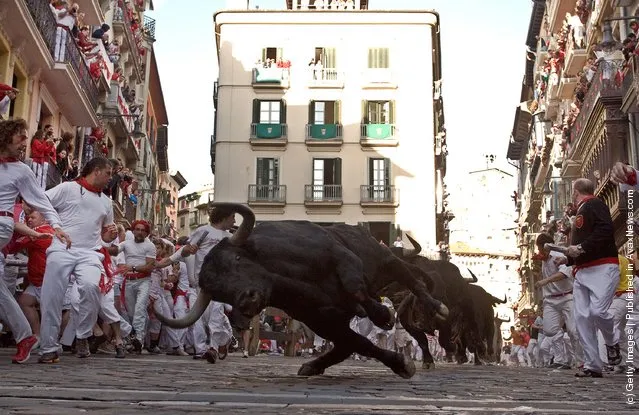
A fighting bull loses its balance during the third day of the San Fermin running-of-the-bulls on July 8, 2011 in Pamplona, Spain. Pamplona's famous Fiesta de San Fermin, which involves the running of the bulls through the historic heart of Pamplona for eight days starting July 7th, was made famous by the 1926 novel of U.S. writer Ernest Hemmingway called “The Sun Also Rises”. (Photo by Denis Doyle/Getty Images)
Details
08 Jul 2011 10:45:00