Loading...
Done
A model walks the runway during the We Are Handsome show at Mercedes-Benz Fashion Week Resort 17 Collections at Carriageworks on May 19, 2016 in Sydney, Australia. (Photo by Stefan Gosatti/Getty Images)

A model walks the runway during the We Are Handsome show at Mercedes-Benz Fashion Week Resort 17 Collections at Carriageworks on May 19, 2016 in Sydney, Australia. (Photo by Stefan Gosatti/Getty Images)
Details
22 May 2016 07:14:00
“Kilauea Rules”. The most extreme place we put ours kayakers to paddle till now. Photo location: Big Island, Hawaii. (Photo and caption by Alexandre Socci/National Geographic Photo Contest)

“Kilauea Rules”. The most extreme place we put ours kayakers to paddle till now. Photo location: Big Island, Hawaii. (Photo and caption by Alexandre Socci/National Geographic Photo Contest)
Details
20 Jun 2014 10:47:00
Hikaru Cho believes that we should challenge our imaginations to create new work using traditional tools, not fancy computers and software. (Photo by Jim Marks/PA Wire)

Hikaru Cho believes that we should challenge our imaginations to create new work using traditional tools, not fancy computers and software. (Photo by Jim Marks/PA Wire)
Details
06 Mar 2014 10:06:00
Pac-Men

As we all know, there have been only a yellow, ghost-eating ball that we drove through innumerable labyrinths. But Reddit user yougruesomehare created his own Pac-Men, numerous icons of the pop culture from Super Mario to Spongebob. ...
Details
03 Aug 2012 03:33:00


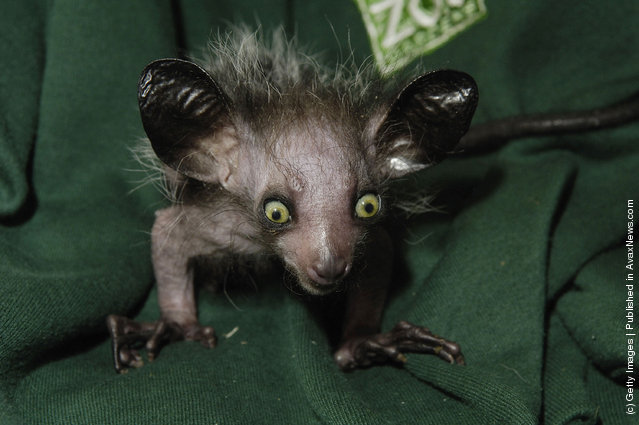
“The aye-aye (Daubentonia madagascariensis) is a lemur, a strepsirrhine primate native to Madagascar that combines rodent-like teeth and a special thin middle finger to fill the same ecological niche as a woodpecker. It is the world's largest nocturnal primate, and is characterized by its unusual method of finding food; it taps on trees to find grubs, then gnaws holes in the wood and inserts its narrow middle finger to pull the grubs out. The only other animal species known to find food in this way is the striped possum. From an ecological point of view the aye-aye fills the niche of a woodpecker as it is capable of penetrating wood to extract the invertebrates within”. – Wikipedia

Photo: In this handout image from Bristol Zoo is seen the first captive bred aye-aye in the UK named “Kintana” (meaning star in Malagasy) April 15, 2005 at Bristol Zoo Gardens, England. The zoo announced today only the second baby aye-aye to be hand-reared in the world (the first was in Jersey Zoo) and has now made his first public appearance since his birth on 11 February 2005. (Photo by Rob Cousins/Bristol Zoo via Getty Images)

Details
13 Apr 2011 13:33:00
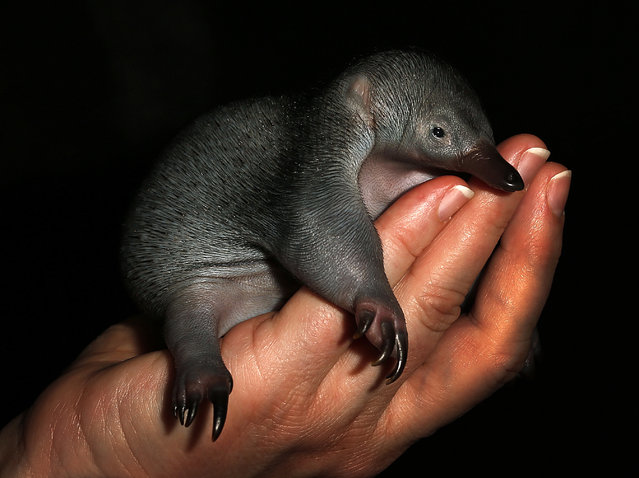
Bo, a 55-day-old baby Echidna known as a puggle, rests in the hands of vet nurse Annabelle Sehlmeier at Taronga Zoo in Sydney November 1, 2012. The puggle was brought to the zoo after it being found by itself on a walking track north of Sydney and will be fed by hand until it is weaned at about six months of age. (Photo by Tim Wimborne/Reuters)

Bo, a 55-day-old baby Echidna known as a puggle, rests in the hands of vet nurse Annabelle Sehlmeier at Taronga Zoo in Sydney November 1, 2012. The puggle was brought to the zoo after it being found by itself on a walking track north of Sydney and will be fed by hand until it is weaned at about six months of age. (Photo by Tim Wimborne/Reuters)
Details
23 Apr 2018 00:03:00
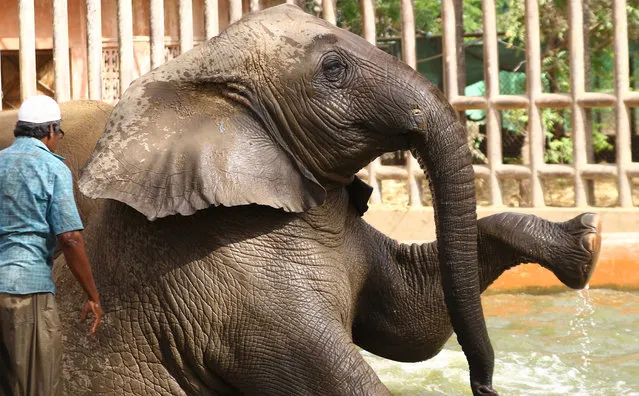
An elephant cools off at a zoo in Karachi, Pakistan, 31 March 2021. Caretakers at Karachi's zoo were working to keep animals cool during a​ heatwave affecting southern Pakistan. (Photo by Shahzaib Akber/EPA/EFE)

An elephant cools off at a zoo in Karachi, Pakistan, 31 March 2021. Caretakers at Karachi's zoo were working to keep animals cool during a​ heatwave affecting southern Pakistan. (Photo by Shahzaib Akber/EPA/EFE)
Details
18 Apr 2021 09:15:00
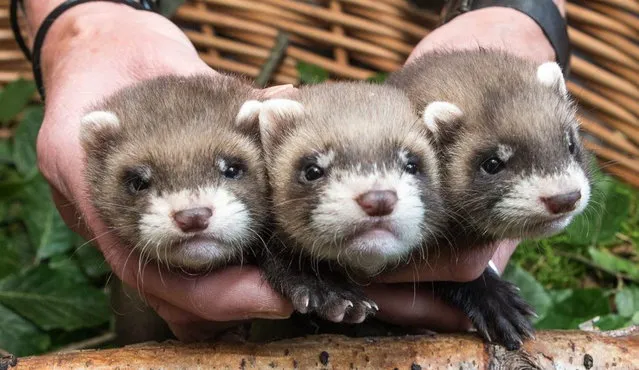
In this picture made available Thursday July 11, 2013 a  zoo-keeper presents three of twelve ferret babies at Eekholt Zoo in Grossenaspe, Germany,  Wednesday July 10, 2013. The ferret babies were born May 25, 2013. (Photo by Markus Scholz/AP Photo/Dpa)

In this picture made available Thursday July 11, 2013 a zoo-keeper presents three of twelve ferret babies at Eekholt Zoo in Grossenaspe, Germany, Wednesday July 10, 2013. The ferret babies were born May 25, 2013. (Photo by Markus Scholz/AP Photo/Dpa)
Details
14 Jul 2013 08:16:00