Loading...
Done
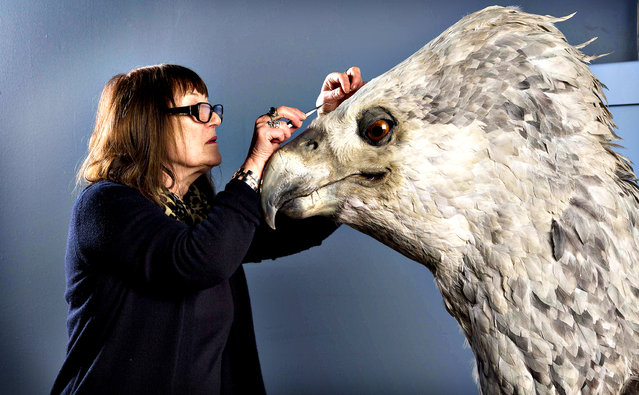
Undated handout photo of Buckbeak, a Hippogriff that lived with Rubeus Hagrid in the Harry Potter series, has his feathers preened and replenished by featherologist Val Jones, as he will feature in the the Feathers and Flight event at Warner Bros. Studio Tour London. (Photo credit should read: Tim Anderson/PA Wire)

Undated handout photo of Buckbeak, a Hippogriff that lived with Rubeus Hagrid in the Harry Potter series, has his feathers preened and replenished by featherologist Val Jones, as he will feature in the the Feathers and Flight event at Warner Bros. Studio Tour London. This is the first make-over Buckbeak has received since the hugely popular Harry Potter film series was made. His intricate coat is created from thousands of individually airbrushed chicken and goose feathers that Val will carefully clean and replenish in time for the start of Feathers and Flight. Val will lead an expert team to demonstrate the techniques that made winged wonders such as Buckbeak and Fawkes the Phoenix a reality on screen. (Photo by Tim Anderson/PA Wire)
Details
22 Mar 2014 13:56:00
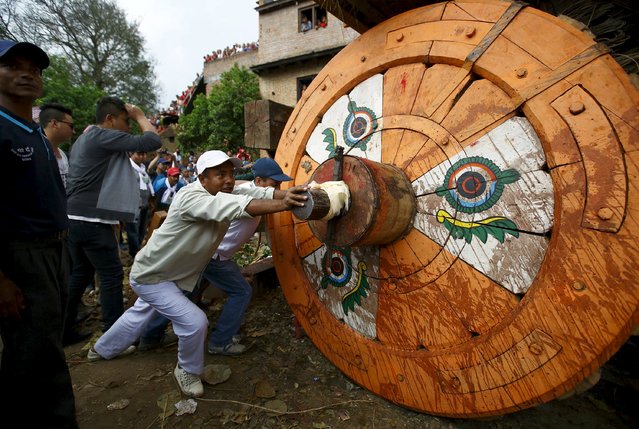
Devotees push the chariot of Rato Machhindranath during the chariot festival at Bungamati in Lalitpur April 22, 2015. Rato Machhindranath is known as the god of rain and both Hindus and Buddhists worship Machhindranath for good rain to prevent drought during the rice harvest season. (Photo by Navesh Chitrakar/Reuters)

Devotees push the chariot of Rato Machhindranath during the chariot festival at Bungamati in Lalitpur April 22, 2015. Rato Machhindranath is known as the god of rain and both Hindus and Buddhists worship Machhindranath for good rain to prevent drought during the rice harvest season. (Photo by Navesh Chitrakar/Reuters)
Details
23 Apr 2015 12:21:00
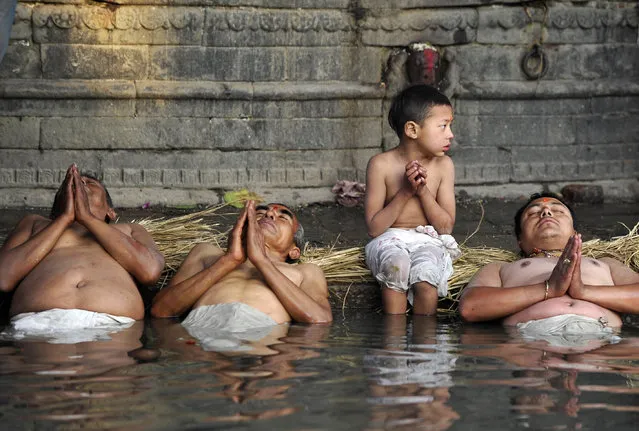
Nepalese Hindu devotees take part in a bathing ritual on the last day of the month-long Swasthani Festival in the Hanumante River at Bhaktapur on the outskirts of Kathmandu on February 22, 2016. Devotees mark the Swasthani Festival with fasting, and with women in particular undertaking rituals in the hope of a prosperous life for her family and conjugal happiness. (Photo by Prakash Mathema/AFP Photo)

Nepalese Hindu devotees take part in a bathing ritual on the last day of the month-long Swasthani Festival in the Hanumante River at Bhaktapur on the outskirts of Kathmandu on February 22, 2016. Devotees mark the Swasthani Festival with fasting, and with women in particular undertaking rituals in the hope of a prosperous life for her family and conjugal happiness. (Photo by Prakash Mathema/AFP Photo)
Details
23 Feb 2016 11:52:00
Students pose for a picture with a 3- D optical illusion artwork of a devastated cityscape in Aleppo, Syria at the campus of the Meiji University in Tokyo on November 18, 2016. The Japanese branch of the human rights organisation Amnesty International displayed the artwork to encourage people to think about the Syrian civil war. (Photo by Toshifumi Kitamura/AFP Photo)

Students pose for a picture with a 3- D optical illusion artwork of a devastated cityscape in Aleppo, Syria at the campus of the Meiji University in Tokyo on November 18, 2016. The Japanese branch of the human rights organisation Amnesty International displayed the artwork to encourage people to think about the Syrian civil war. (Photo by Toshifumi Kitamura/AFP Photo)
Details
19 Nov 2016 11:36:00
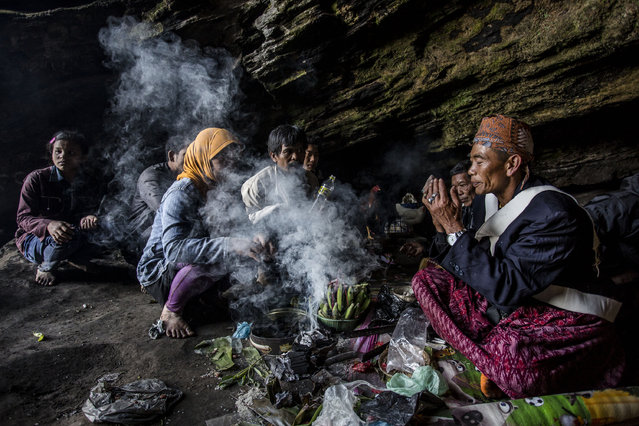
A Tenggerese shaman praying for worshippers at Widodaren cave during the Tenggerese Hindu Yadnya Kasada festival on July 31, 2015 in Probolinggo, East Java, Indonesia. The festival is the main festival of the Tenggerese people and lasts about a month. On the fourteenth day, the Tenggerese make the journey to Mount Bromo to make offerings of rice, fruits, vegetables, flowers and livestock to the mountain gods by throwing them into the volcano's caldera. (Photo by Ulet Ifansasti/Getty Images)

A Tenggerese shaman praying for worshippers at Widodaren cave during the Tenggerese Hindu Yadnya Kasada festival on July 31, 2015 in Probolinggo, East Java, Indonesia. The festival is the main festival of the Tenggerese people and lasts about a month. On the fourteenth day, the Tenggerese make the journey to Mount Bromo to make offerings of rice, fruits, vegetables, flowers and livestock to the mountain gods by throwing them into the volcano's caldera. The origin of the festival lies in the 15th century when a princess named Roro Anteng started the principality of Tengger with her husband Joko Seger, and the childless couple asked the mountain Gods for help in bearing children. The legend says the Gods granted them 24 children but on the provision that the 25th must be tossed into the volcano in sacrifice. The 25th child, Kesuma, was finally sacrificed in this way after initial refusal, and the tradition of throwing sacrifices into the caldera to appease the mountain Gods continues today. (Photo by Ulet Ifansasti/Getty Images)
Details
01 Aug 2015 12:07:00
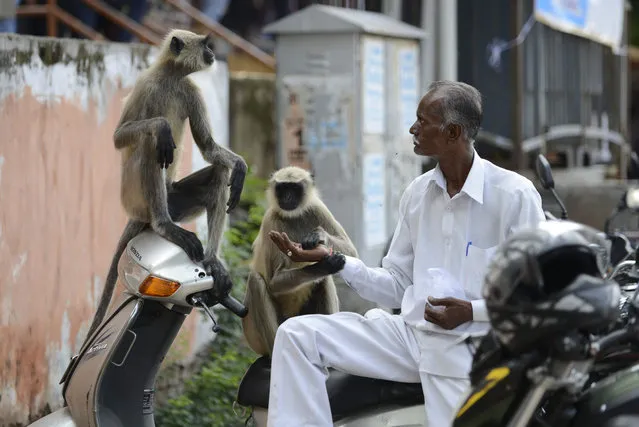
An Indian man feeds peanuts to monkeys along a busy street in Ahmedabad on July 31, 2016. Feeding animals is sacred in Hindu society. (Photo by Sam Panthaky/AFP Photo)

An Indian man feeds peanuts to monkeys along a busy street in Ahmedabad on July 31, 2016. Feeding animals is sacred in Hindu society. (Photo by Sam Panthaky/AFP Photo)
Details
03 Aug 2016 11:57:00
A woman carries her child as she watches Mount Sinabung volcano spewing thick volcanic ash, as seen from Karo on July 21, 2017. Sinabung roared back to life in 2010 for the first time in 400 years, after another period of inactivity it erupted once more in 2013, and has remained highly active since. (Photo by Gatha Ginting/AFP Photo)

A woman carries her child as she watches Mount Sinabung volcano spewing thick volcanic ash, as seen from Karo on July 21, 2017. Sinabung roared back to life in 2010 for the first time in 400 years, after another period of inactivity it erupted once more in 2013, and has remained highly active since. (Photo by Gatha Ginting/AFP Photo)
Details
22 Jul 2017 08:47:00
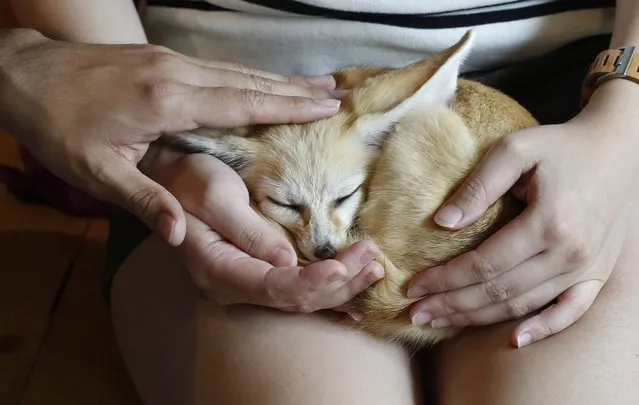
A picture made available on 07 March 2016 shows visitors petting and holding a Fennec fox, native to the Sahara, in the petting room at the Little Zoo Cafe, a business built to capitalize on Thais' love for exotic animals, and food, on the outskirts of Bangkok, Thailand, 05 March 2016. (Photo by Barbara Walton/EPA)

A picture made available on 07 March 2016 shows visitors petting and holding a Fennec fox, native to the Sahara, in the petting room at the Little Zoo Cafe, a business built to capitalize on Thais' love for exotic animals, and food, on the outskirts of Bangkok, Thailand, 05 March 2016. The cafe boasts Fennec foxes, Meerkat, native to parts of Africa, Silver Fox, Raccoon and Chinchillas, along with a menu of Thai food and Cheesecake, among other sweet deserts. Nature is a faraway fantasy in the bustling exhaust-filled cement city of Bangkok, fuelling a demand to own and be close to exotic pets. The trend to be near to a species that was once wild, in a city environment, far from the natural setting, has drawn criticism but continues to grow. (Photo by Barbara Walton/EPA)
Details
13 Mar 2016 09:38:00