Loading...
Done
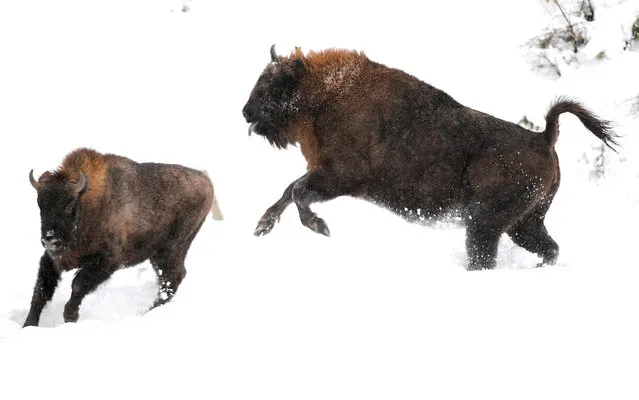
European bisons (also known as Wisent) at the Bison farm in Muczne, southeastern Poland, 30 December 2018. The Bison farm is a continuation of bison breeding in Bieszczady, which was started in 1963. Here visitors can admire the bison of Bialowieza-Caucasian line, also called the mountain race. The European Bison is the national animal of Poland. (Photo by Darek Delmanowicz/EPA/EFE)

European bisons (also known as Wisent) at the Bison farm in Muczne, southeastern Poland, 30 December 2018. The Bison farm is a continuation of bison breeding in Bieszczady, which was started in 1963. Here visitors can admire the bison of Bialowieza-Caucasian line, also called the mountain race. The European Bison is the national animal of Poland. (Photo by Darek Delmanowicz/EPA/EFE)
Details
06 Jan 2019 00:03:00
Cheerleaders let their hair fly as they perform prior to a German first division Bundesliga soccer match between 1. FC Cologne and Bayern Munich in Cologne, Germany, March 4, 2017. (Photo by Michael Probst/AP Photo)

Cheerleaders let their hair fly as they perform prior to a German first division Bundesliga soccer match between 1. FC Cologne and Bayern Munich in Cologne, Germany, March 4, 2017. (Photo by Michael Probst/AP Photo)
Details
05 Mar 2017 07:45:00
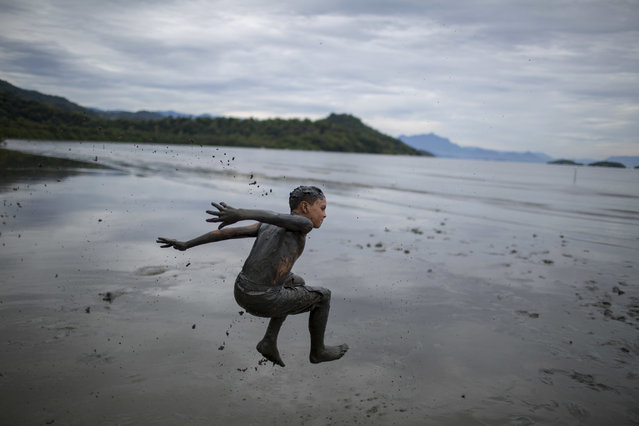
A boy jumps into a pool of mud during the traditional “Bloco da Lama” or “Mud Street” carnival party, in Paraty, Brazil, Saturday, February 25, 2017. Legend has it the “bloco” was born in 1986 after local teens hiking in a nearby mangrove forest smeared themselves with mud to discourage mosquitoes and then wandered through Paraty. The party grew year after year, but revelers eventually were banned from parading in the colonial downtown after shopkeepers complained pristine white walls were stained with the hard-to-remove mud. (Photo by Mauro Pimentel/AP Photo)

A boy jumps into a pool of mud during the traditional “Bloco da Lama” or “Mud Street” carnival party, in Paraty, Brazil, Saturday, February 25, 2017. Legend has it the “bloco” was born in 1986 after local teens hiking in a nearby mangrove forest smeared themselves with mud to discourage mosquitoes and then wandered through Paraty. The party grew year after year, but revelers eventually were banned from parading in the colonial downtown after shopkeepers complained pristine white walls were stained with the hard-to-remove mud. (Photo by Mauro Pimentel/AP Photo)
Details
28 Mar 2017 09:07:00
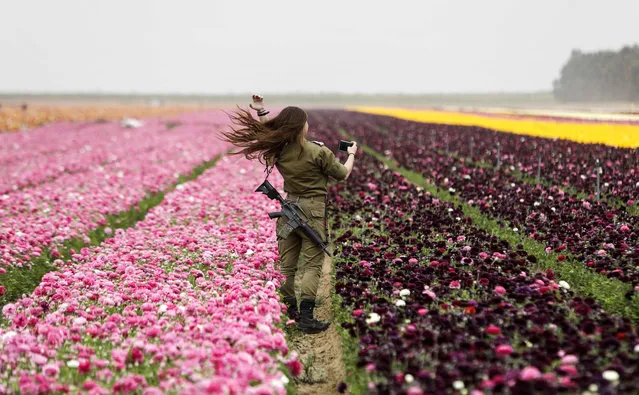
An Israeli soldier looks through her cell phone as she enjoys the Ranunculus flowers in a field in the southern Israeli Kibbutz of Nir Yitzhak, located along the Israeli- Gaza Strip border, during the Jewish holiday of Pesach (Passover) on April 12, 2017. (Photo by Menahem Kahana/AFP Photo)

An Israeli soldier looks through her cell phone as she enjoys the Ranunculus flowers in a field in the southern Israeli Kibbutz of Nir Yitzhak, located along the Israeli- Gaza Strip border, during the Jewish holiday of Pesach (Passover) on April 12, 2017. (Photo by Menahem Kahana/AFP Photo)
Details
21 Apr 2017 07:54:00
A man pours water on his camel on a hot summer day in Ahmedabad, India, May 18, 2017. (Photo by Amit Dave/Reuters)

A man pours water on his camel on a hot summer day in Ahmedabad, India, May 18, 2017. (Photo by Amit Dave/Reuters)
Details
22 May 2017 07:21:00
A man dressed up as the devil jumps over babies lying on a mattress in the street during “El Colacho”, the “baby jumping festival” in the village of Castrillo de Murcia, near Burgos on June 18, 2017. Baby jumping (El Colacho) is a traditional Spanish practice dating back to 1620 that takes place annually to celebrate the Catholic feast of Corpus Christi. During the act – known as El Salto del Colacho (the devil's jump) or simply El Colacho – men dressed as the Devil jump over babies born in the last twelve months of the year who lie on mattresses in the street. (Photo by Cesar Manso/AFP Photo)

A man dressed up as the devil jumps over babies lying on a mattress in the street during “El Colacho”, the “baby jumping festival” in the village of Castrillo de Murcia, near Burgos on June 18, 2017. Baby jumping (El Colacho) is a traditional Spanish practice dating back to 1620 that takes place annually to celebrate the Catholic feast of Corpus Christi. During the act – known as El Salto del Colacho (the devil's jump) or simply El Colacho – men dressed as the Devil jump over babies born in the last twelve months of the year who lie on mattresses in the street. (Photo by Cesar Manso/AFP Photo)
Details
20 Jun 2017 07:29:00
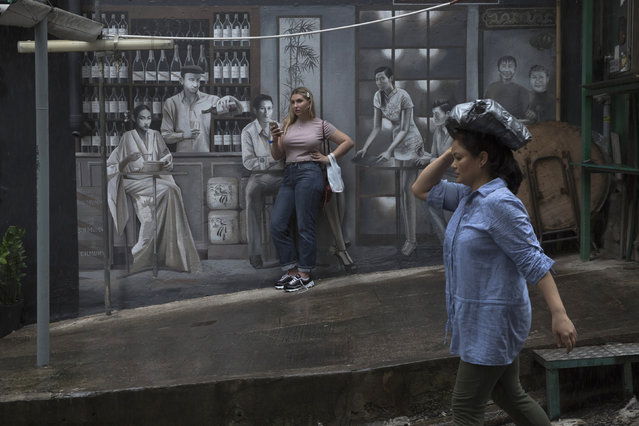
In this June 12, 2017 photo, a woman stands in front of a mural on the slope in Central district, Hong Kong. (Photo by Kin Cheung/AP Photo)

In this June 12, 2017 photo, a woman stands in front of a mural on the slope in Central district, Hong Kong. Once known as Victoria after the British queen, Hong Kong island's waterfront formed the core of the British settlement after Hong Kong island was handed over as a colony in 1842. Today as Hong Kong approaches the 20th anniversary of its return to China, it remains a bustling commercial and financial center as well as the location of the main government offices. However, along the streets that angle sharply upward toward the mountains above, a more relaxed pace of life endures. (AP Photo/Kin Cheung)
Details
28 Jun 2017 08:18:00
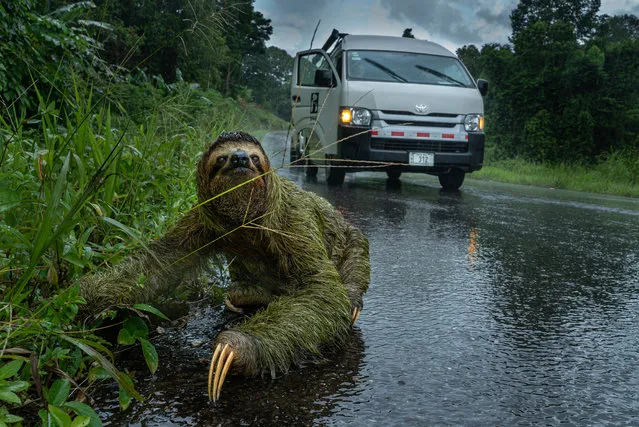
People and Nature category winner: Why did the sloth cross the road? by Andrew Whitworth (Osa Conservation and University of Glasgow), taken in Osa Peninsula, Costa Rica. “I was driving out from the Osa Peninsula, located on the southern Pacific coast of Costa Rica on a dark, stormy day. This female three-toed sloth (Bradypus variegatus) had luckily just about made it across the road, and the drivers of the Toyota on this occasion had spotted her in good time”. (Photo by Andrew Whitworth/2019 British Ecological Society Photography Competition)

People and Nature category winner: Why did the sloth cross the road? by Andrew Whitworth (Osa Conservation and University of Glasgow), taken in Osa Peninsula, Costa Rica. “I was driving out from the Osa Peninsula, located on the southern Pacific coast of Costa Rica on a dark, stormy day. This female three-toed sloth (Bradypus variegatus) had luckily just about made it across the road, and the drivers of the Toyota on this occasion had spotted her in good time”. (Photo by Andrew Whitworth/2019 British Ecological Society Photography Competition)
Details
30 Nov 2019 00:05:00