Loading...
Done
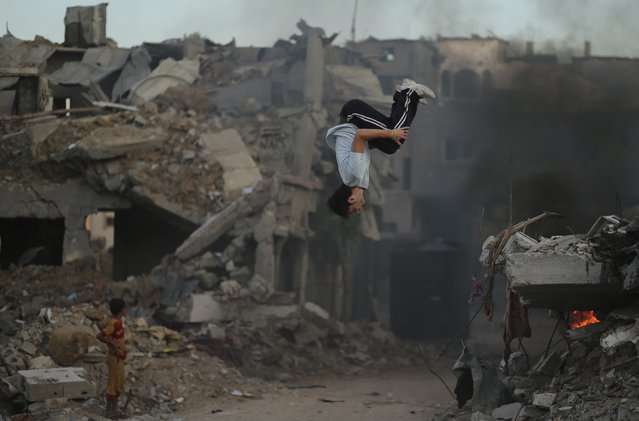
A Palestinian youth practices his Parkour skills over the ruins of houses, which witnesses said were destroyed during a seven-week Israeli offensive, in the Shejaia neighborhood east of Gaza City October 1, 2014. Some Palestinian youths aged between 13 and 17 years old, train in the devastated area as a personal initiative to develop their skills. Parkour is a physical discipline of movement focused on overcoming obstacles. (Photo by Mohammed Salem/Reuters)

A Palestinian youth practices his Parkour skills over the ruins of houses, which witnesses said were destroyed during a seven-week Israeli offensive, in the Shejaia neighborhood east of Gaza City October 1, 2014. Some Palestinian youths aged between 13 and 17 years old, train in the devastated area as a personal initiative to develop their skills. Parkour is a physical discipline of movement focused on overcoming obstacles. (Photo by Mohammed Salem/Reuters)
Details
02 Oct 2014 10:32:00
In this Sunday, March 12, 2017, picture a Don Sphinx cat reaches for a judge while being evaluated, in Bucharest, Romania. (Photo by Vadim Ghirda/AP Photo)

In this Sunday, March 12, 2017, picture a Don Sphinx cat reaches for a judge while being evaluated, in Bucharest, Romania. More than 1,500 dogs and 150 cats from twelve countries were evaluated during a three day pet show and competition in the Romanian capital. (Photo by Vadim Ghirda/AP Photo)
Details
21 Mar 2017 08:00:00
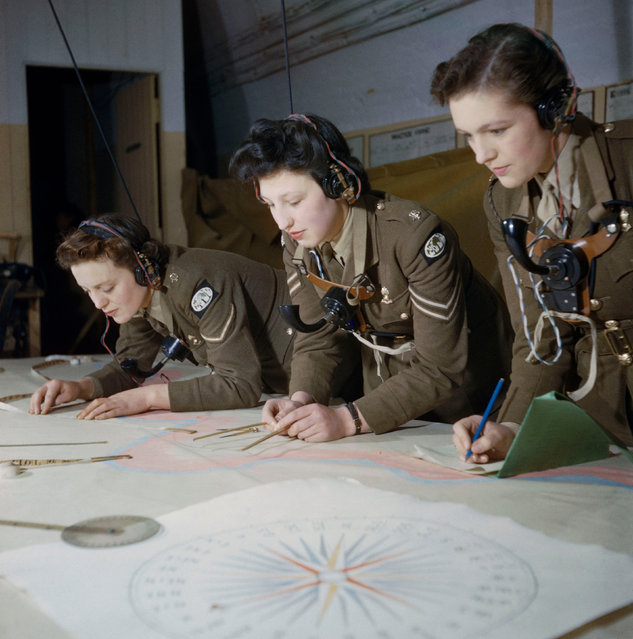
Auxiliary Territorial Service (ATS) plotters at work at Coastal Artillery Headquarters in Dover, December 1942. (Photo by Ted Dearberg/IWM/PA Wire)

Auxiliary Territorial Service (ATS) plotters at work at Coastal Artillery Headquarters in Dover, December 1942. The Auxiliary Territorial Service was the women's branch of the British Army during the Second World War. It was formed on 9 September 1938, initially as a women's voluntary service, and existed until 1 February 1949, when it was merged into the Women's Royal Army Corps. The ATS had its roots in the Women's Auxiliary Army Corps (WAAC), which was formed in 1917 as a voluntary service. During the First World War its members served in a number of jobs including clerks, cooks, telephonists and waitresses. The WAAC was disbanded after four years in 1921. (Photo by Ted Dearberg/IWM/PA Wire)
Details
13 Jul 2017 07:52:00
A cosplayer uses moving stairs during the first public day of the world's largest computer games fair Gamescom in Cologne, Germany August 23, 2017. (Photo by Wolfgang Rattay/Reuters)

A cosplayer uses moving stairs during the first public day of the world's largest computer games fair Gamescom in Cologne, Germany August 23, 2017. (Photo by Wolfgang Rattay/Reuters)
Details
25 Aug 2017 08:22:00
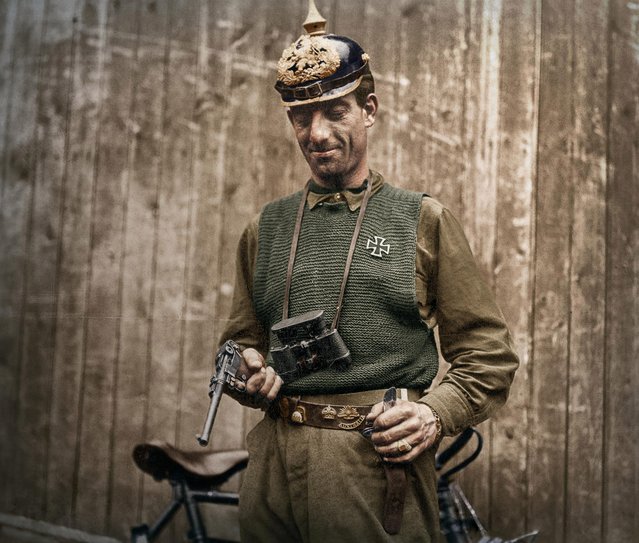
One image shows an unidentified American soldier posing with a pistol, helmet, and Iron Cross medal taken from a German soldier, 1918. (Photo by Mario Unger/Mediadrumworld)

The faces of war have been brought back to life after a series of World War One photographs were expertly colourised. The black and white snaps were painstakingly restored and colourised by photographer Mario Unger (53) from Rotenturm, Austria. Here: One image shows an unidentified American soldier posing with a pistol, helmet, and Iron Cross medal taken from a German soldier, 1918. (Photo by Mario Unger/Mediadrumworld)
Details
04 Dec 2017 07:47:00
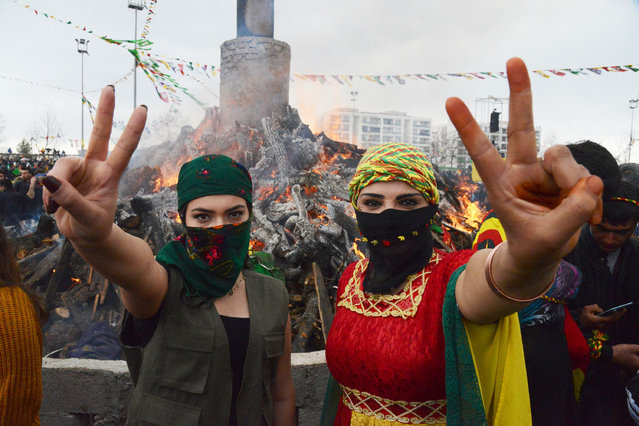
Young women flash the victory sign in front of a bonfire as Turkish Kurds gather during Newroz celebrations for the new year in Diyarbakir, southeastern Turkey, on March 21, 2017. Newroz (also known as Nawroz or Nowruz) is an ancient Persian festival, which is also celebrated by Kurdish people, marking the first day of spring, which falls on March 21. (Photo by Ilyas Akengin/AFP Photo)

Young women flash the victory sign in front of a bonfire as Turkish Kurds gather during Newroz celebrations for the new year in Diyarbakir, southeastern Turkey, on March 21, 2017. Newroz (also known as Nawroz or Nowruz) is an ancient Persian festival, which is also celebrated by Kurdish people, marking the first day of spring, which falls on March 21. (Photo by Ilyas Akengin/AFP Photo)
Details
22 Mar 2017 09:51:00
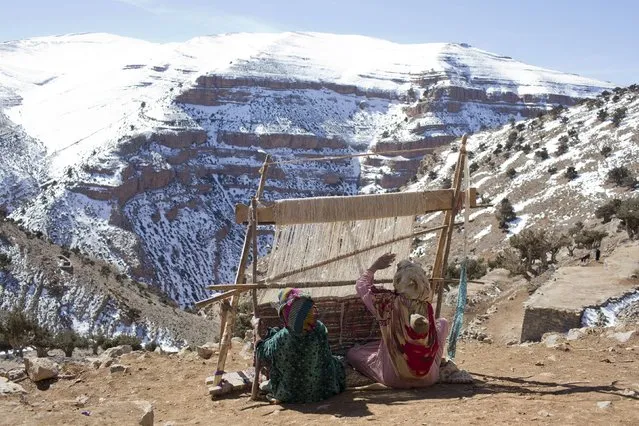
Berber women weave traditional carpets in the village of Ait Sghir in the High Atlas region of Morocco February 15, 2015. The snowy foothills of the High Atlas mountains in Morocco are home to several Berber villages where the inhabitants make their living by farming, baking bread in traditional ovens, herding cattle, and the making and selling of honey, olive oil and pottery. Extreme weather fluctuations and erosion that causes flooding and landslides have led to a drop in agricultural productivity, the United Nations said. (Photo by Youssef Boudlal/Reuters)

Berber women weave traditional carpets in the village of Ait Sghir in the High Atlas region of Morocco February 15, 2015. The snowy foothills of the High Atlas mountains in Morocco are home to several Berber villages where the inhabitants make their living by farming, baking bread in traditional ovens, herding cattle, and the making and selling of honey, olive oil and pottery. Extreme weather fluctuations and erosion that causes flooding and landslides have led to a drop in agricultural productivity, the United Nations said. (Photo by Youssef Boudlal/Reuters)
Details
26 Feb 2015 06:07:00
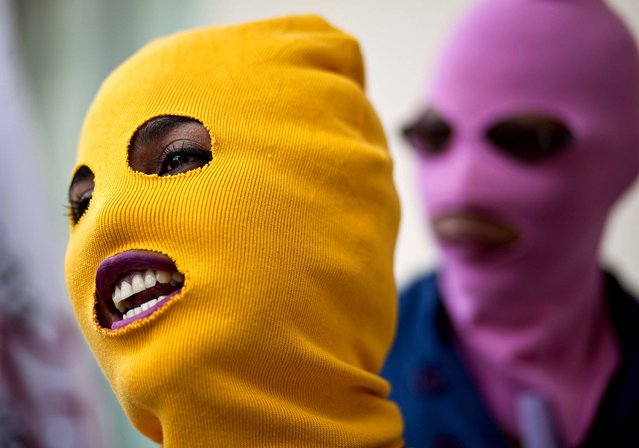
Masked women shout slogans during a demonstration marking the Latin American Day for Decriminalization of Therapeutic Abortion in Managua, Nicaragua, where abortions are illegal, on September 28, 2012. (Photo by Esteban Felix/Associated Press)

Masked women shout slogans during a demonstration marking the Latin American Day for Decriminalization of Therapeutic Abortion in Managua, Nicaragua, where abortions are illegal, on September 28, 2012. (Photo by Esteban Felix/Associated Press)
Details
03 Oct 2012 09:01:00