Loading...
Done
A female Kurdistan Workers Party (PKK) fighter stands near a security position in Sinjar, March 13, 2015. (Photo by Asmaa Waguih /Reuters)

A female Kurdistan Workers Party (PKK) fighter stands near a security position in Sinjar, March 13, 2015. Women fighters at a Kurdistan Workers Party (PKK) base on Mount Sinjar in northwest Iraq, just like their male counterparts, have to be ready for action at any time. Smoke from the front line, marking their battle against Islamic State, which launched an assault on northern Iraq last summer, is visible from the base. Many of the women have cut links with their families back home; the fighters come from all corners of the Kurdish region. (Photo by Asmaa Waguih /Reuters)
Details
02 May 2015 14:44:00
Revellers enjoy the atmosphere during the opening day or “Chupinazo” of the San Fermin Running of the Bulls fiesta on July 6, 2015 in Pamplona, Spain. The annual Fiesta de San Fermin, made famous by the 1926 novel of US writer Ernest Hemmingway entitled “The Sun Also Rises”, involves the daily running of the bulls through the historic heart of Pamplona to the bull ring. (Photo by Pablo Blazquez Dominguez/Getty Images)

Revellers enjoy the atmosphere during the opening day or “Chupinazo” of the San Fermin Running of the Bulls fiesta on July 6, 2015 in Pamplona, Spain. The annual Fiesta de San Fermin, made famous by the 1926 novel of US writer Ernest Hemmingway entitled “The Sun Also Rises”, involves the daily running of the bulls through the historic heart of Pamplona to the bull ring. (Photo by Pablo Blazquez Dominguez/Getty Images)
Details
07 Jul 2015 12:08:00
An art installation formed with milk churns, made by land art artist Gerard Benoit a la Guillaume, is seen at the Chenau de Mayen in the resort of Leysin, Switzerland August 7, 2015. More than 80 milk churns were placed between the Tour d'Ai and the Tour de Mayen summits at an altitude of 2,000 meters (6,561 feet) above sea level under the direction of the artist, to be photographed for his ongoing art project entitled “Milk churns without borders”. (Photo by Denis Balibouse/Reuters)

An art installation formed with milk churns, made by land art artist Gerard Benoit a la Guillaume, is seen at the Chenau de Mayen in the resort of Leysin, Switzerland August 7, 2015. More than 80 milk churns were placed between the Tour d'Ai and the Tour de Mayen summits at an altitude of 2,000 meters (6,561 feet) above sea level under the direction of the artist, to be photographed for his ongoing art project entitled “Milk churns without borders”. (Photo by Denis Balibouse/Reuters)
Details
08 Aug 2015 13:16:00
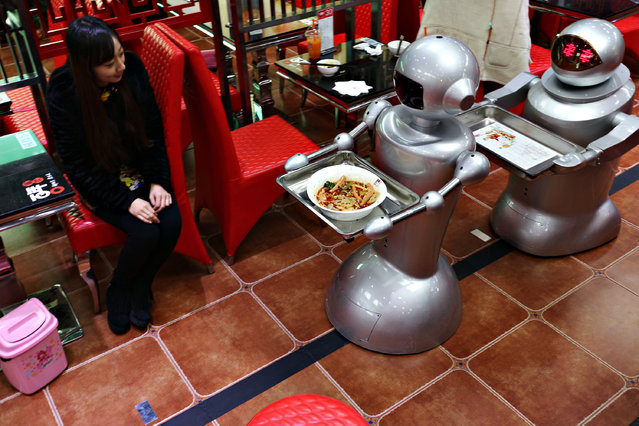
Two 70 thousand RMB (about 11,310 USD) robots carry dishes and offer service for customers at a robot themed restaurant at Chunxi Road in Chengdu, China, December 11, 2014. The restaurant has 10 robots to serve as waiters. Each robot can carry simple dishes and offer simple greetings. (Photo by ChinaFotoPress/ChinaFotoPress via Getty Images)

Two 70 thousand RMB (about 11,310 USD) robots carry dishes and offer service for customers at a robot themed restaurant at Chunxi Road in Chengdu, China, December 11, 2014. The restaurant has 10 robots to serve as waiters. Each robot can carry simple dishes and offer simple greetings. (Photo by ChinaFotoPress/ChinaFotoPress via Getty Images)
Details
13 Dec 2014 13:01:00
A volunteer photographs a woman as she kisses a volunteer wearing a condom costume during marking the International Condom Day in Kiev, Ukraine, 13 February 2015. The event was organized to promote and create awareness towards “Safe s*x” and the use of condoms to control and prevent Human Immunodeficiency Virus (HIV) and other sexually transmitted diseases on the occasion of the International Condom day. (Photo by Roman Pilipey/EPA)

A volunteer photographs a woman as she kisses a volunteer wearing a condom costume during marking the International Condom Day in Kiev, Ukraine, 13 February 2015. The event was organized to promote and create awareness towards “Safe s*x” and the use of condoms to control and prevent Human Immunodeficiency Virus (HIV) and other sexually transmitted diseases on the occasion of the International Condom day. (Photo by Roman Pilipey/EPA)
Details
14 Feb 2015 12:20:00
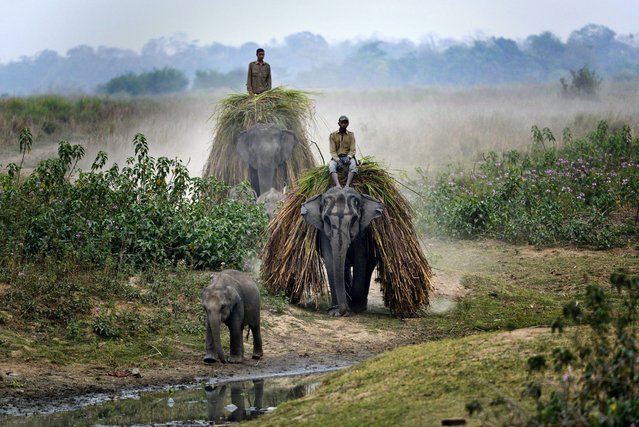
Mahouts return home with their elephants carrying grass to feed them on the eve of the rhino census in Kaziranga National Park in Assam state, India, 24 March 2015. Kaziranga will be closed to visitors for the next two days for a census of the rhinos commencing 25 March, in a previous census in 2013 in the park the population of the Indian rhinos was 2329. (Photo by EPA/Stringer)

Mahouts return home with their elephants carrying grass to feed them on the eve of the rhino census in Kaziranga National Park in Assam state, India, 24 March 2015. Kaziranga will be closed to visitors for the next two days for a census of the rhinos commencing 25 March, in a previous census in 2013 in the park the population of the Indian rhinos was 2329. (Photo by EPA/Stringer)
Details
28 Mar 2015 11:46:00
Disguised revellers parade on the occasion of the Cortege during the Carnival in Basel, Switzerland, February 17, 2016. (Photo by Georgios Kefalas/EPA)

Disguised revellers parade on the occasion of the Cortege during the Carnival in Basel, Switzerland, February 17, 2016. (Photo by Georgios Kefalas/EPA)
Details
18 Feb 2016 13:53:00
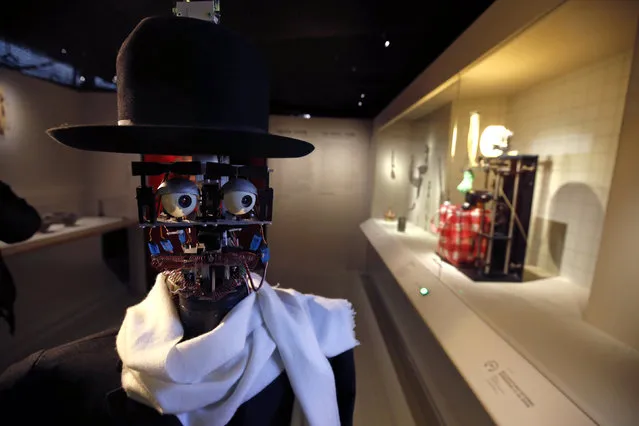
The Berenson robot strolls among visitors during the exhibition “Persona : Oddly Human” at the Quai Branly museum in Paris, France, February 23, 2016. The Berenson robot, developed in France in 2011, is the brainchild of anthropologist Denis Vidal and robotics engineer Philippe Gaussier. Its programming allows it to record reactions of museum visitors to certain pieces of art and then use the data to develop its own unique taste, which allows “Berenson” to judge whether or not it likes a certain work of art within an exhibition. (Photo by Philippe Wojazer/Reuters)

The Berenson robot strolls among visitors during the exhibition “Persona : Oddly Human” at the Quai Branly museum in Paris, France, February 23, 2016. The Berenson robot, developed in France in 2011, is the brainchild of anthropologist Denis Vidal and robotics engineer Philippe Gaussier. Its programming allows it to record reactions of museum visitors to certain pieces of art and then use the data to develop its own unique taste, which allows “Berenson” to judge whether or not it likes a certain work of art within an exhibition. (Photo by Philippe Wojazer/Reuters)
Details
25 Feb 2016 12:26:00