Loading...
Done
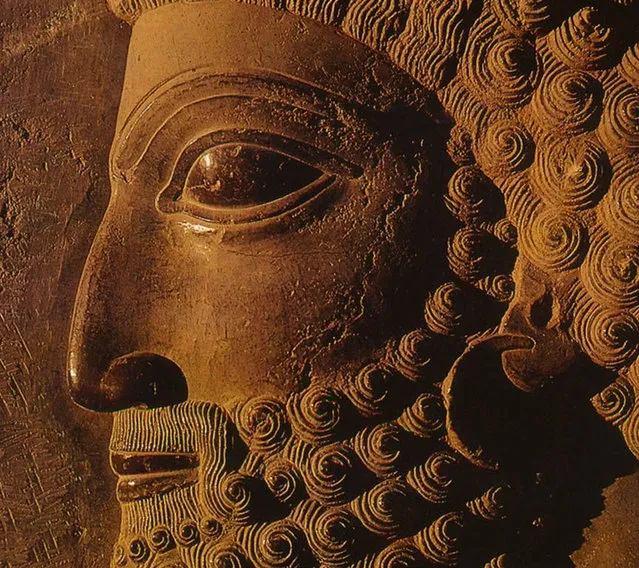
Persepolis, Takht-E-Jamshid Iran

Few people haven’t heard about the ancient city of Persepolis, which lies at the foot of the Mountain of Mercy (Kuh-I-Rahmat). In ancient times, Persepolis was the capital of the Achaemenid Empire. Regretfully, it was burned by the Greeks in 330 BC after they looted the immense treasure of this city. It is said that Greeks needed 5,000 camels and 20,000 mules to carry all the treasures from Persepolis. The only thing of Persepolis that has survived the wear of time is the ginormous stone terrace 530 by 330 meters adorned by elaborate stone sculptures. It is amazing how intricately detailed some of the sculptures are, despite the fact that they were created many centuries ago.
Details
26 Oct 2014 12:30:00
A visitor walks inside the initiation well at Quinta da Regaleira in Sintra October 6, 2014. (Photo by Rafael Marchante/Reuters)

A visitor walks inside the initiation well at Quinta da Regaleira in Sintra October 6, 2014. Sintra became the first centre of European Romantic architecture in the 19th century, which influenced the development of landscape architecture throughout Europe. It was classified as a World Heritage Site by UNESCO in 1995. Its monuments are visited by more than 1.5 million of tourists every year, according to local media. (Photo by Rafael Marchante/Reuters)
Details
28 Oct 2014 12:35:00


“Sky burial or ritual dissection was once a common funerary practice in Tibet wherein a human corpse is cut in specific locations and placed on a mountaintop, exposing it to the elements or the mahabhuta and animals – especially to birds of prey. The location of the sky burial preparation and place of execution are understood in the Vajrayana traditions as charnel grounds. In Tibet the practice is known as jhator, which literally means, «giving alms to the birds»”. – Wikipedia

Photo: A burial master chops bones of a body to feed vultures during a celestial burial ceremony on April 19, 2006 in Dari County of Guoluo Prefecture, Qinghai Province, northwest China. Celestial burial is a traditional funeral of Tibetan people, which began in the 7th century. (Photo by China Photos/Getty Images)
Details
18 Jun 2011 12:12:00
Red Bull Flying Bach

Gengis “Lil Ceng” Ademoski (L) and Khaled “KC” Chaabi (R) of the four time world champion Berlin dance troupe “Flying Steps” strike a freeze on a piano played by muscian Jia Lim (C) of Singapore at the 17th century waterfront area of Nyhavn in build up to the Red Bull Flying Bach European Tour, a show that features the cultural clash of break dancing with the classical music of Johann Sebastian Bach, on August 30, 2011 in Copenhagen, Denmark. (Photo by Dean Treml/Red Bull via Getty Images)
Details
01 Sep 2011 12:21:00
Mikhail Baburin, 66, talks to his cat Marquis at his house in the remote Siberian village of Mikhailovka, Krasnoyarsk region, Russia, December 5, 2016. (Photo by Ilya Naymushin/Reuters)

Mikhail Baburin, 66, talks to his cat Marquis at his house in the remote Siberian village of Mikhailovka, Krasnoyarsk region, Russia, December 5, 2016. Baburin, a former Navy man, barge worker and employee of a military plant in Krasnoyarsk, is the last inhabitant of Mikhailovka, which was founded in the 19th century by migrants from Russia's Mordovia region. He moved in 2000 to Mikhailovka where he was born and has lived there all alone for the last 10 years with only domestic animals. (Photo by Ilya Naymushin/Reuters)
Details
07 Dec 2016 12:22:00
A herder stops for reindeers to have a rest while riding along the tundra area in Nenets Autonomous District, Russia, November 27, 2016. (Photo by Sergei Karpukhin/Reuters)

A herder stops for reindeers to have a rest while riding along the tundra area in Nenets Autonomous District, Russia, November 27, 2016. In Russia's remote Arctic regions reindeer herding has been a way of life for centuries. Each winter herders in Russia's sparsely populated Nenets Autonomous District corral their reindeers into open-air pens before selecting weak animals to be culled... (Photo by Sergei Karpukhin/Reuters)
Details
16 Dec 2016 10:41:00


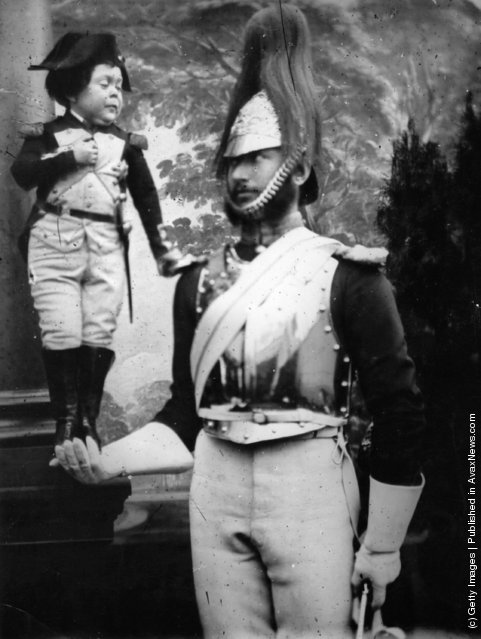
“Tom Thumb is a character of English folklore. The History of Tom Thumb was published in 1621, and has the distinction of being the first fairy tale printed in English. Tom is no bigger than his father's thumb, and his adventures include being swallowed by a cow, tangling with giants, and becoming a favourite of King Arthur. The earliest allusions to Tom occur in various 16th century works such as Reginald Scot's Discovery of Witchcraft (1584) where Tom is cited as one of the supernatural folk employed by servant maids to frighten children”. – Wikipedia

Photo: Portrait of the dwarf, Tom Thumb standing on the hand of a Guardsman. Charles Sherwood Stratton (1838 – 1883) was nicknamed General Tom Thumb by P T Barnum, the circus owner. (Photo by London Stereoscopic Company/Getty Images). Circa 1875
Details
24 Mar 2011 10:16:00
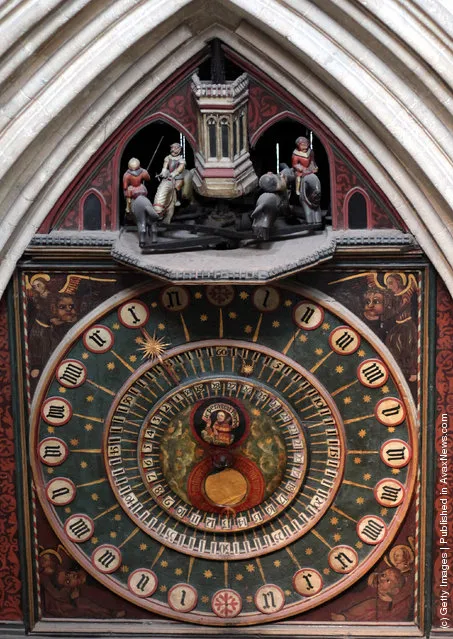
Wells Clock – World's Oldest Mechanical Clock

“Wells Cathedral is a Church of England cathedral in Wells, Somerset, England. Built between 1175 and 1490, Wells Cathedral has been described as “the most poetic of the English Cathedrals”. The Wells clock, an astronomical clock, is located in the north transept. The surviving mechanism, dated to between 1386 and 1392, was replaced in the 19th century, and was eventually moved to the Science Museum in London, where it continues to operate. It is the second-oldest surviving clock in England”. – Wikipedia

Photo: The clock face of world's oldest continually-working mechanical clock is seen as it is hand wound for the very last time on August 21, 2010 in Wells, England. (Photo by Matt Cardy/Getty Images)
Details
10 Aug 2011 11:23:00