Loading...
Done
A large teddy bear, used to enforce social distancing, is pictured sitting at a cafe in Pristina on July 23, 2020, as Kosovo authorities announce new measures to fight against the resurgence of the COVID-19, the novel coronavirus. (Photo by Armend Nimani/AFP Photo)

A large teddy bear, used to enforce social distancing, is pictured sitting at a cafe in Pristina on July 23, 2020, as Kosovo authorities announce new measures to fight against the resurgence of the COVID-19, the novel coronavirus. (Photo by Armend Nimani/AFP Photo)
Details
26 Jul 2020 00:07:00
A hot air balloon in the shape of children's comic Rupert Bear is seen tethered before a tethered flight at the Bristol International Balloon fiesta in south west England, Britain, August 10, 2018. (Photo by Adrian Sherratt/The Guardian)

A hot air balloon in the shape of children's comic Rupert Bear is seen tethered before a tethered flight at the Bristol International Balloon fiesta in south west England, Britain, August 10, 2018. (Photo by Adrian Sherratt/The Guardian)
Details
12 Aug 2018 07:01:00
Tardigrades (commonly known as waterbears or moss piglets). (Photo by SPL/East News)

“Tardigrades (commonly known as waterbears or moss piglets) are small, water-dwelling, segmented animals with eight legs. Tardigrades were first discovered in 1773 by Johann August Ephraim Goeze, who called them kleiner Wasserbär, meaning “little water bear” in German. The name Tardigrada means “slow walker” and was given by Lazzaro Spallanzani in 1777. The name water bear comes from the way they walk, reminiscent of a bear's gait. The biggest adults may reach a body length of 1.5 millimetres (0.059 in), the smallest below 0.1 mm. Freshly hatched tardigrades may be smaller than 0.05 mm”. – Wikipedia. Photo: Tardigrades. (Photo by SPL/East News)
Details
26 Sep 2012 09:55:00
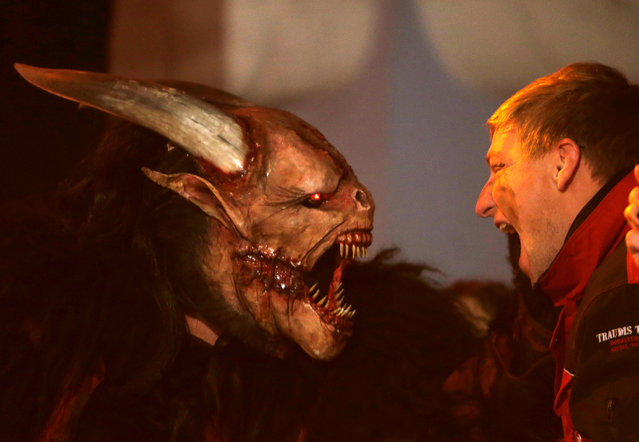
A man dressed as a devil performs during a Krampus show in the southern Bohemian town of Kaplice, December 12, 2015. Each year people in traditional costumes and masks parade through the streets to perform an old ritual to disperse the ghosts of winter. (Photo by David W. Cerny/Reuters)

A man dressed as a devil performs during a Krampus show in the southern Bohemian town of Kaplice, December 12, 2015. Each year people in traditional costumes and masks parade through the streets to perform an old ritual to disperse the ghosts of winter. (Photo by David W. Cerny/Reuters)
Details
14 Dec 2015 08:05:00
A Hindu devotee performs a ritual on Bagmati River during Kuse Aunse (Father's Day) at Gokarna Temple in Kathmandu, Nepal September 13, 2015. (Photo by Navesh Chitrakar/Reuters)

A Hindu devotee performs a ritual on Bagmati River during Kuse Aunse (Father's Day) at Gokarna Temple in Kathmandu, Nepal September 13, 2015. Hindus all over the country, whose fathers have passed away, come to the temple for worship, holy dips, and to present offerings on this occasion. (Photo by Navesh Chitrakar/Reuters)
Details
14 Sep 2015 13:20:00
People play "Palin", a traditional ritual and ancestral Mapuche game played with curved sticks called "Chuecas" and a wooden ball, during a meet on Dia de la Raza (Day of the Races), also known as Columbus Day in Vina del Mar, Chile October 11, 2015. (Photo by Rodrigo Garrido/Reuters)

People play "Palin", a traditional ritual and ancestral Mapuche game played with curved sticks called "Chuecas" and a wooden ball, during a meet on Dia de la Raza (Day of the Races), also known as Columbus Day in Vina del Mar, Chile October 11, 2015. (Photo by Rodrigo Garrido/Reuters)
Details
15 Oct 2015 08:01:00
The head of a mountain ram is attached to a wooden column at the site used for shamans' rituals in the Aldyn Bulak area on the bank of the Yenisei River during sunset outside the village of Elegest, Tuva region, Southern Siberia, Russia, October 7, 2015. (Photo by Ilya Naymushin/Reuters)

The head of a mountain ram is attached to a wooden column at the site used for shamans' rituals in the Aldyn Bulak area on the bank of the Yenisei River during sunset outside the village of Elegest, Tuva region, Southern Siberia, Russia, October 7, 2015. The region is inhabited by Tuvans, historically cattle-herding nomads, who nowadays practise two main confessions – Buddhism and Shamanism. (Photo by Ilya Naymushin/Reuters)
Details
19 Oct 2015 08:05:00
A woman reacts after she mades a wreath of flowers during the celebrations of the Kupala night in Pyrohiv, near Kiev, on July 6, 2021. During the celebration, an ancient slavic ritual related to the summer solstice, people wear wreaths, jump over fires and bathe naked in rivers and lakes. (Photo by Sergei Supinsky/AFP Photo)

A woman reacts after she mades a wreath of flowers during the celebrations of the Kupala night in Pyrohiv, near Kiev, on July 6, 2021. During the celebration, an ancient slavic ritual related to the summer solstice, people wear wreaths, jump over fires and bathe naked in rivers and lakes. (Photo by Sergei Supinsky/AFP Photo)
Details
27 Mar 2022 05:04:00