Loading...
Done
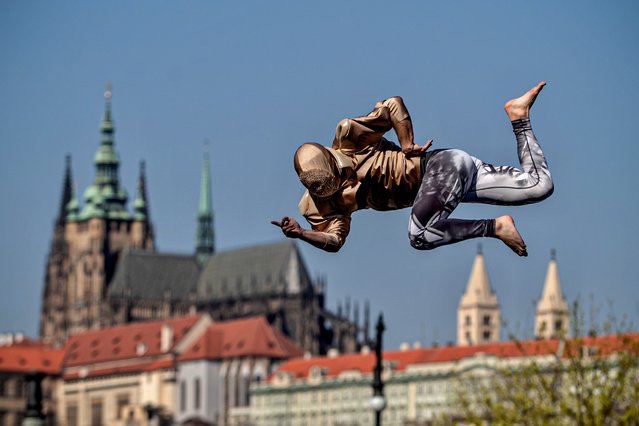
A member of the contemporary circus company Cirk La Putyka perform on the mobile trampoline as he amuses local residents in Prague, Czech Republic, 09 April 2020. The aim of the Cirk La Putyka events in the streets of Czech capital is to get live art back to people during the lockdown. According to them, when people can't go to the artists, to the theater, the actors go to the people. The Czech government has imposed a lockdown in an attempt to slow down the spread of the pandemic COVID-19 disease caused by the SARS-CoV-2 coronavirus. (Photo by Martin Divisek/EPA/EFE)

A member of the contemporary circus company Cirk La Putyka perform on the mobile trampoline as he amuses local residents in Prague, Czech Republic, 09 April 2020. The aim of the Cirk La Putyka events in the streets of Czech capital is to get live art back to people during the lockdown. According to them, when people can't go to the artists, to the theater, the actors go to the people. The Czech government has imposed a lockdown in an attempt to slow down the spread of the pandemic COVID-19 disease caused by the SARS-CoV-2 coronavirus. (Photo by Martin Divisek/EPA/EFE)
Details
11 Apr 2020 00:07:00
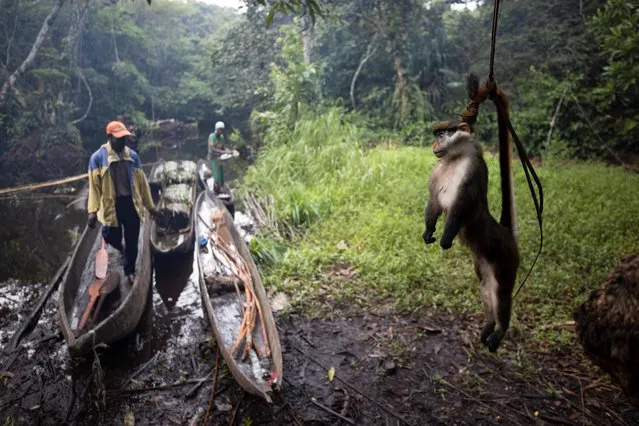
A dead red-tailed monkey hangs by its tail above the ground, in order to keep it away from ants, in the forest near the city of Mbandaka, Democratic Republic of the Congo, April 5, 2019. Bushmeat hunters are emptying Central Africa's forests at a high rate, researchers say. A growing appetite for wild meat in cities has ramped up the scale of hunting. Research shows around 6 million tonnes of bushmeat are sourced annually from the Congo Basin, whose forest spans across six countries and is second in size only to the Amazon. (Photo by Thomas Nicolon/Reuters)

A dead red-tailed monkey hangs by its tail above the ground, in order to keep it away from ants, in the forest near the city of Mbandaka, Democratic Republic of the Congo, April 5, 2019. Bushmeat hunters are emptying Central Africa's forests at a high rate, researchers say. A growing appetite for wild meat in cities has ramped up the scale of hunting. Research shows around 6 million tonnes of bushmeat are sourced annually from the Congo Basin, whose forest spans across six countries and is second in size only to the Amazon. (Photo by Thomas Nicolon/Reuters)
Details
14 Oct 2019 00:03:00
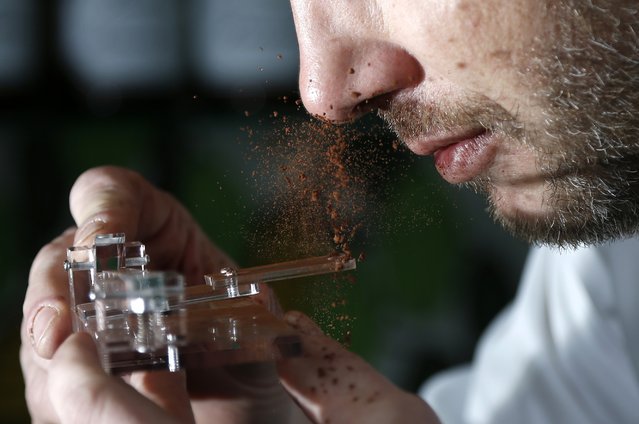
Belgian chocolatier Dominique Persoone snorts cocoa powder off his Chocolate Shooter in his factory in Bruges, February 3, 2015. (Photo by Francois Lenoir/Reuters)

Belgian chocolatier Dominique Persoone snorts cocoa powder off his Chocolate Shooter in his factory in Bruges, February 3, 2015. When Belgian chocolatier Dominique Persoone created a chocolate-sniffing device for a Rolling Stones party in 2007, he never imagined demand would stretch much beyond the rock 'n' roll scene. But, seven years later, he has sold 25,000 of them. Inspired by a device his grandfather used to propel tobacco snuff up his nose, Persoone created a “Chocolate Shooter” to deliver a hit of Dominican Republic or Peruvian cocoa powder, mixed with mint and either ginger or raspberry. (Photo by Francois Lenoir/Reuters)
Details
08 Feb 2015 12:13:00
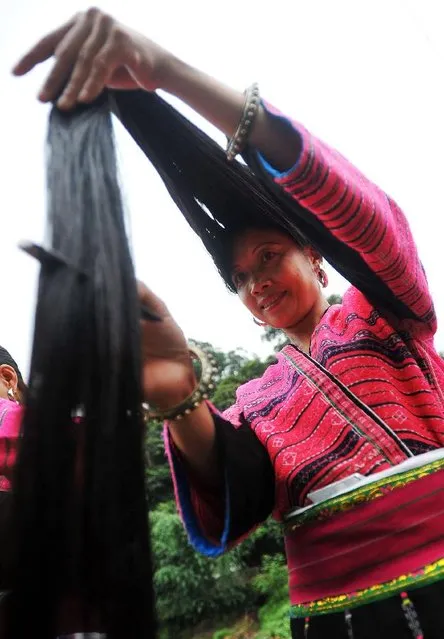
A woman combs her hair at the Huangluo Village of the Yao ethnic group in Guilin, south China's Guangxi Zhuang Autonomous Region, July 15, 2012. (Photo by Lu Boan/Xinhua)

“The Yao nationality is a government classification for various minorities in China. They form one of the 55 ethnic minority groups officially recognized by the People's Republic of China, where they reside in the mountainous terrain of the southwest and south”. – Wikipedia

Photo: A woman combs her hair at the Huangluo Village of the Yao ethnic group in Guilin, south China's Guangxi Zhuang Autonomous Region, July 15, 2012. The Huangluo Village of the Yao ethnic group locates at the Longji Terraces in Heping Town of Longsheng County in Guilin. Women here have the tradition of keeping long hair. They believe that long hair brings good luck and fortune. The average length of hair of 180 women in the village is 1.7 meters. (Photo by Lu Boan/Xinhua)
Details
07 Mar 2015 08:33:00


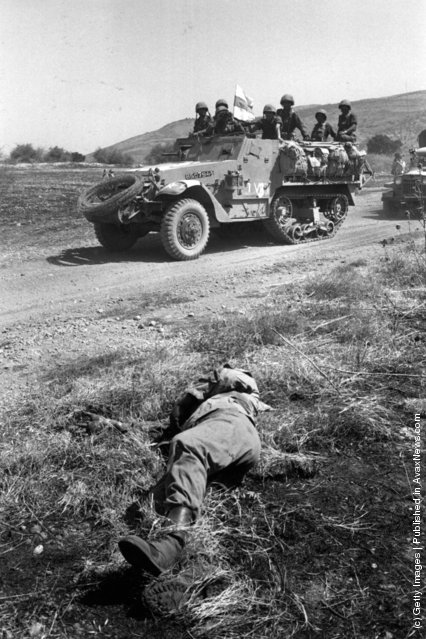
“The Six-Day War or June War, also known as the 1967 Arab-Israeli War or the Third Arab-Israeli War, was fought between June 5 and June 10, 1967, by Israel and the neighboring states of Egypt (known then as the United Arab Republic [UAR]), Jordan, and Syria. The war began with a large-scale surprise air strike by Israel on Egypt. The outcome was a swift and decisive Israeli victory. Israel took effective control of the Gaza Strip and the Sinai Peninsula from Egypt, the West Bank and East Jerusalem from Jordan, and the Golan Heights from Syria. Opinions are divided on whether Israel's attack was an act of aggression or a preemptive strike of a defensive nature”. – Wikipedia

Photo: The corpse of a soldier lying on the line of the Israeli advance into Syria during the Six-Day War. (Photo by Terry Fincher/Getty Images). 1967
Details
21 May 2011 08:29:00
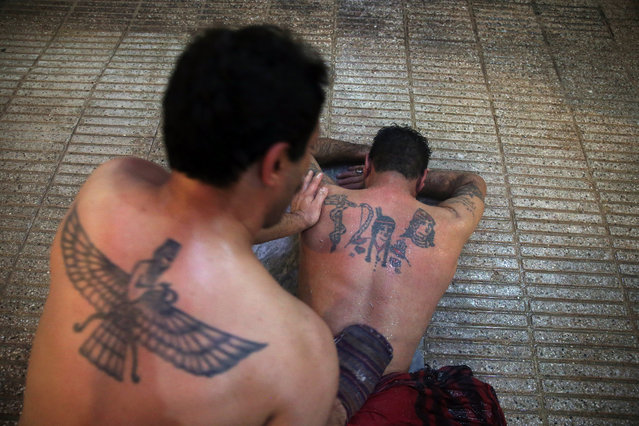
In this Friday, January 9, 2015 photo, bathhouse worker Omid Riahi, 39, scrubs a man to remove dead skin, at the Ghebleh public bathhouse, in Tehran, Iran. The steamy air and curved tiled walls of Iran's famed public bathhouses, some rinsing and massaging patrons for hundreds of years, slowly may wash away as interest in them wanes. (Photo by Ebrahim Noroozi/AP Photo)

In this Friday, January 9, 2015 photo, bathhouse worker Omid Riahi, 39, scrubs a man to remove dead skin, at the Ghebleh public bathhouse, in Tehran, Iran. The steamy air and curved tiled walls of Iran's famed public bathhouses, some rinsing and massaging patrons for hundreds of years, slowly may wash away as interest in them wanes. The bathhouses, known as “hammams” in Persian, find themselves in rough financial times as modern conveniences now allow showers and baths in most homes across the Islamic Republic. (Photo by Ebrahim Noroozi/AP Photo)
Details
03 Apr 2015 12:40:00
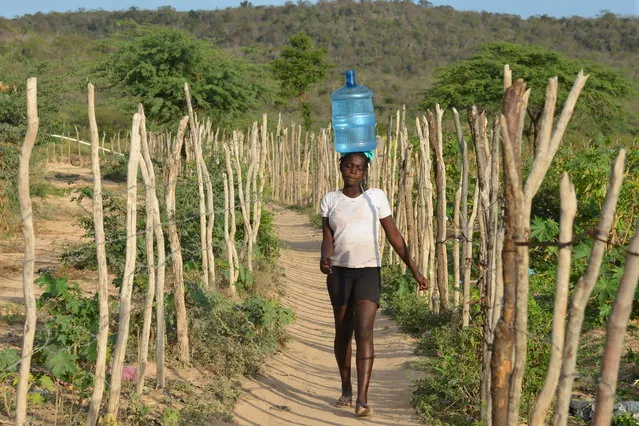
In this March 21, 2015 photo, 15-year-old Guerline Augustin carries river water on her head, back to a borderland encampment outside the southeast Haitian town of Anse-a-Pitres, Haiti. (Photo by David McFadden/AP Photo)

In this March 21, 2015 photo, 15-year-old Guerline Augustin carries river water on her head, back to a borderland encampment outside the southeast Haitian town of Anse-a-Pitres, Haiti. The encampment is filled with people who either fled or were forcibly removed from the neighboring Dominican Republic amid an immigration crackdown. Within the next month, authorities hope to move nearly 2,400 people out of six encampments by providing subsidies for them to rent homes for a year in southeastern Haiti. The International Organization for Migration is coordinating the effort with $2 million from a U.N. emergency fund. (Photo by David McFadden/AP Photo)
Details
31 Mar 2016 11:20:00
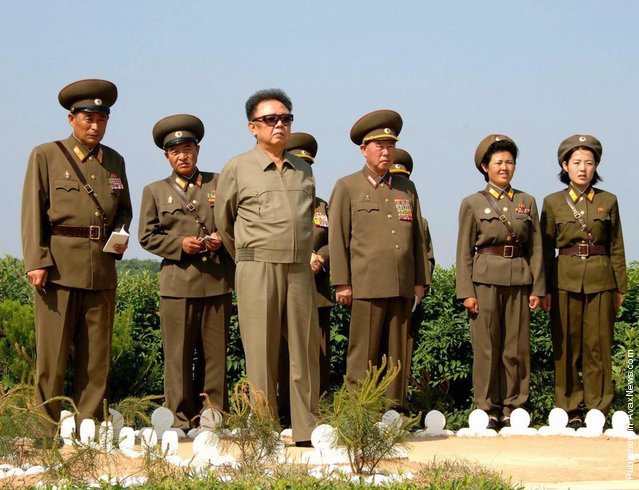
North Korean leader Kim Jong Il inspects a military unit in North Korea

“Kim Jong-il, also written as Kim Jong Il, birth name Yuri Irsenovich Kim (according to Soviet records) (16 February 1941/2 – 17 December 2011), was the supreme Leader of the Democratic People's Republic of Korea (North Korea). He was the General Secretary of the Workers' Party of Korea, the ruling party since 1948, Chairman of the the National Defence Commission of North Korea, and the Supreme Commander of the Korean People's Army, the fourth-largest standing army in the world”. – Wikipedia

Photo: North Korean leader Kim Jong Il inspects a military unit in North Korea. (Photo by Korean Central Television/Yonhap)
Details
19 Dec 2011 10:38:00