Loading...
Done
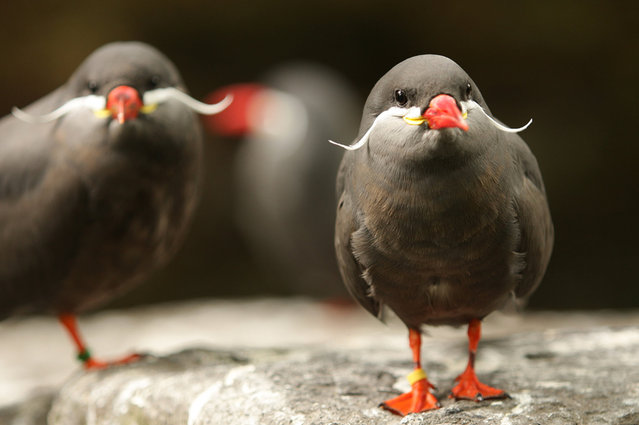
Beard Bird Inca Tern

The Inca Tern is a seabird in the family Sternidae. It is the only member of the genus Larosterna. This uniquely plumaged bird breeds on the coasts of Peru and Chile, and is restricted to the Humboldt current. It can be identified by its dark grey body, white moustache on the both sides of its head, and red-orange beak and feet.
Details
21 Apr 2013 17:02:00
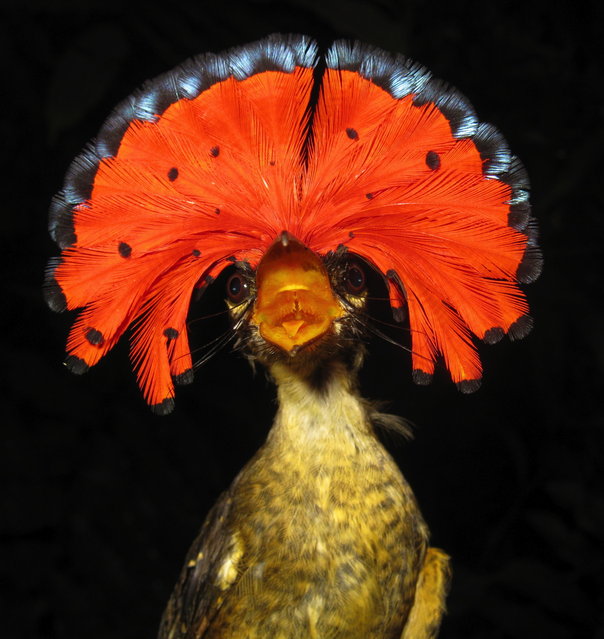
Royal Flycatcher

The Royal Flycatchers are birds in the genus Onychorhynchus in the Tityridae family. Depending on authority, it includes a single widespread, or four more localized species. The specific epithet of the type species, coronatus, and the common name of all the species in this genus, Royal Flycatcher, refer to the striking, colourful crest, which is seen displayed very rarely, except after mating, while preening, in courtship as well as being handled.
Details
02 Jun 2013 10:04:00


Their Royal Highnesses Prince William, Duke of Cambridge and Catherine, Duchess of Cambridge kiss on the balcony at Buckingham Palace on April 29, 2011 in London, England. The marriage of the second in line to the British throne was led by the Archbishop of Canterbury and was attended by 1900 guests, including foreign Royal family members and heads of state. Thousands of well-wishers from around the world have also flocked to London to witness the spectacle and pageantry of the Royal Wedding. (Photo by Peter Macdiarmid/Getty Images)
Details
29 Apr 2011 13:09:00


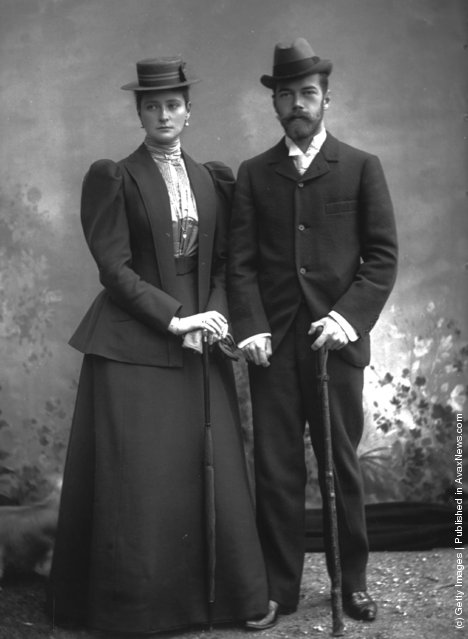
“Nicholas II (Russian: Николай II, Николай Александрович Романов, tr. Nikolay II, Nikolay Alexandrovich Romanov) (18 May [O.S. 6 May] 1868 – 17 July 1918) was the last Emperor of Russia, Grand Prince of Finland, and titular King of Poland. His official title was Nicholas II, Emperor and Autocrat of All the Russias and he is known as Saint Nicholas the Passion-Bearer by the Russian Orthodox Church. Nicholas II, his wife, his son, his four daughters, the family's medical doctor, the Tsar's valet, the Empress' lady-in-waiting and the family's cook were murdered in the same room by the Bolsheviks on the night of 16/17 July 1918”. – Wikipedia

Photo: Tsar Nicholas II (1868–1918) with his wife. (Photo by W. & D. Downey/Getty Images). Circa 1900
Details
12 May 2011 07:26:00
“After the death of a teenager (14-year-old Elijah Doughty), hundreds of Indigenous locals took to the streets of Kalgoorlie to vent their anger. Danella Bevis captures the grief and outrage of a family and a community. There is raw aggression in an eruption of racial tensions and violence, and in stark contrast she concludes the narrative with a moment of quiet beauty at a dusk vigil”. (Photo by Danella Bevis/The Walkley Foundation)

“After the death of a teenager (14-year-old Elijah Doughty), hundreds of Indigenous locals took to the streets of Kalgoorlie to vent their anger. Danella Bevis captures the grief and outrage of a family and a community. There is raw aggression in an eruption of racial tensions and violence, and in stark contrast she concludes the narrative with a moment of quiet beauty at a dusk vigil”. (Photo by Danella Bevis/The Walkley Foundation)
Details
17 Oct 2016 10:20:00
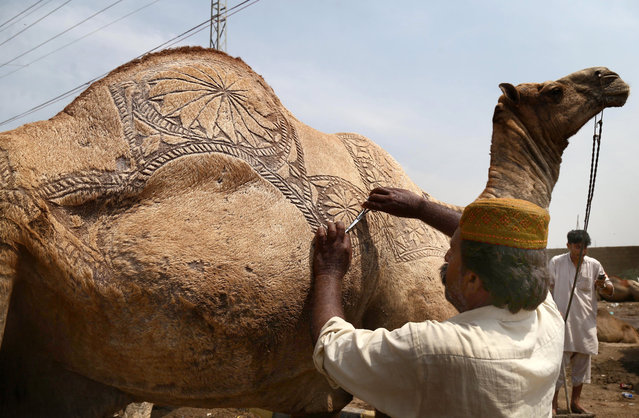
A vendor decorates a sacrificial camel ahead of the Eid al-Adha festival, in Karachi, Pakistan, 23 August 2016. Eid al-Adha is the holiest of the two Muslims holidays celebrated each year, with this year will be celebrated on 02nd September. Eid al-Adha marks the yearly Muslim pilgrimage (Hajj) to visit Mecca, the holiest place in Islam. Muslims slaughter a sacrificial animal and split the meat into three parts, one for the family, one for friends and relatives, and one for the poor and needy. (Photo by Rehan Khan/EPA)

A vendor decorates a sacrificial camel ahead of the Eid al-Adha festival, in Karachi, Pakistan, 23 August 2016. Eid al-Adha is the holiest of the two Muslims holidays celebrated each year, with this year will be celebrated on 02nd September. Eid al-Adha marks the yearly Muslim pilgrimage (Hajj) to visit Mecca, the holiest place in Islam. Muslims slaughter a sacrificial animal and split the meat into three parts, one for the family, one for friends and relatives, and one for the poor and needy. (Photo by Rehan Khan/EPA)
Details
28 Aug 2017 12:03:00
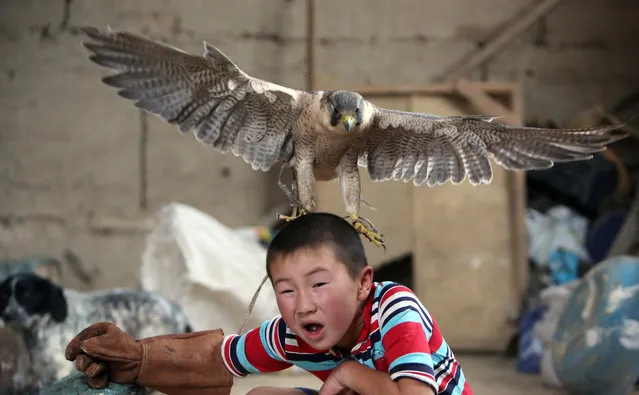
Azat Shajbyrov reacts with a baby falcon on his head in a village of Bokonbaevo, Issyk-Kul area (270 km from Bishkek), Kyrgyzstan, 22 June 2016, as he dreams of continuing a family tradition of golden eagle hunting. Eagle and falcon hunting is an old Kyrgyz tradition. With their birds, Kyrgyz berkutchy hunt in the mountains and participate in the hunting festival “Salburun”. (Photo by Igor Kovalenko/EPA)

Azat Shajbyrov reacts with a baby falcon on his head in a village of Bokonbaevo, Issyk-Kul area (270 km from Bishkek), Kyrgyzstan, 22 June 2016, as he dreams of continuing a family tradition of golden eagle hunting. Eagle and falcon hunting is an old Kyrgyz tradition. With their birds, Kyrgyz berkutchy hunt in the mountains and participate in the hunting festival “Salburun”. (Photo by Igor Kovalenko/EPA)
Details
23 Jun 2016 13:17:00
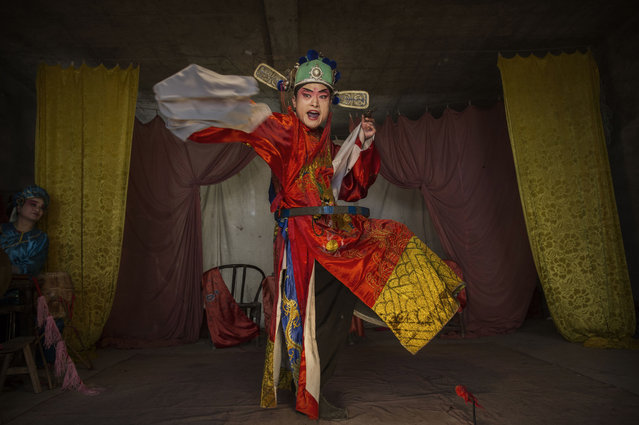
Sichuan Opera performer Wu Yonghong, 26 years, of the Jinyuan Opera Company performs for villagers at the Dongyue Temple on May 2, 2016 in Cangshan, Sichuan province, China. Sichuan opera is a vibrant, centuries-old tradition that showcases the joys and challenges of daily life in rural China with tales of love, tradition, and family honor. As the traditional audience grows older, the opera as a form of art and recreation is struggling to endure as newer spectators within younger generations are leaving the countryside for China's cities to seek employment. (Photo by Kevin Frayer/Getty Images)

Sichuan Opera performer Wu Yonghong, 26 years, of the Jinyuan Opera Company performs for villagers at the Dongyue Temple on May 2, 2016 in Cangshan, Sichuan province, China. Sichuan opera is a vibrant, centuries-old tradition that showcases the joys and challenges of daily life in rural China with tales of love, tradition, and family honor. Photo by Kevin Frayer/Getty Images)
Details
07 May 2016 13:14:00