Loading...
Done
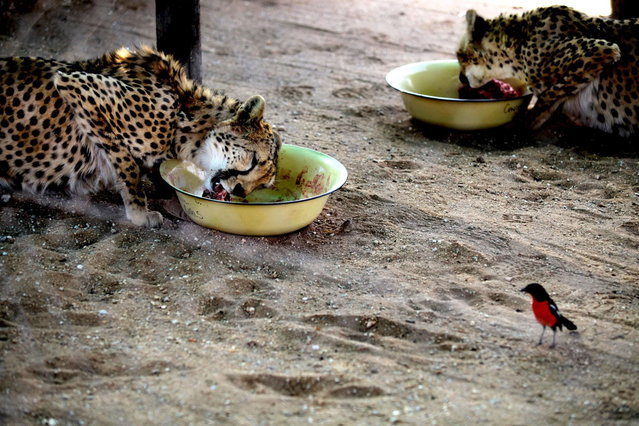
Young cheetahs eat meat at The Cheetah Conservation Fund (CCF) center in Otjiwarongo, Namibia, on August 13, 2013. The CCF started breeding Anatolian livestock dogs to promote cheetah-friendly farming after some 10,000 big cats – the current total worldwide population – were killed or moved off farms in the 1980s.  Up to 1,000 cheetahs were being killed a year, mostly by farmers who saw them as livestock killers. But the use of dogs has slashed losses for sheep and goat farmers and led to less retaliation against the vulnerable cheetah. (Photo by Jennifer Bruce/AFP Photo)

Young cheetahs eat meat at The Cheetah Conservation Fund (CCF) center in Otjiwarongo, Namibia, on August 13, 2013. The CCF started breeding Anatolian livestock dogs to promote cheetah-friendly farming after some 10,000 big cats – the current total worldwide population – were killed or moved off farms in the 1980s. Up to 1,000 cheetahs were being killed a year, mostly by farmers who saw them as livestock killers. But the use of dogs has slashed losses for sheep and goat farmers and led to less retaliation against the vulnerable cheetah. (Photo by Jennifer Bruce/AFP Photo)
Details
29 Aug 2013 10:56:00
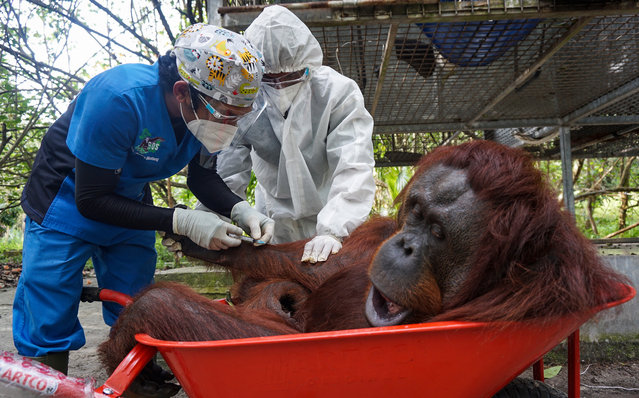
A handout photo made available by Borneo Orangutan Survival Foundation (BOSF) shows veterinarian wearing protective masks and suit, conducting anesthesia procedure on Nenuah, a nine year old Bornean Orangutan before being transported and released to the Bukit Batikap protection forest, at the Nyaru Menteng Orangutan Rehabilitation Center in Palangkaraya, Central Kalimantan, Indonesia, 15 February 2021. BOSF and the national nature conservation agency (BKSDA) released 10 orangutans back to the wild in Bukit Batikap Protection Forest in Central Kalimantan and the Kehje Sewen Forest in East Kalimantan amid the pandemic according to BOSF. (Photo by BOSF Handout/EPA/EFE)

A handout photo made available by Borneo Orangutan Survival Foundation (BOSF) shows veterinarian wearing protective masks and suit, conducting anesthesia procedure on Nenuah, a nine year old Bornean Orangutan before being transported and released to the Bukit Batikap protection forest, at the Nyaru Menteng Orangutan Rehabilitation Center in Palangkaraya, Central Kalimantan, Indonesia, 15 February 2021. BOSF and the national nature conservation agency (BKSDA) released 10 orangutans back to the wild in Bukit Batikap Protection Forest in Central Kalimantan and the Kehje Sewen Forest in East Kalimantan amid the pandemic according to BOSF. (Photo by BOSF Handout/EPA/EFE)
Details
07 Mar 2021 09:54:00
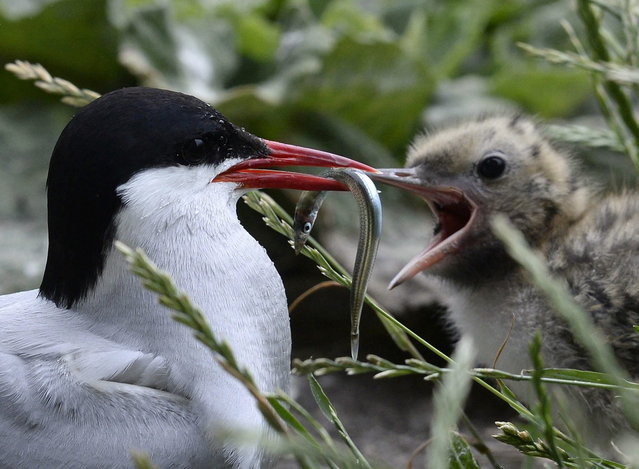
An arctic tern feeds its chick on the Farne Islands off the Northumberland coast, northern England July 8, 2013. (Photo by Nigel Roddis/Reuters)

An arctic tern feeds its chick on the Farne Islands off the Northumberland coast, northern England July 8, 2013. The Farne Islands, which lie off the coast of northeast England, are home to a huge array of wildlife. The islands are owned and protected by the British conservation charity, the National Trust, which says they host some 23 species of seabird, as well as a substantial colony of grey seals, who come to have their pups there in the autumn. Every five years the National Trust carries out a census of the islands' population of puffins, and this year's survey showed there were almost 40,000 nesting pairs on the islands – an 8 percent rise from 2008. (Photo by Nigel Roddis/Reuters)
Details
11 Dec 2013 09:21:00
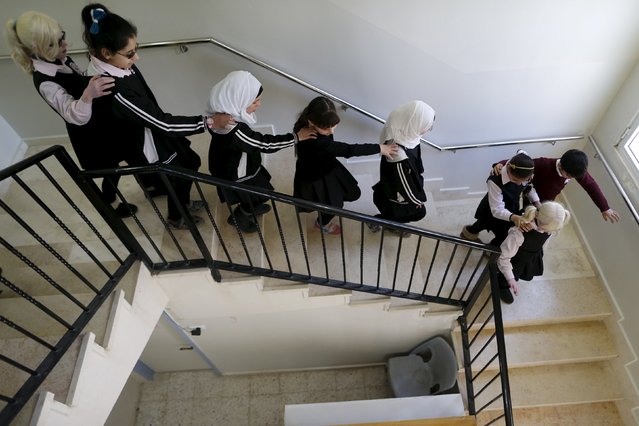
Blind and visually impaired Palestinian students walk down the stairs at a school, where they are taught English through song and music, at a school in the West Bank city of Hebron March 2, 2016. (Photo by Ammar Awad/Reuters)

Blind and visually impaired Palestinian students walk down the stairs at a school, where they are taught English through song and music, at a school in the West Bank city of Hebron March 2, 2016. Palestinian students at a school for the blind in the West Bank are learning English through song, a welcome departure from using braille and memorising grammar rules. While students are delighted with the change, some parents in the religiously conservative town of Hebron are concerned that using music in the classroom jars with Islamic tradition. (Photo by Ammar Awad/Reuters)
Details
03 Mar 2016 11:20:00
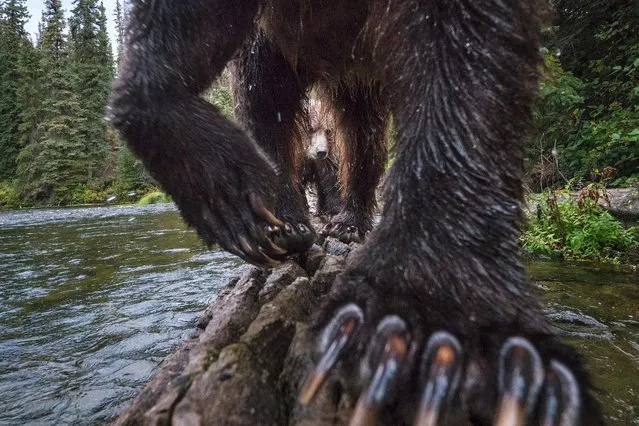
“The Salmon Catchers”. Terrestrial Wildlife. To capture this view of a mother grizzly bear and her cub, photographer Peter Mather set up a camera trap on a log that he knew the bears tended to traverse while fishing for salmon, in the Yukon River watershed in Canada. (Photo by Peter Mather/BigPicture Natural World Photography Competition 2017)

The fourth annual BigPicture Natural World Photography Competition aims to celebrate the diversity of life on Earth, and encourages people to protect and conserve it. Here: “The Salmon Catchers”. Terrestrial Wildlife. To capture this view of a mother grizzly bear and her cub, photographer Peter Mather set up a camera trap on a log that he knew the bears tended to traverse while fishing for salmon, in the Yukon River watershed in Canada. (Photo by Peter Mather/BigPicture Natural World Photography Competition 2017)
Details
02 Jul 2017 07:25:00
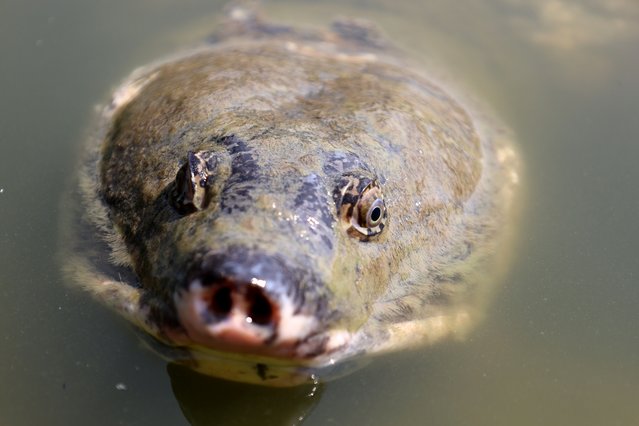
Black softshell turtle or Bostami turtle (Nilssonia nigricans), extremely rare and critically endangered species of tortoise is seen in a pond in Chittagong, Bangladesh on March 1, 2022. For decades, the breeding grounds have shrunk and their habitat has been threatened by habitat pollution. Through conservation methods and protection of the species, some of these turtles can be found today throughout the wild, and scientists and environmental biologists are continuing to work hard to preserve this endangered species and their natural habitat. (Photo by Mohammad Shajahan/Anadolu Agency via Getty Images)

Black softshell turtle or Bostami turtle (Nilssonia nigricans), extremely rare and critically endangered species of tortoise is seen in a pond in Chittagong, Bangladesh on March 1, 2022. For decades, the breeding grounds have shrunk and their habitat has been threatened by habitat pollution. (Photo by Mohammad Shajahan/Anadolu Agency via Getty Images)
Details
26 May 2024 04:02:00
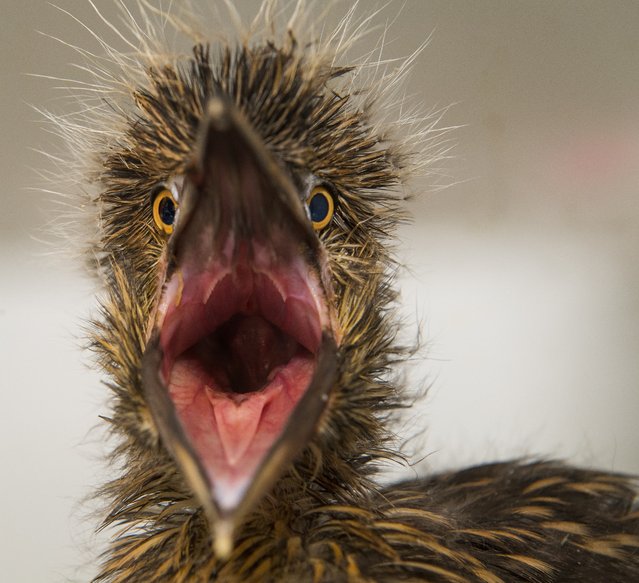
A baby Black-crowned Night Heron squawks in its incubator while being cared for at City Wildlife rescue and rehabilitation center in Washington, DC on May 31, 2017. The heron is one of several that have been brought to CW by the staff at The National Zoo over the past few years. The heron is a native bird and has made an established rookery inside the zoo grounds over a hundred years ago.  Every year at this time, some of the chicks get pushed or fall out of the nest and require human care.  Because the birds are native and not part of the Smithsonian collection, they partnered with CW to rehabilitate the herons for re-release back to the flock inside Zoo. They're reintroduced back to their flock so that they can migrate together in the Fall. The Black-crowned heron usually migrates from the DC area down to southeast North Carolina, some going as far as Jacksonville, FL in winter. The Black-crowned heron is the species of greatest conservation need in the District of Columbia because their numbers are in such rapid decline due to habitat loss. (Photo Linda Davidson/The Washington Post)

A baby Black-crowned Night Heron squawks in its incubator while being cared for at City Wildlife rescue and rehabilitation center in Washington, DC on May 31, 2017. The heron is one of several that have been brought to CW by the staff at The National Zoo over the past few years. (Photo Linda Davidson/The Washington Post)
Details
04 Jun 2017 08:04:00
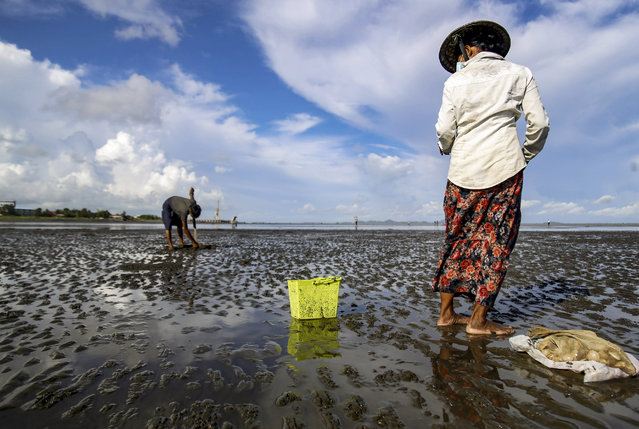
People search for shells on a beach in Sittwe, Rakhine State, Myanmar, 17 September 2020. International Coastal Cleanup Day is observed annually on the third Saturday of September and will occur on 19 September this year. The day was established to encourage global efforts to clean up garbage on beaches and coastal areas and raise awareness on protecting the world's oceans and waterways. According to a report released by the US-based nonprofit environmental advocacy group Ocean Conservancy on 08 September 2020, plastic food packaging topped the list of most common items found in beach trash. Close to five million food wrappers were collected in a single day during the International Coastal Cleanup Day in 2019. An approximate 11 million metric tons of plastic enters the ocean every year according to a 2016 analysis, affecting more than 800 marine species and causing contamination to human food chains and drinking water. (Photo by Nyunt Win/EPA/EFE/Rex Features/Shutterstock)

People search for shells on a beach in Sittwe, Rakhine State, Myanmar, 17 September 2020. International Coastal Cleanup Day is observed annually on the third Saturday of September and will occur on 19 September this year. (Photo by Nyunt Win/EPA/EFE/Rex Features/Shutterstock)
Details
24 Oct 2020 00:05:00