Loading...
Done
Zookeeper Agata holds a rare newborn Brazilian three-banded armadillo inside its enclosure at the Wroclaw Zoo in Wroclaw, Poland on May 11, 2023. The Tolypeutes matatus, or the southern armor also known as bolita or tatu-bola, is a fairly popular animal in South America but is increasingly rare. The new zoo child was born on March 23. The species is listed as vulnerable by the International Union for the Conservation of Nature (IUCN) and threatened by habitat loss and hunting. (Photo by Omar Marques/Anadolu Agency via Getty Images)

Zookeeper Agata holds a rare newborn Brazilian three-banded armadillo inside its enclosure at the Wroclaw Zoo in Wroclaw, Poland on May 11, 2023. The Tolypeutes matatus, or the southern armor also known as bolita or tatu-bola, is a fairly popular animal in South America but is increasingly rare. The new zoo child was born on March 23. The species is listed as vulnerable by the International Union for the Conservation of Nature (IUCN) and threatened by habitat loss and hunting. (Photo by Omar Marques/Anadolu Agency via Getty Images)
Details
28 May 2023 04:09:00
While much of the U.S. sustains another round of winter weather, a brown anole, a species of lizard, finds a blooming poinsettia the perfect perch to catch some afternoon rays of sunshine in a Maitland, Fla., neighborhood, Monday, January 8, 2024. After a cold front brings storms to Central Florida on Tuesday, rain returns to the forecast on Friday with temperatures near 80 predicted. (Photo by Joe Burbank/Orlando Sentinel via AP Photo)

While much of the U.S. sustains another round of winter weather, a brown anole, a species of lizard, finds a blooming poinsettia the perfect perch to catch some afternoon rays of sunshine in a Maitland, Fla., neighborhood, Monday, January 8, 2024. After a cold front brings storms to Central Florida on Tuesday, rain returns to the forecast on Friday with temperatures near 80 predicted. (Photo by Joe Burbank/Orlando Sentinel via AP Photo)
Details
19 Jan 2024 17:51:00
A black golden shaded British Shorthair cat is admired by visitors as he is carried at the Cat Extravaganza event at Olympia in London, Sunday, February 18, 2024. Loving Cats Worldwide brought its Cat Extravaganza and Rescue Awareness Event to London, where visitors could learn all about this intelligent species by observing the show's five judging rings. Plus, meet with local rescues and charities, as well as hear educational anecdotes about different cat breeds. (Photo by Kirsty Wigglesworth/AP Photo)

A black golden shaded British Shorthair cat is admired by visitors as he is carried at the Cat Extravaganza event at Olympia in London, Sunday, February 18, 2024. Loving Cats Worldwide brought its Cat Extravaganza and Rescue Awareness Event to London, where visitors could learn all about this intelligent species by observing the show's five judging rings. Plus, meet with local rescues and charities, as well as hear educational anecdotes about different cat breeds. (Photo by Kirsty Wigglesworth/AP Photo)
Details
25 Feb 2024 06:44:00
An injured vulture is treated at the VulPro Vulture Rehabilitation Centre in Hartebeepoortdam in the Magalisburg region on September 15, 2015. Confined to southern Africa, just under 4,000 breeding pairs of Cape Vultures remain in the wild, mostly in South Africa, Lesotho and Botswana. Unless conservation efforts are successful, Africa's largest vulture species may be facing eventual extinction. (Photo by Mujahid Safodien/AFP Photo)

An injured vulture is treated at the VulPro Vulture Rehabilitation Centre in Hartebeepoortdam in the Magalisburg region on September 15, 2015. Confined to southern Africa, just under 4,000 breeding pairs of Cape Vultures remain in the wild, mostly in South Africa, Lesotho and Botswana. Unless conservation efforts are successful, Africa's largest vulture species may be facing eventual extinction. (Photo by Mujahid Safodien/AFP Photo)
Details
19 Sep 2015 12:27:00
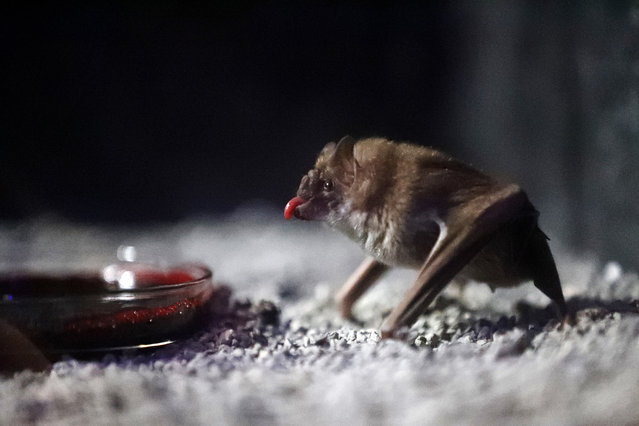
In this Tuesday, March 20, 2018 photo, a Vampire Bat drinks bovine blood in the Criaturas de la Noche (Creatures of the Night) Bat House, the Audubon Zoo's new night house in New Orleans. The various species are all from Central and South America, and the building's interior simulates an abandoned warehouse set up to protect Mayan artifacts during a dig. (Photo by Gerald Herbert/AP Photo)

In this Tuesday, March 20, 2018 photo, a Vampire Bat drinks bovine blood in the Criaturas de la Noche (Creatures of the Night) Bat House, the Audubon Zoo's new night house in New Orleans. The various species are all from Central and South America, and the building's interior simulates an abandoned warehouse set up to protect Mayan artifacts during a dig. (Photo by Gerald Herbert/AP Photo)
Details
25 Mar 2018 00:03:00
Baby Fennec Fox

“The fennec fox is a small nocturnal fox found in the Sahara of North Africa. Its most distinctive feature is unusually large ears. The name “fennec” comes from the Arabic word for fox, and the species name zerda has a Greek origin that refers to its habitat. The fennec is the smallest species of canid in the world; coat, ears and kidney functions have adapted to a high-temperature, low-water, desert environment. In addition, its hearing is sensitive enough to hear prey moving underground”. – Wikipedia

Photo: A Baby Fennec is seen at Sunshine International Aquarium on June 24, 2009 in Tokyo, Japan. The small nocturnal fox babies were born on May 17 2009. (Photo by Junko Kimura/Getty Images)
Details
16 Sep 2011 12:02:00
Pink Champagne Fox Miko

Meet this Miko, a 4-month fox color "pink champagne". Fox this color were first bred on the Canadian farm, one hundred years ago. They are so rare species that currently exist in the world only two such individuals: one lives in Ontario, and the other is Miko. Such foxes bred in captivity and contain only as pets in Canada.
Details
21 Mar 2014 12:49:00
Heterochromia in Animals: Pets With Different Colored Eyes

“In anatomy, heterochromia refers to a difference in coloration, usually of the iris (but also of hair or skin). Although infrequently seen in humans, complete heterochromia is more frequently observed in other species, where it almost always involves one blue eye”. – Wikipedia (Photo by StooMathiesen)
Details
24 Jun 2012 12:47:00