Loading...
Done
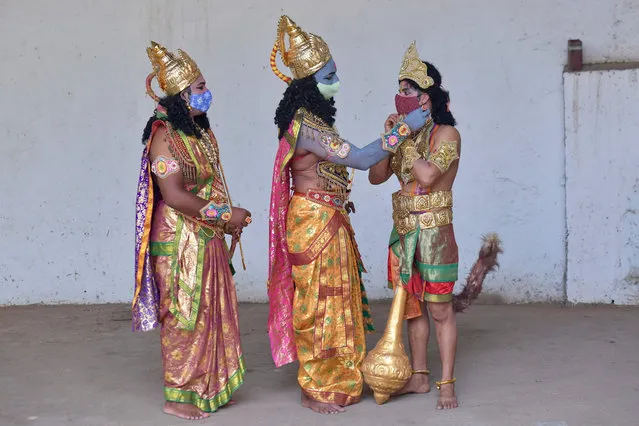
Men dressed as Hindu deities from the epic Ramayan wear face masks before going on a public awareness campaign against the spread of the Covid-19 coronavirus, on the occasion of the Hindu festival “Ram Navami”, in Bangalore on April 21, 2021. (Photo by Manjunath Kiran/AFP Photo)

Men dressed as Hindu deities from the epic Ramayan wear face masks before going on a public awareness campaign against the spread of the Covid-19 coronavirus, on the occasion of the Hindu festival “Ram Navami”, in Bangalore on April 21, 2021. (Photo by Manjunath Kiran/AFP Photo)
Details
27 Apr 2021 09:49:00
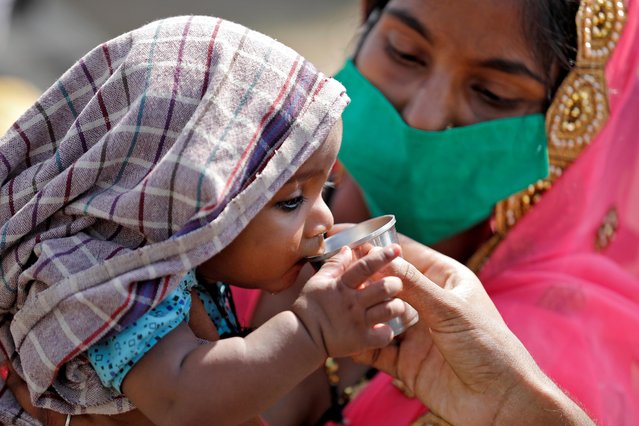
A child of a migrant worker drinks water as his mother holds him while waiting in a queue for transport to reach to a railway station to board a train to their home state of northern Uttar Pradesh, after a limited reopening of India's giant rail network following a nearly seven-week lockdown to slow the spreading of the coronavirus disease (COVID-19), in Ahmedabad, India, May 15, 2020. (Photo by Amit Dave/Reuters)

A child of a migrant worker drinks water as his mother holds him while waiting in a queue for transport to reach to a railway station to board a train to their home state of northern Uttar Pradesh, after a limited reopening of India's giant rail network following a nearly seven-week lockdown to slow the spreading of the coronavirus disease (COVID-19), in Ahmedabad, India, May 15, 2020. (Photo by Amit Dave/Reuters)
Details
23 May 2020 00:01:00
A watchmaker waits for customers during a government-imposed nationwide lockdown as a preventive measure against the COVID-19 coronavirus in Chennai on June 29, 2020. (Photo by Arun Sankar/AFP Photo)

A watchmaker waits for customers during a government-imposed nationwide lockdown as a preventive measure against the COVID-19 coronavirus in Chennai on June 29, 2020. (Photo by Arun Sankar/AFP Photo)
Details
07 Jul 2020 00:01:00
Women labourers work at the construction site of a road in Kolkata January 8, 2015. Across towns and cities in India, it is not uncommon to see women cleaning building sites, carrying bricks and or shoveling gravel - helping construct the infrastructure necessary for the country's economic and social development. (Photo by Rupak De Chowdhuri/Reuters)

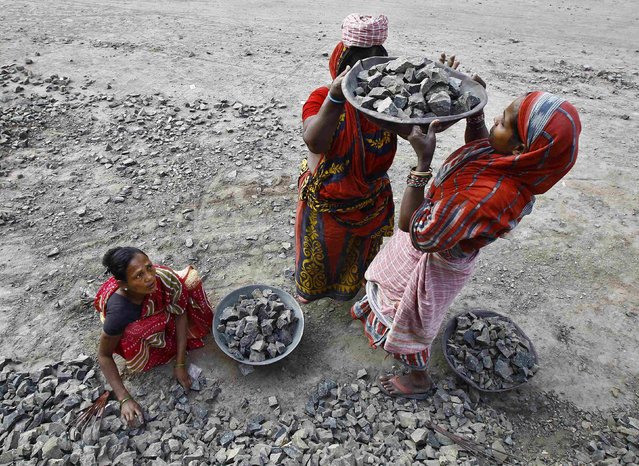
Women labourers work at the construction site of a road in Kolkata January 8, 2015. Across towns and cities in India, it is not uncommon to see women cleaning building sites, carrying bricks and or shoveling gravel – helping construct the infrastructure necessary for the country's economic and social development. They help build roads, railway tracks, airports, and offices. They lay pipes for clean water supplies, cables for telecommunications, and dig the drains for sewage systems. But although women make up at least 20 percent of India's 40 million construction workers, they are less recognized than male workers with lower pay and often prone to safety hazards and sexual harassment. They are often unaware of their rights or scared to complain, say activists now trying to campaign for better treatment of women in the construction industry. (Photo by Rupak De Chowdhuri/Reuters)
Details
15 Jan 2015 13:47:00
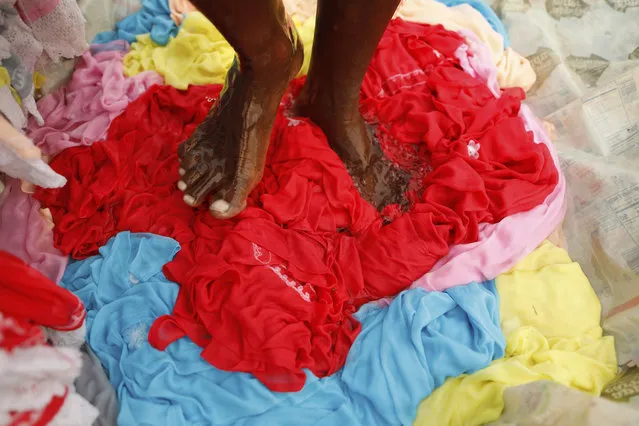
A dhobi, or a washerman washes cloths on the banks of the River Gomti in Lucknow, India, Saturday, September 12, 2020. Dhobis are traditional laundry workers who wash clothes by hand and dry them in the sun, an occupation which has been in existence for generations. Most cities in India have a Dhobi Ghat, or washermen's area, where the city's pile of clothes is laundered. This practice is still popular in India, despite of modern technology. Around 1,000 families work in Lucknow's Dhobi Ghat. However, in light of the novel coronavirus, their wages have decreased drastically. With each family earning around US$100-200 per month. (Photo by Rajesh Kumar Singh/AP Photo)

A dhobi, or a washerman washes cloths on the banks of the River Gomti in Lucknow, India, Saturday, September 12, 2020. Dhobis are traditional laundry workers who wash clothes by hand and dry them in the sun, an occupation which has been in existence for generations. Most cities in India have a Dhobi Ghat, or washermen's area, where the city's pile of clothes is laundered. This practice is still popular in India, despite of modern technology. Around 1,000 families work in Lucknow's Dhobi Ghat. However, in light of the novel coronavirus, their wages have decreased drastically. With each family earning around US$100-200 per month. (Photo by Rajesh Kumar Singh/AP Photo)
Details
25 Sep 2020 00:03:00
People cross waterlogged railway tracks next to a parked passenger train during heavy rains in Mumbai, India, June 9, 2021. (Photo by Hemanshi Kamani/Reuters)

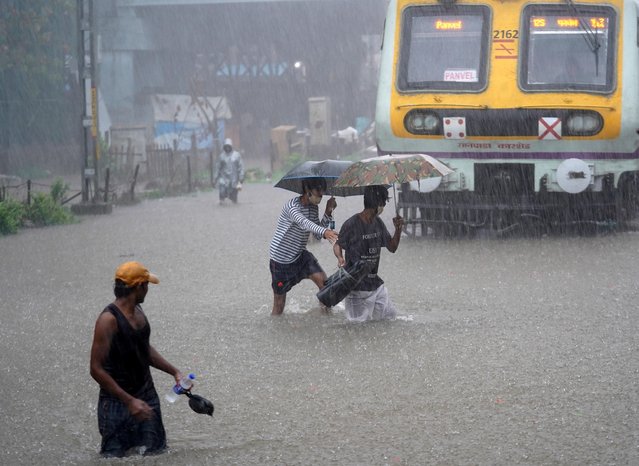
People cross waterlogged railway tracks next to a parked passenger train during heavy rains in Mumbai, India, June 9, 2021. (Photo by Hemanshi Kamani/Reuters)
Details
10 Jun 2021 08:01:00
These heartbreaking photo show a confused family of elephants attempting to navigate a railway line built straight through their habitat on October 16, 2012. Taken by Biplab Hazra in Bishnupur, India, the images show the extreme lengths the inhabitants of the town go to to deter elephants from damaging their crops and property. As the images show, villagers often resort to extreme tactics in an effort to drive the elephants out  with one shocking photograph revealing firebombs being launched at a mother and calf as they cross the road. Elephants encroaching out of their habitats is an increasingly common occurrence with deforestation in much of India. (Photo by Biplab Hazra/Caters News Agency)

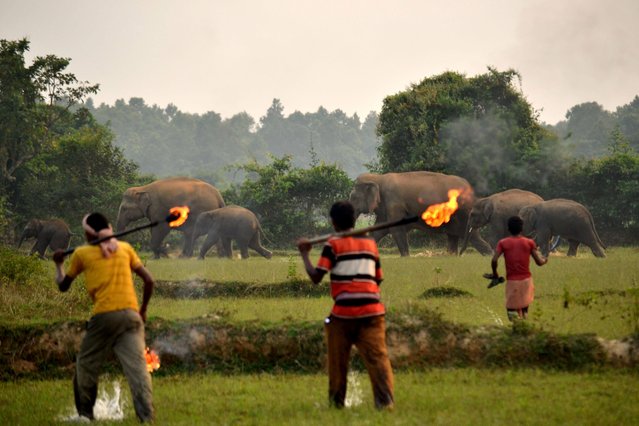
These heartbreaking photo show a confused family of elephants attempting to navigate a railway line built straight through their habitat on October 16, 2012. Taken by Biplab Hazra in Bishnupur, India, the images show the extreme lengths the inhabitants of the town go to to deter elephants from damaging their crops and property. As the images show, villagers often resort to extreme tactics in an effort to drive the elephants out with one shocking photograph revealing firebombs being launched at a mother and calf as they cross the road. Elephants encroaching out of their habitats is an increasingly common occurrence with deforestation in much of India. (Photo by Biplab Hazra/Caters News Agency)
Details
26 Jan 2019 00:05:00
A man carries his daughter, dressed as Kumari, on a scooter, as they arrive to attend rituals to celebrate the Navratri Festival, on a road outside the Adyapeath Temple, on the outskirts of Kolkata, India on March 25, 2018. (Photo by Rupak De Chowdhuri/Reuters)

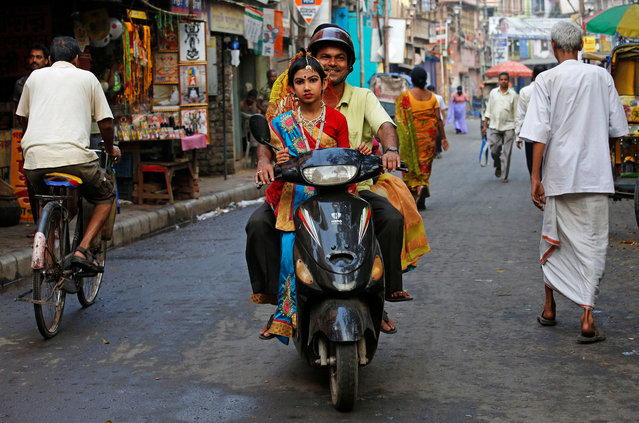
A man carries his daughter, dressed as Kumari, on a scooter, as they arrive to attend rituals to celebrate the Navratri Festival, on a road outside the Adyapeath Temple, on the outskirts of Kolkata, India on March 25, 2018. (Photo by Rupak De Chowdhuri/Reuters)
Details
06 Apr 2018 00:05:00