Loading...
Done
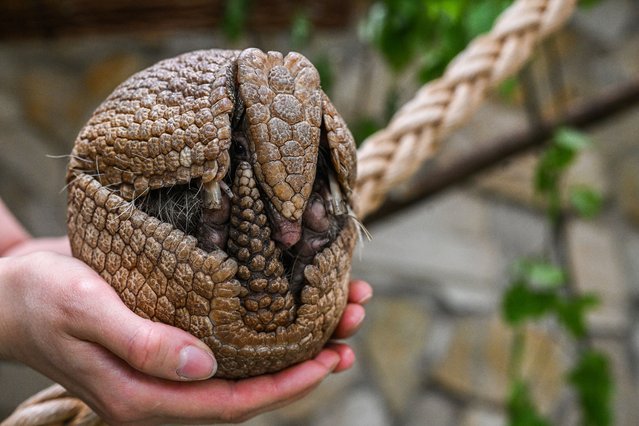
Zookeeper Agata holds a rare newborn Brazilian three-banded armadillo inside its enclosure at the Wroclaw Zoo in Wroclaw, Poland on May 11, 2023. The Tolypeutes matatus, or the southern armor also known as bolita or tatu-bola, is a fairly popular animal in South America but is increasingly rare. The new zoo child was born on March 23. The species is listed as vulnerable by the International Union for the Conservation of Nature (IUCN) and threatened by habitat loss and hunting. (Photo by Omar Marques/Anadolu Agency via Getty Images)

Zookeeper Agata holds a rare newborn Brazilian three-banded armadillo inside its enclosure at the Wroclaw Zoo in Wroclaw, Poland on May 11, 2023. The Tolypeutes matatus, or the southern armor also known as bolita or tatu-bola, is a fairly popular animal in South America but is increasingly rare. The new zoo child was born on March 23. The species is listed as vulnerable by the International Union for the Conservation of Nature (IUCN) and threatened by habitat loss and hunting. (Photo by Omar Marques/Anadolu Agency via Getty Images)
Details
28 May 2023 04:09:00
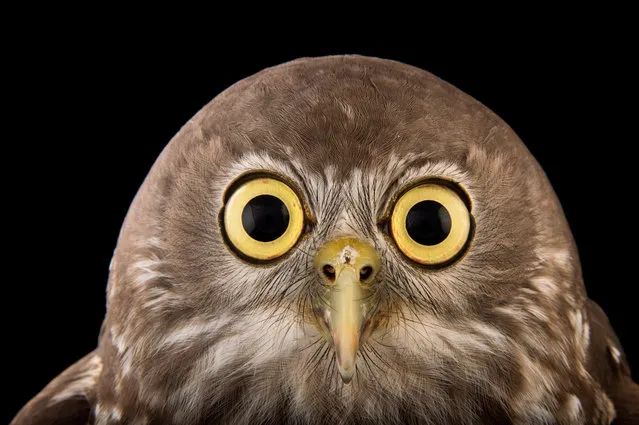
The National Geographic Photo Ark is a travelling exhibition of photographer Joel Sartore’s quest to create a photo archive of biodiversity around the world. So far, Sartore has captured studio portraits of more than 6,000 species – a number that he hopes to double. On 1 July, the ark will open at Melbourne zoo – the first time it has been exhibited in the southern hemisphere. More than 50 portraits will be on display, including many of Australian endangered animals being protected by programs at the zoo itself. These captions have been edited from text supplied by Melbourne zoo. Here: Barking owl. So-named because its call sounds like a barking dog, these birds are native to Australia, Indonesia and Papua New Guinea. In Victoria they are listed as an endangered species, and in 2003 there were estimated to be fewer than 50 breeding pairs. The main threat to the species in Victoria is loss of habitat, especially large trees with hollows in which they can nest and on which many of their prey depend. Apart from a bark, they may utter a chilling scream when they feel threatened. (Photo by Joel Sartore/National Geographic Photo Ark/The Guardian)

The National Geographic Photo Ark is a travelling exhibition of photographer Joel Sartore’s quest to create a photo archive of biodiversity around the world. So far, Sartore has captured studio portraits of more than 6,000 species – a number that he hopes to double. On 1 July, the ark will open at Melbourne zoo – the first time it has been exhibited in the southern hemisphere. More than 50 portraits will be on display, including many of Australian endangered animals being protected by programs at the zoo itself. These captions have been edited from text supplied by Melbourne zoo. Here: Barking owl. (Photo by Joel Sartore/National Geographic Photo Ark/The Guardian)
Details
01 Jul 2017 07:45:00
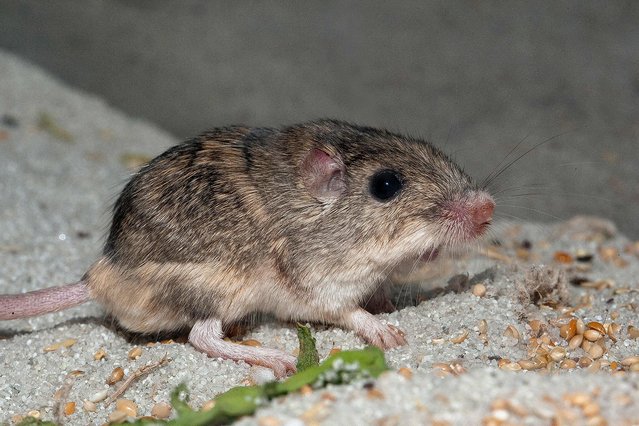
This undated handout image courtesy of the San Diego Zoo Wildlife Alliance shows “Pat”, a Pacific pocket mouse fondly named after actor Sir Patrick Stewart. A mouse named after “Star Trek” actor Patrick Stewart is officially the world's oldest in captivity, a US zoo has announced Pat the Pacific Pocket Mouse – the smallest species of mouse in North America – bagged the title when he hit nine years and 209 days old on February 8, 2023. (Photo by Ken Bohn/San Diego Zoo Wildlife Alliance via AFP Photo)

This undated handout image courtesy of the San Diego Zoo Wildlife Alliance shows “Pat”, a Pacific pocket mouse fondly named after actor Sir Patrick Stewart. A mouse named after “Star Trek” actor Patrick Stewart is officially the world's oldest in captivity, a US zoo has announced Pat the Pacific Pocket Mouse – the smallest species of mouse in North America – bagged the title when he hit nine years and 209 days old on February 8, 2023. (Photo by Ken Bohn/San Diego Zoo Wildlife Alliance via AFP Photo)
Details
11 Jun 2024 02:39:00
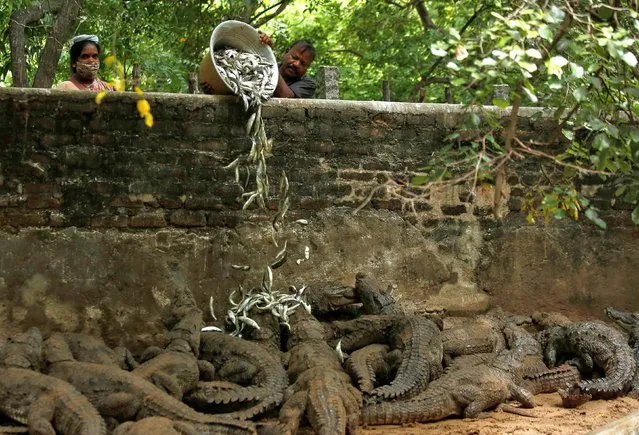
Zoo keepers feed crocodiles in their enclosure at the Madras Crocodile Bank, closed due to the outbreak of coronavirus disease (COVID-19), in Mahabalipuram, India, August 3, 2020. (Photo by P. Ravikumar/Reuters)

Zoo keepers feed crocodiles in their enclosure at the Madras Crocodile Bank, closed due to the outbreak of coronavirus disease (COVID-19), in Mahabalipuram, India, August 3, 2020. (Photo by P. Ravikumar/Reuters)
Details
18 Aug 2020 00:05:00
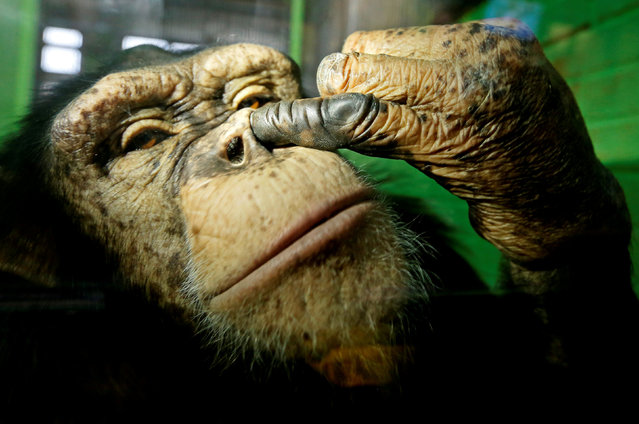
Anfisa, a twelve-year-old female chimpanzee, picks its nose at the Royev Ruchey Zoo in a suburb of the Siberian city of Krasnoyarsk, Russia October 18, 2017. (Photo by Ilya Naymushin/Reuters)

Anfisa, a twelve-year-old female chimpanzee, picks its nose at the Royev Ruchey Zoo in a suburb of the Siberian city of Krasnoyarsk, Russia on October 18, 2017. (Photo by Ilya Naymushin/Reuters)
Details
22 Oct 2017 06:42:00
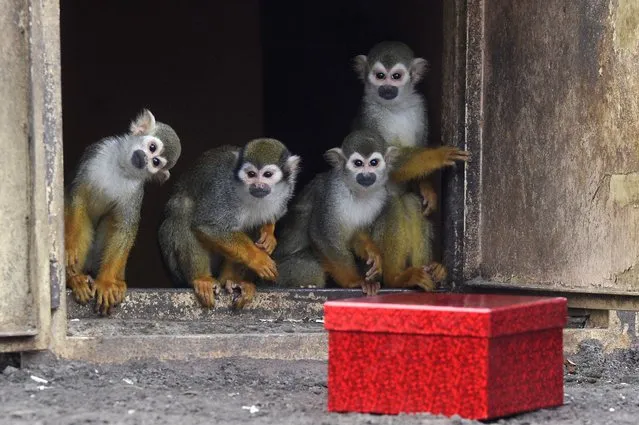
Common squirrel monkeys observe their Christmas present, a box full of mealworms, at the South America enclosure of the Budapest Zoo, in Budapest, Hungary, 24 December 2017. (Photo by Photo by Attila Kovacs/EPA/EFE/Rex Features/Shutterstock)

Common squirrel monkeys observe their Christmas present, a box full of mealworms, at the South America enclosure of the Budapest Zoo, in Budapest, Hungary, 24 December 2017. (Photo by Photo by Attila Kovacs/EPA/EFE/Rex Features/Shutterstock)
Details
31 Dec 2017 06:57:00
Wang Shang-chi, 75, a mobile hats vender, rides his bike on a parking lot next to the Taipei City Zoo on July 9, 2020. (Photo by Sam Yeh/AFP Photo)

Wang Shang-chi, 75, a mobile hats vender, rides his bike on a parking lot next to the Taipei City Zoo on July 9, 2020. (Photo by Sam Yeh/AFP Photo)
Details
11 Jul 2020 00:07:00
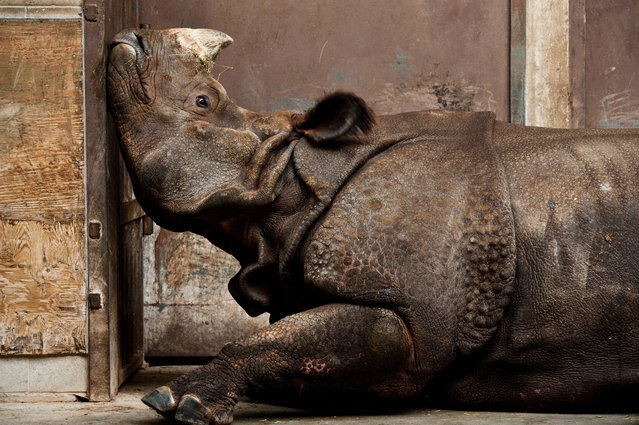
“Honorable Mention”. An Indian rhinoceros, far from home and stuck inside with late-winter blues at the Toronto zoo. Photo location: Toronto, Ontario, Canada. (Photo and caption by Stephen De Lisle/National Geographic Photo Contest)

“Honorable Mention”. An Indian rhinoceros, far from home and stuck inside with late-winter blues at the Toronto zoo. Photo location: Toronto, Ontario, Canada. (Photo and caption by Stephen De Lisle/National Geographic Photo Contest)
Details
20 Dec 2013 10:04:00