Loading...
Done
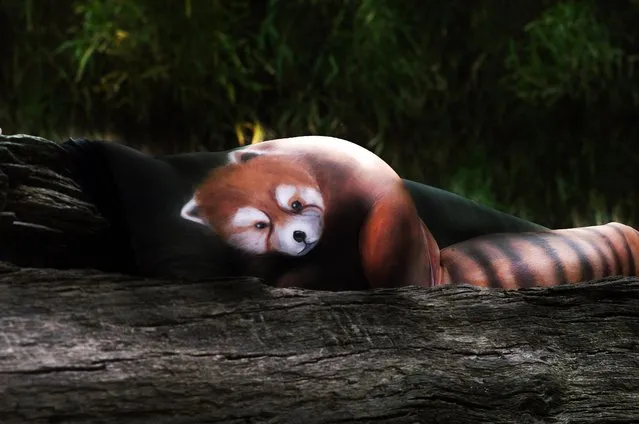
Using body paint and a woodland like location, Gesine appears to have created a model to look just like a red panda, Dortmund, Germany, October, 2016. An artist brings animals to life using body paint and contorted models. At first glance, these images could be mistaken for portraits of wildlife in their natural habitat were created with paper and paint. However, they are actually the incredible works of illusion by talented body painter Gesine Marwedel, who paints models to creates realistic animals. Marwedel, 29, from Dortmund, Germany has always been fascinated by the concept of transferring her designs to human bodies and her latest project features models posing in contorted positions. One image appears to show an elegant swan in a park pond, whilst another picture shows a mother penguin and its chick in a snowy landscape. (Photo by Gesine Marwedel/Barcroft Images)

Using body paint and a woodland like location, Gesine appears to have created a model to look just like a red panda, Dortmund, Germany, October, 2016. An artist brings animals to life using body paint and contorted models. At first glance, these images could be mistaken for portraits of wildlife in their natural habitat were created with paper and paint. However, they are actually the incredible works of illusion by talented body painter Gesine Marwedel, who paints models to creates realistic animals. (Photo by Gesine Marwedel/Barcroft Images)
Details
20 Dec 2016 12:53:00
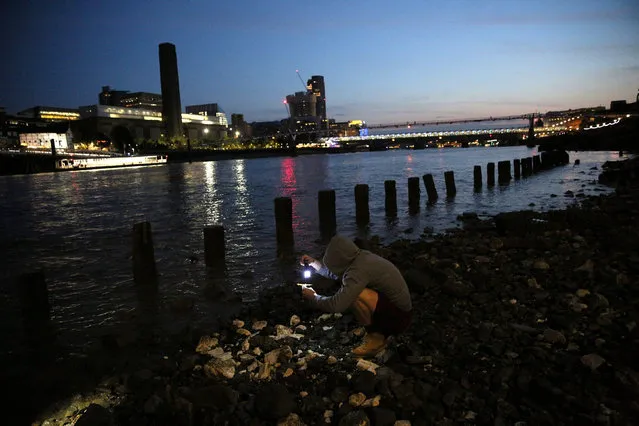
A mudlark uses a torch to look for items on the bank of the River Thames in London, Britain June 06, 2016. Mudlarking is believed to trace its origins to the 18th and 19th century, when scavengers searched the Thames' shores for items to sell. These days, history and archaeology fans are the ones hoping to find old relics such as coins, ceramics, artifacts or everyday items from across centuries. They wait for the low tide and then scour specific areas of exposed shores. "If you're in a field you could be out all day long, with the river you're restricted to about two or three hours," mudlark Nick Stevens said. While many just use the naked eye for their searches, others rely on metal detectors for which a permit from the Port of London Authority is needed. Digging also requires consent. (Photo by Neil Hall/Reuters)

A mudlark uses a torch to look for items on the bank of the River Thames in London, Britain June 06, 2016. Mudlarking is believed to trace its origins to the 18th and 19th century, when scavengers searched the Thames' shores for items to sell. These days, history and archaeology fans are the ones hoping to find old relics such as coins, ceramics, artifacts or everyday items from across centuries. their finds with the Portable Antiquities Scheme. Any item over 300 years old must be recorded. (Photo by Neil Hall/Reuters)
Details
27 Aug 2016 10:43:00
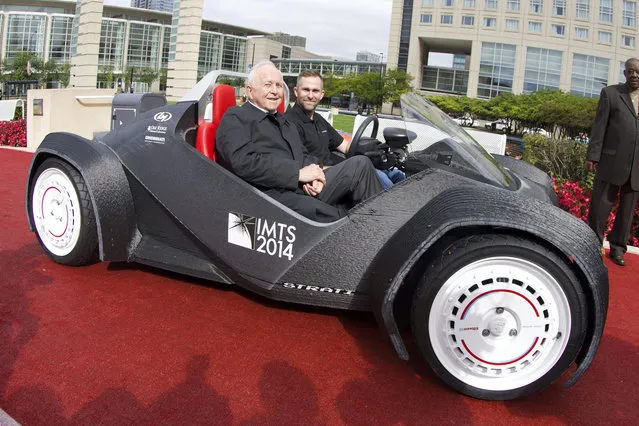
The world's first 3D printed car – the Stratti – was built in just 45 hours at the International Manufacturing Technology Show which took place between September 8 – 13, 2014. The Strati, which is Italian for layers, has a chassis body made of one solid piece and has a top speed of 40mph. (Photo by Barcroft Media/ABACAPress)

The world's first 3D printed car – the Stratti – was built in just 45 hours at the International Manufacturing Technology Show which took place between September 8 – 13, 2014. The Strati, which is Italian for layers, has a chassis body made of one solid piece and has a top speed of 40mph. The tyres, seats, wheels, battery, wiring, suspension, electric motor and window shield of the revolutionary vehicle were made using conventional methods. (Photo by Barcroft Media/ABACAPress)
Details
24 Oct 2014 12:44:00
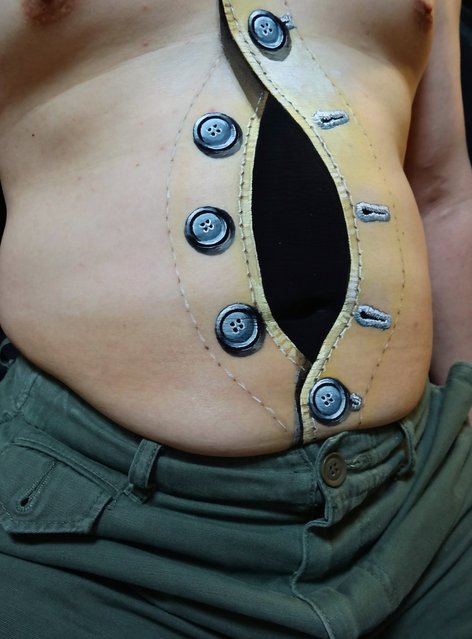
Body Art Illusions by Chooo-San

Using acrylic paint, 19-year old Japanese student and artist Chooo-San has transformed the bodies of herself and a handful of lucky volunteers into ones that appear to be from another planet. Bored with technology, she wanted to see how far she could go with creating eye-catching illusions in the real world, rather than relying on programs like Photoshop.

SEE ALSO: «A frightening-realistic Body Art by Chooo-San»

Details
22 Oct 2012 09:12:00
Fire patterns created by igniting gasoline in midair. (Photo by Rob Prideaux)

A photographer has taken an explosive set of images by igniting gasoline in midair. Rob Prideaux, 45, photographs fire and smoke and then creates patterns from it. The San Francisco-based artist captures the fire in the split second its visible by using highly arcane methods. Rob's Smoke and Fire series is his quest “to shape one of the more uncontrollable phenomena in nature”. (Photo by Rob Prideaux)
Details
10 Sep 2013 11:50:00
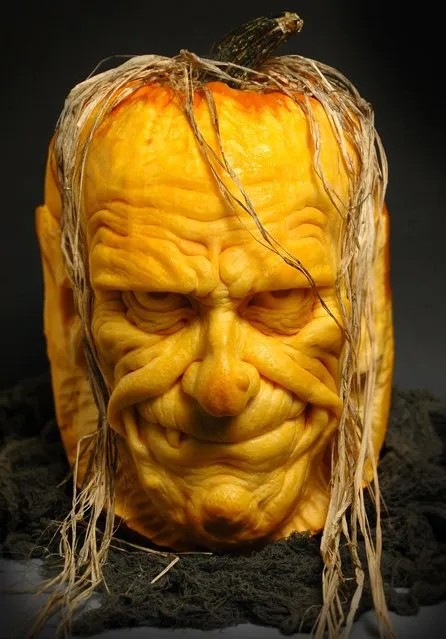
A horror face carved out of a pumpkin by Ray Villafane and team in Bellaire, Michigan. (Photo by Ray Villafane/Barcroft Media)

These Halloween horrors were all carved out of humble pumpkins by Ray Villafane and his team of professional sculptors who meticulously carved the terrifying characters using spoons and scalpels. Each one takes on average two hours to complete – with the horrifying results netting Villafane, plus colleagues Andy Bergholtz and Chris Vierra, numerous TV appearances each Halloween. This year the team has gone global travelling to Germany, Switzerland and Hong Kong to create their masterpieces. Photo: A horror face carved out of a pumpkin by Ray Villafane and team in Bellaire, Michigan. (Photo by Ray Villafane/Barcroft Media)
Details
30 Oct 2013 10:32:00
Slauerhoff Bridge, Netherlands

The Slauerhoffbrug (English: Slauerhoff Bridge) is a fully automatic bascule bridge (aka tail bridge) in the city of Leeuwarden in the Netherlands. It uses two arms to swing a section of road in and out of place within the road itself. It is also known as the “Slauerhoffbrug ‘Flying’ Drawbridge”. A tail bridge can quickly and efficiently be raised and lowered from one pylon (instead of hinges). This quickly allows water traffic to pass while only briefly stalling road traffic. The deck is 15 m by 15 m. It is painted in yellow and blue, representative of Leeuwarden's flag and seal.
Details
06 Nov 2013 10:34:00
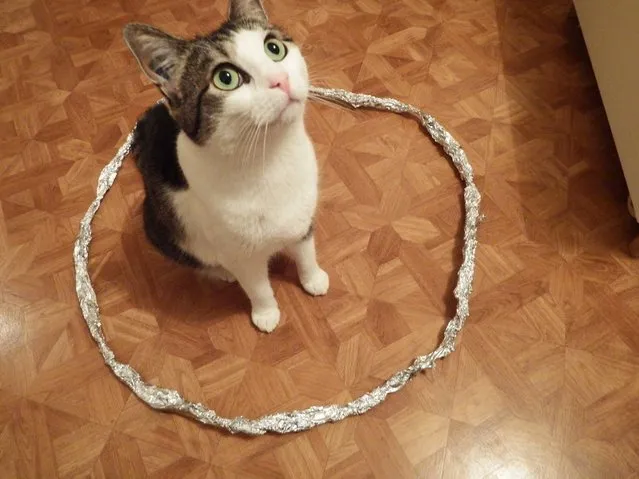
New Internet Sensation - Cat Circles

Residents of Reddit have found a strange phenomenon. If you make a circle on the floor with anything from tinfoil to scotch tape, the house cat would simply love to sit right in the middle of it. Is it a fake, or do cats actually like sitting in circles on the floor? We cannot answer this question until we test it out ourselves. However, one thing is for sure – cats are curious and adorable creatures that never cease to amaze us. So, if you own a cat, try this experiment yourself, and see if your cat likes to sit in an imaginary circle on the floor.
Details
14 Nov 2014 14:10:00