Loading...
Done
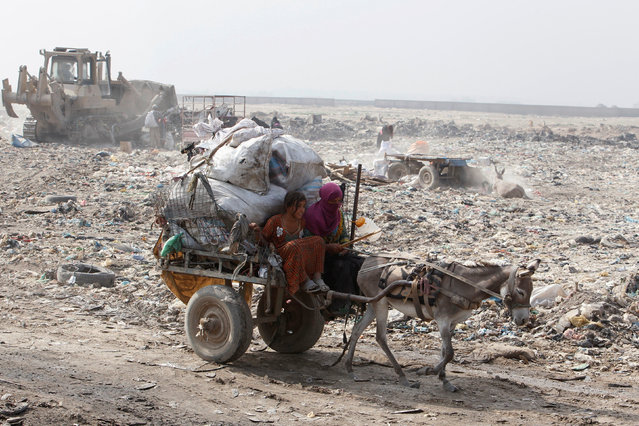
Garbage pickers collect ride on donkey cart while looking for recyclable materials at a rubbish dump in the outskirts of Baghdad, Iraq, August 23, 2016. Despite its huge untapped oil and gas reserves and steadily rising oil output and revenue, 23 percent of the population live below the poverty line, according to the Ministry of Planning. Eg, for 12-year-old Mohammed, life in Sadr City means long days during his school holidays scrabbling through the refuse in the scorching summer heat before selling his daily haul to a middleman. He sells each kilogram (2.2 lb) of plastic bottles or soda cans for 250 Iraqi dinars (around 20 U.S. cents), earning between 2,000 to 4,000 dinars ($1.50–$3) a day. A International Labor Organization report listing dangerous jobs in which children are engaged across the world mentioned collecting garbage as one of the activities in which minors risked suffering violence and injury. (Photo by Khalid al Mousily/Reuters)

Garbage pickers collect ride on donkey cart while looking for recyclable materials at a rubbish dump in the outskirts of Baghdad, Iraq, August 23, 2016. Despite its huge untapped oil and gas reserves and steadily rising oil output and revenue, 23 percent of the population live below the poverty line, according to the Ministry of Planning. (Photo by Khalid al Mousily/Reuters)
Details
24 Aug 2016 11:52:00
“A snapshot from mountaineer's life”. Have you ever wondered how does a mountaineer's day start? (Photo and caption by Kamil Tamiola/National Geographic Traveler Photo Contest)

“A snapshot from mountaineer's life”. Have you ever wondered how does a mountaineer's day start? I will give you a hint: you wake up at 3 am, set the stove, wake up your partner, pretend it is warm, quickly consume a high-calorie breakfast, watch your friends slowly ascending the icy slopes of your dream summit with their tiny head torches glimmering against perfectly blue ice, and hope for the good weather. One would ask: why all this trouble? The answer is easy: for the love of the adventure and the unknown. Location: Chamonix, Haute Savoye, France. (Photo and caption by Kamil Tamiola/National Geographic Traveler Photo Contest)

ATTENTION! All pictures are presented in high resolution. To see Hi-Res images – just TWICE click on any picture. In other words, click small picture – opens the BIG picture. Click BIG picture – opens VERY BIG picture.
Details
27 Jun 2013 12:47:00


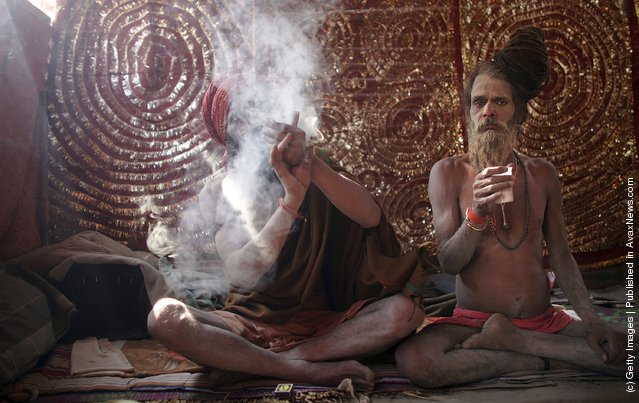
“Kumbh Mela is a mass Hindu pilgrimage in which Hindus gather at the Ganges river. The normal Kumbh Mela is celebrated every 3 years, the Ardh (half) Kumbh Mela is celebrated every six years at Haridwar and Prayag, the Purna (complete) Kumbh takes place every twelve years, at four places (Prayag (Allahabad), Haridwar, Ujjain, and Nashik). The Maha (great) Kumbh Mela which comes after 12 “Purna Kumbh Melas”, or 144 years, is held at Allahabad.

The last Ardh Kumbh Mela was held over a period of 45 days beginning in January 2007, more than 70 million Hindu pilgrims took part in the Ardh Kumbh Mela at Prayag, and on January 15, the most auspicious day of the festival of Makar Sankranti, more than 5 million participated. The previous Maha Kumbh Mela, held in 2001, was attended by around 60 million people, making it at the time the largest gathering anywhere in the world in recorded history”. – Wikipedia

Photo: Sadhus (holy men) smoke at their camp near the ritual site at Sangam, the confluence of the Ganges, Yamuna and mythical Saraswati rivers during the Ardh Kumbh Mela festival (Half Pitcher festival) January 18, 2007 in Allahabad, India. Millions of Hindu pilgrims have flocked to the largest religious gathering in the world which lasts for 45 days in northern India. The festival commemorates the mythical conflict between gods and demons over a pitcher filled with the “nectar of immortality”. Devotees believe that taking a holy dip in the Ganges at this time washes away their sins and paves the path to salvation. (Photo by Mario Tama/Getty Images)

Details
30 Jun 2011 10:27:00
Cheng Liping, whose husband Ju was onboard Malaysia Airlines Flight MH370 which disappeared on March 8, 2014, shows a picture of she and her husband together and an old card with a message given by her husband, at a park near her house where she and her husband used to visit during an interview with Reuters in Beijing July 24, 2014. (Photo by Kim Kyung-Hoon/Reuters)

Cheng Liping, whose husband Ju was onboard Malaysia Airlines Flight MH370 which disappeared on March 8, 2014, shows a picture of she and her husband together and an old card with a message given by her husband, at a park near her house where she and her husband used to visit during an interview with Reuters in Beijing July 24, 2014. Cheng said her life has been totally changed since the incident. Their two little sons, who don't know about this incident, keep asking her when their dad is coming back. Six months after Malaysia Airlines Flight MH370, with 239 mostly Chinese people on board, disappeared about an hour into a routine journey from Kuala Lumpur to Beijing March 8, loved ones of missing passengers derive what comfort they can from what's left behind after the world's greatest aviation mystery. More than two dozen countries have been involved in the air, sea and underwater search for the Boeing 777 but months of sorties failed to turn up any trace – even after narrowing the search area to the southern Indian Ocean – long after batteries on the black box voice and data recorders had gone flat. (Photo by Kim Kyung-Hoon/Reuters)
Details
05 Sep 2014 11:27:00


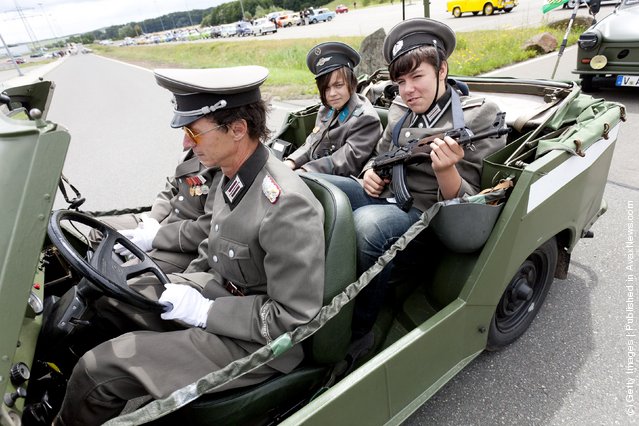
“The Trabant is a car that was produced by former East German auto maker VEB Sachsenring Automobilwerke Zwickau in Zwickau, Sachsen. It was the most common vehicle in East Germany, and was also exported to countries both inside and outside the communist bloc. The main selling points was that it had room for four adults and luggage in a compact, light and durable shell and that it was fast (when introduced) and durable. With its mediocre performance, smoky two-stroke engine, and production shortages, the Trabant is often cited as an example of the disadvantages of centralized planning; on the other hand, it is regarded with derisive affection as a symbol of the failed former East Germany and of the fall of communism (in former West Germany, as many East Germans streamed into West Berlin and West Germany in their Trabants after the opening of the Berlin Wall in 1989). It was in production without any significant changes for nearly 30 years with 3,096,099 Trabants produced in total”. – Wikipedia

Photo: Enthusiasts weared in uniforms of the former eastern german army trive in a military Trabant car as fans and owners of East German-era Trabant cars gather at the 2011 International Trabantfahrer Treffen (International Trabant Drivers Meeting) on June 26, 2011 in Zwickau, Germany. The Trabant, also known as the Trabi, was among the main cars produced in communist East Germany and built by VEB Sachsenring Automobilwerke in Zwickau for 30 years until 1989. Today the car has cult status for many followers and one company, IndiKar, is even seeking to revive the brand in a modern, electric version. (Photo by Carsten Koall/Getty Images)
Details
27 Jun 2011 12:21:00
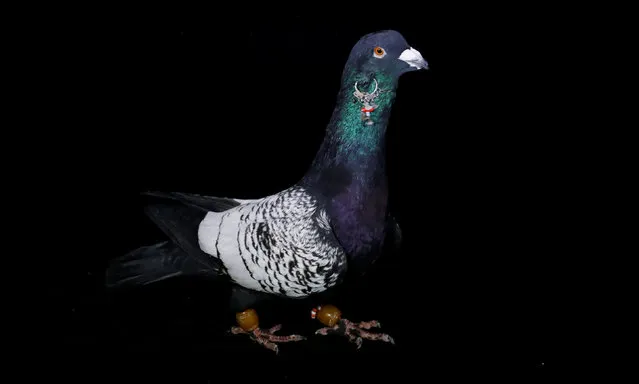
A pigeon, known as Siyah Kinifirli, with an approximate market value of 1000 Turkish Lira ($263), bred by 23-year-old Ismail Ozbek, is pictured in Sanliurfa, Turkey, December 23, 2016. As night-time approaches in Sanliurfa, southeastern Turkey, most of the alleyways of the city's old bazaar are emptying out of buyers and vendors, except for one. The bustle of daytime trading has died down, but on this little street, a stream of men carry cardboard boxes filled with pigeons to a cluster of three teahouses. Here, they sell the birds at Sanliurfa's famed auctions to a dedicated band of pigeon keepers and breeders, a pastime that has been thriving for hundreds of years across the region and over the nearby border into war-torn Syria. In a country where the minimum wage is about 1,400 Liras ($367) a month, enthusiasts regularly easily spend hundreds of dollars for one bird. “I once sold a pair of pigeons for 35,000 Turkish Lira”, says auctioneer Imam Dildas. “This is a passion, a hobby you cannot quit. I've been known to sell the fridge and my wife's gold bracelets to pay for pigeons”. (Photo by Umit Bektas/Reuters)

A pigeon, known as Siyah Kinifirli, with an approximate market value of 1000 Turkish Lira ($263), bred by 23-year-old Ismail Ozbek, is pictured in Sanliurfa, Turkey, December 23, 2016. As night-time approaches in Sanliurfa, southeastern Turkey, most of the alleyways of the city's old bazaar are emptying out of buyers and vendors, except for one. (Photo by Umit Bektas/Reuters)
Details
17 Jan 2017 12:05:00
Devotees of the small farming village of Bibiclat celebrate the Feast of Saint John the Baptist while covered in banana leaves and mud on June 24, 2025 in Aliaga, Philippines. Known as the “Taong Putik” (mud people), the ritual happens yearly in this small farming village as their own version of expressing their faith and celebrating the feast of Saint John the Baptist whom the survivors of the Japanese occupation in 1944 in their area prayed to for rain to save their fellow villagers. A marker near the church entrance of the village tells a story of a heavy torrential rain that happened that day that forced the Japanese military to call off the execution of 14 villagers. The Philippines is the only predominantly Catholic country in Southeast Asia after more than 300 years of Spanish rule. (Photo by Ezra Acayan/Getty Images)

Devotees of the small farming village of Bibiclat celebrate the Feast of Saint John the Baptist while covered in banana leaves and mud on June 24, 2025 in Aliaga, Philippines. Known as the “Taong Putik” (mud people), the ritual happens yearly in this small farming village as their own version of expressing their faith and celebrating the feast of Saint John the Baptist whom the survivors of the Japanese occupation in 1944 in their area prayed to for rain to save their fellow villagers. (Photo by Ezra Acayan/Getty Images)
Details
29 Aug 2025 03:18:00
A visitor is reflected in a light installation at Mulberry Lights on Regent Street in London, UK on November 16, 2018. Visitors have fun taking selfies and posing with the colourful light installations. Mulberry Lights is a series of illuminating interactive experiences that celebrate how light, colour, shapes and people come together to create a modern British Christmas. It runs at 100 Regent Street until November 18, The London pop-up is the start of a nationwide campaign with further installations to follow. (Photo by Imageplotter/Rex Features/Shutterstock)

A visitor is reflected in a light installation at Mulberry Lights on Regent Street in London, UK on November 16, 2018. Visitors have fun taking selfies and posing with the colourful light installations. Mulberry Lights is a series of illuminating interactive experiences that celebrate how light, colour, shapes and people come together to create a modern British Christmas. (Photo by Imageplotter/Rex Features/Shutterstock)
Details
18 Nov 2018 00:07:00