Loading...
Done
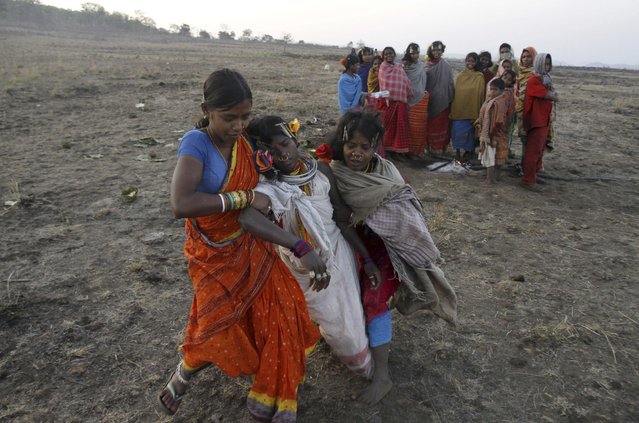
A member of India’s Dongria tribe faints in trance during the two-day long Niyamraja Festival atop the Niyamgiri hills near Lanjigarh in Kalahandi district, Orissa state, India, Sunday, February 22, 2015. Every year, members of this indigenous group celebrate this festival sacrificing animals and birds in worship of their deity. (Photo by Biswaranjan Rout/AP Photo)

A member of India’s Dongria tribe faints in trance during the two-day long Niyamraja Festival atop the Niyamgiri hills near Lanjigarh in Kalahandi district, Orissa state, India, Sunday, February 22, 2015. Every year, members of this indigenous group celebrate this festival sacrificing animals and birds in worship of their deity. (Photo by Biswaranjan Rout/AP Photo)
Details
23 Feb 2015 12:33:00
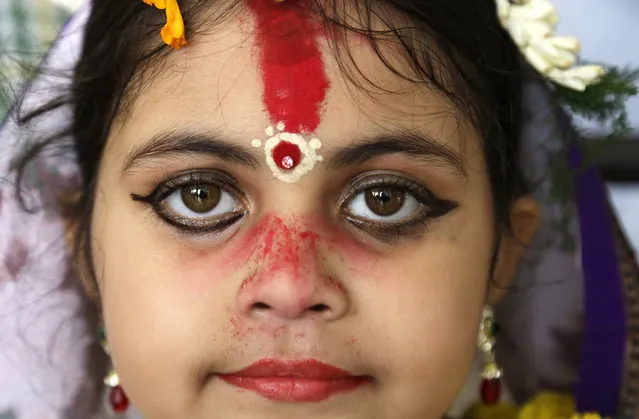
A young Hindu girl sits for a ceremony where she and other girls are worshipped as “Kumari”, or living goddess, during Ram Navami festival, at a temple in Kolkata, India, Saturday, March 28, 2015. (Photo by Bikas Das/AP Photo)

A young Hindu girl sits for a ceremony where she and other girls are worshipped as “Kumari”, or living goddess, during Ram Navami festival, at a temple in Kolkata, India, Saturday, March 28, 2015. Ram Navami marks the birth of Hindu God Rama. (Photo by Bikas Das/AP Photo)
Details
29 Mar 2015 12:23:00
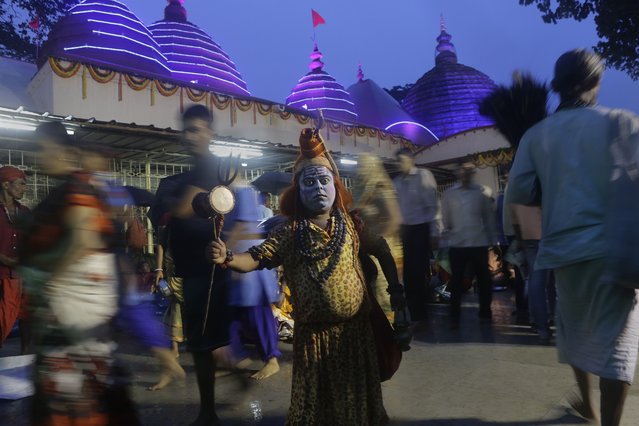
An Indian man stands dressed like Hindu god Shiva to attract alms from devotees during the Ambubasi festival at the Kamakhya Hindu temple in Gauhati, India, Sunday, June 22, 2014. The annual festival where hundreds of holy men from an esoteric form of Hinduism, gather to perform rituals at the temple begins on June 22. (Photo by Anupam Nath/AP Photo)

An Indian man stands dressed like Hindu god Shiva to attract alms from devotees during the Ambubasi festival at the Kamakhya Hindu temple in Gauhati, India, Sunday, June 22, 2014. The annual festival where hundreds of holy men from an esoteric form of Hinduism, gather to perform rituals at the temple begins on June 22. (Photo by Anupam Nath/AP Photo)
Details
23 Jun 2014 11:43:00
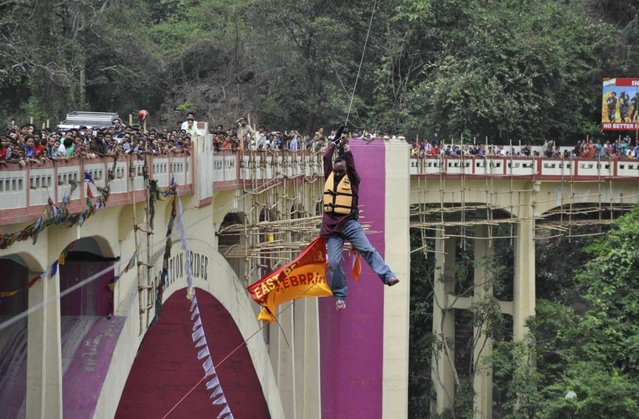
In this Sunday, April 28, 2013 photograph, people watch as Indian Sailendra Nath Roy attempts to cross Teesta river suspended from a zip wire attached to his ponytail moments before his death in Siliguri, West Bengal state, India. Roy who was named a Guinness World Record holder in 2011 for travelling the farthest distance on a zip wire using hair died during the stunt Sunday when he suffered a heart attack. (Photo by AP Photo)

In this Sunday, April 28, 2013 photograph, people watch as Indian Sailendra Nath Roy attempts to cross Teesta river suspended from a zip wire attached to his ponytail moments before his death in Siliguri, West Bengal state, India. Roy who was named a Guinness World Record holder in 2011 for travelling the farthest distance on a zip wire using hair died during the stunt Sunday when he suffered a heart attack. (Photo by AP Photo)
Details
30 Apr 2013 08:21:00
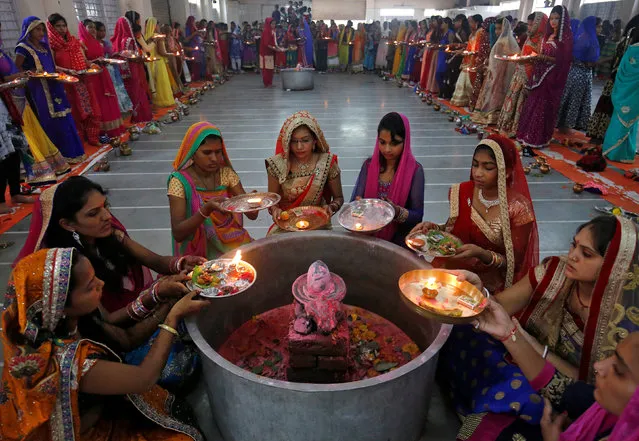
Hindu women perform a ritual known as Aarti around a Shivling (a symbol of Lord Shiva) on the last day of Jaya Parvati Vrat festival in Ahmedabad, India, July 10, 2017. (Photo by Amit Dave/Reuters)

Hindu women perform a ritual known as Aarti around a Shivling (a symbol of Lord Shiva) on the last day of Jaya Parvati Vrat festival in Ahmedabad, India, July 10, 2017. (Photo by Amit Dave/Reuters)
Details
11 Jul 2017 06:09:00
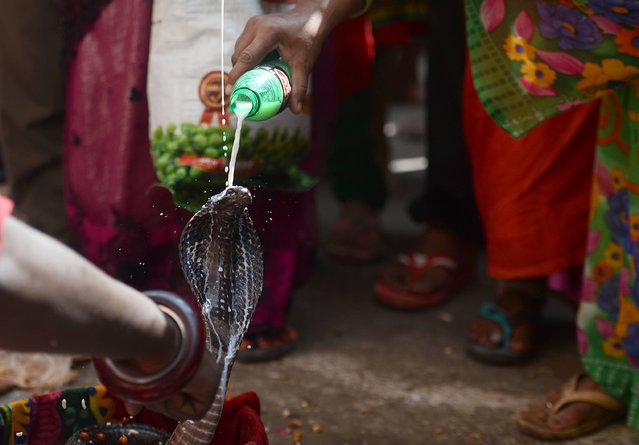
An Indian Hindu devotee pours milk on a snake as an offering during the annual Nag Panchami festival, dedicated to the worship of snakes outside the Nagvasuki temple, in Allahabad, on July 28, 2017. (Photo by Sanjay Kanojia/AFP Photo)

An Indian Hindu devotee pours milk on a snake as an offering during the annual Nag Panchami festival, dedicated to the worship of snakes outside the Nagvasuki temple, in Allahabad, on July 28, 2017. Officially the snake charmers' profession is banned in India, but many in the country offered prayers and milk blessings to cobras and other deadly serpents on July 28 in an annual tribute. The 800,000 charmers and their young apprentices come to the fore for the Nag Panchami festival which dates back several centuries. (Photo by Sanjay Kanojia/AFP Photo)
Details
31 Jul 2017 09:17:00
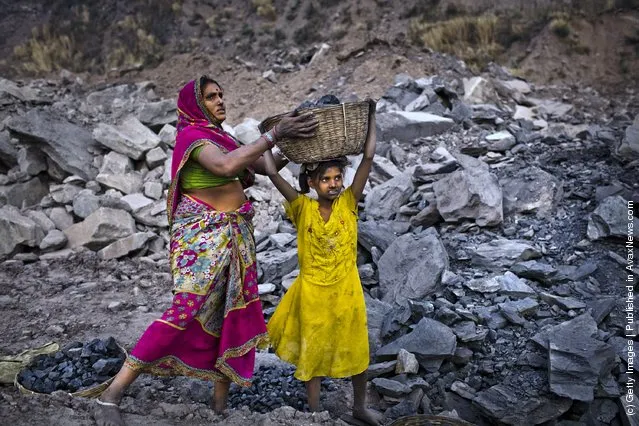
Coal Mining In India's Jharia

7 year old Soni has a basket of coal lifted onto her head by her mother, 28 year old Savita, after having scavenged coal illegally from an open-cast coal mine in the village of Bokapahari on February 08, 2012 near to Jharia, India. (Photo by Daniel Berehulak /Getty Images)
Details
15 Feb 2012 11:06:00
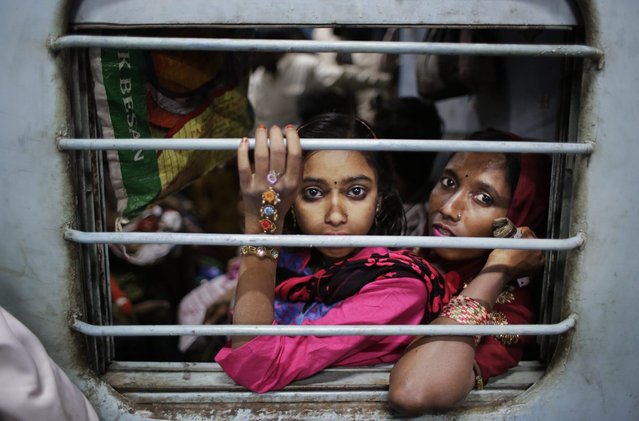
In this November 18, 2014 photo, Murshida, 12, sits on the lap of her mother Marjina as the train leaves for their village in West Bengal, at a railway station in New Delhi, India. Six months ago, Marjina stepped off a train in New Delhi with her two children, hoping to find a better life after her husband abandoned them without so much as a goodbye. (Photo by Altaf Qadri/AP Photo)

In this November 18, 2014 photo, Murshida, 12, sits on the lap of her mother Marjina as the train leaves for their village in West Bengal, at a railway station in New Delhi, India. Six months ago, Marjina stepped off a train in New Delhi with her two children, hoping to find a better life after her husband abandoned them without so much as a goodbye. The family spent their days at a landfill picking through other people’s garbage to find salvageable bits to resell or recycle. After six months of poverty, illness and shame, they returned to that train station in New Delhi, headed back to an uncertain future to their hometown in West Bengal. (Photo by Altaf Qadri/AP Photo)
Details
09 Dec 2014 09:47:00