Loading...
Done


Indonesian activists covered with sludge from the mud volcano hold a protest during five year anniversary of the Sidoarjo mud eruption on May 29, 2011 in the subdistrict of Porong in Sidoarjo, East Java, Indonesia. (Photo by Ulet Ifansasti/Getty Images)
Details
30 May 2011 07:18:00
Peacock Mantis Shrimp

Odontodactylus scyllarus, known as the peacock mantis shrimp, harlequin mantis shrimp or painted mantis shrimp, is a large mantis shrimp native to the Indo-Pacific from Guam to East Africa.

Details
22 Jan 2013 12:29:00
Beautiful Nicobar Pigeon

The Nicobar pigeon (Caloenas nicobarica) is a pigeon found on small islands and in coastal regions from the Nicobar Islands, east through the Malay Archipelago, to the Solomons and Palau. It is the only living member of the genus Caloenas and the closest living relative of the extinct dodo.
Details
06 Sep 2014 17:09:00
This handout photo taken and released on August 1, 2025 by Indonesia's Geological Agency shows Mount Lewotobi Laki-Laki spewing lava and volcanic ash up to approximately 10 kilometres high during its eruption as observed from the monitoring post in East Flores, in East Nusa Tenggara province. A volcano in eastern Indonesia erupted on August 1, belching an ash tower 10 kilometres (6.2 miles) into the sky, the country's volcanology agency said, weeks after another huge eruption triggered dozens of flight cancellations to and from Bali. (Photo by Indonesia's Geological Agency/AFP Photo)

This handout photo taken and released on August 1, 2025 by Indonesia's Geological Agency shows Mount Lewotobi Laki-Laki spewing lava and volcanic ash up to approximately 10 kilometres high during its eruption as observed from the monitoring post in East Flores, in East Nusa Tenggara province. A volcano in eastern Indonesia erupted on August 1, belching an ash tower 10 kilometres (6.2 miles) into the sky, the country's volcanology agency said, weeks after another huge eruption triggered dozens of flight cancellations to and from Bali. (Photo by Indonesia's Geological Agency/AFP Photo)

Details
24 Nov 2025 04:52:00
Mikhail Kalashnikov, the father of the world's most popular assault rifle, is handed  an AK-74 November 23, 2002 in Izhevsk,1000 East km. from Moscow. November 23 marked the 55th anniversary of the release of the first Kalashnikov gun. According to the Moscow-based Center for Analysis of Strategic and Technologies some 70 million to 100 million Kalashnikovs have been built worldwide since 1947, compared about 7 million to Kalashnikov's Western rival the M-16 assault rifles. (Photo by Oleg Nikishin/Getty Images)

Mikhail Kalashnikov, the father of the world's most popular assault rifle, is handed an AK-74 November 23, 2002 in Izhevsk,1000 East km. from Moscow. November 23 marked the 55th anniversary of the release of the first Kalashnikov gun. According to the Moscow-based Center for Analysis of Strategic and Technologies some 70 million to 100 million Kalashnikovs have been built worldwide since 1947, compared about 7 million to Kalashnikov's Western rival the M-16 assault rifles. (Photo by Oleg Nikishin/Getty Images)
Details
24 Dec 2013 09:12:00
Tardigrades (commonly known as waterbears or moss piglets). (Photo by SPL/East News)

“Tardigrades (commonly known as waterbears or moss piglets) are small, water-dwelling, segmented animals with eight legs. Tardigrades were first discovered in 1773 by Johann August Ephraim Goeze, who called them kleiner Wasserbär, meaning “little water bear” in German. The name Tardigrada means “slow walker” and was given by Lazzaro Spallanzani in 1777. The name water bear comes from the way they walk, reminiscent of a bear's gait. The biggest adults may reach a body length of 1.5 millimetres (0.059 in), the smallest below 0.1 mm. Freshly hatched tardigrades may be smaller than 0.05 mm”. – Wikipedia. Photo: Tardigrades. (Photo by SPL/East News)

Details
26 Sep 2012 09:55:00
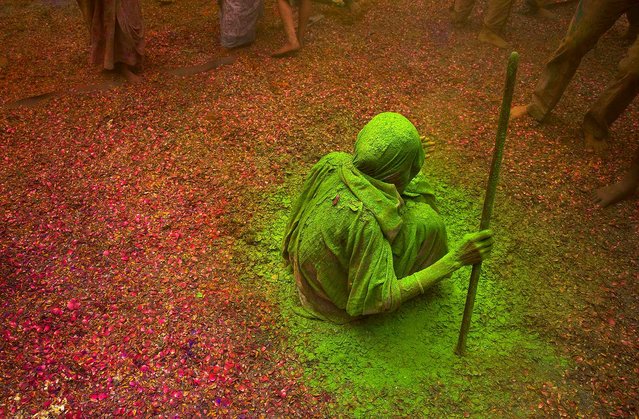
An Indian Hindu widow smeared with colors sits and watches others playing during Holi celebrations at the Gopinath temple, 180 kilometres (112 miles) south-east of New Delhi, India Monday, March 21, 2016. (Photo by Manish Swarup/AP Photo)

An Indian Hindu widow smeared with colors sits and watches others playing during Holi celebrations at the Gopinath temple, 180 kilometres (112 miles) south-east of New Delhi, India Monday, March 21, 2016. A few years ago this joyful celebration was forbidden for Hindu widows. Like hundreds of thousands of observant Hindu women they would have been expected to live out their days in quiet worship, dressed only in white, their very presence being considered inauspicious for all religious festivities. (Photo by Manish Swarup/AP Photo)
Details
22 Mar 2016 11:24:00
A herdsman stands on the back of a grey bull during a ceremony of driving sheep from their winter habitat to their summer pasture in the puszta or Hungarian steppe of Hortobagy, 183 kms east of Budapest, Hungary, 23 April 2016. Sheep are traditionally driven to their summer pasture at around St. George's Day in the Hortobagy region, because livestock breeding people traditionally consider St. George's Day the beginning of spring. (Photo by Zsolt Czegledi/EPA)

A herdsman stands on the back of a grey bull during a ceremony of driving sheep from their winter habitat to their summer pasture in the puszta or Hungarian steppe of Hortobagy, 183 kms east of Budapest, Hungary, 23 April 2016. Sheep are traditionally driven to their summer pasture at around St. George's Day in the Hortobagy region, because livestock breeding people traditionally consider St. George's Day the beginning of spring. (Photo by Zsolt Czegledi/EPA)
Details
24 Apr 2016 09:27:00