Loading...
Done
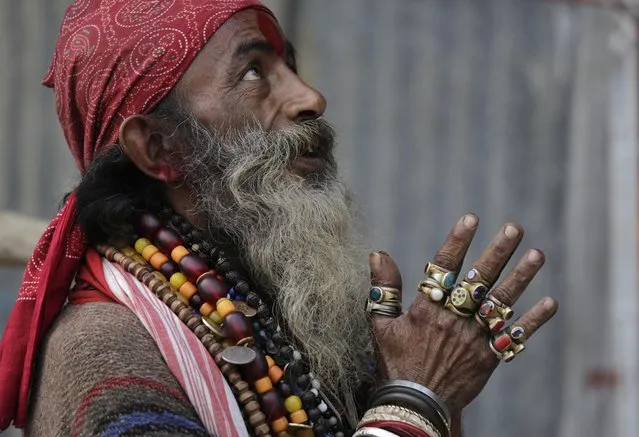
A Hindu holy man on his way to the annual holy dip at Gangasagar, gestures towards a visitor as he rests at a transit camp in Kolkata, India, Wednesday, January 6, 2016. (Photo by Bikas Das/AP Photo)

A Hindu holy man on his way to the annual holy dip at Gangasagar, gestures towards a visitor as he rests at a transit camp in Kolkata, India, Wednesday, January 6, 2016. Thousands of Hindu pilgrims are expected to take the annual holy dip at Gangasagar, where the Ganges River reaches the Bay of Bengal, on the auspicious Makar Sankranti festival day that falls on Jan.14. (Photo by Bikas Das/AP Photo)
Details
10 Jan 2016 08:06:00
Robert The Bruce's army from The Clanranald Trust during a rehearsal for the Battle of Bannockburn re-enactment performance which will be staged at the Bannockburn Live Event in Bannockburn, the 700th anniversary of the battle, on June 27, 2014. (Photo by Andrew Milligan/PA Wire)

Robert The Bruce's army from The Clanranald Trust during a rehearsal for the Battle of Bannockburn re-enactment performance which will be staged at the Bannockburn Live Event in Bannockburn, the 700th anniversary of the battle, on June 27, 2014. (Photo by Andrew Milligan/PA Wire)
Details
28 Jun 2014 13:36:00
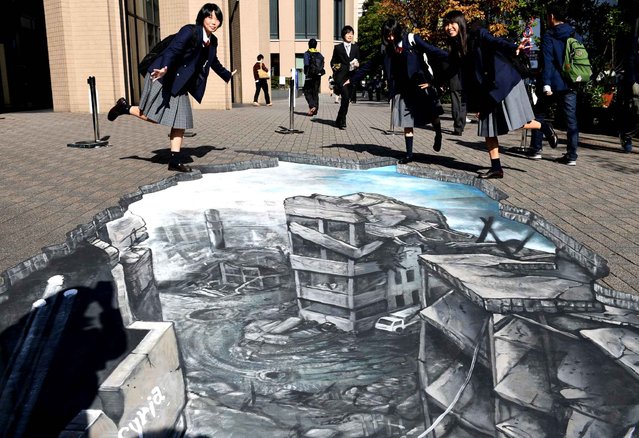
Students pose for a picture with a 3- D optical illusion artwork of a devastated cityscape in Aleppo, Syria at the campus of the Meiji University in Tokyo on November 18, 2016. The Japanese branch of the human rights organisation Amnesty International displayed the artwork to encourage people to think about the Syrian civil war. (Photo by Toshifumi Kitamura/AFP Photo)

Students pose for a picture with a 3- D optical illusion artwork of a devastated cityscape in Aleppo, Syria at the campus of the Meiji University in Tokyo on November 18, 2016. The Japanese branch of the human rights organisation Amnesty International displayed the artwork to encourage people to think about the Syrian civil war. (Photo by Toshifumi Kitamura/AFP Photo)
Details
19 Nov 2016 11:36:00
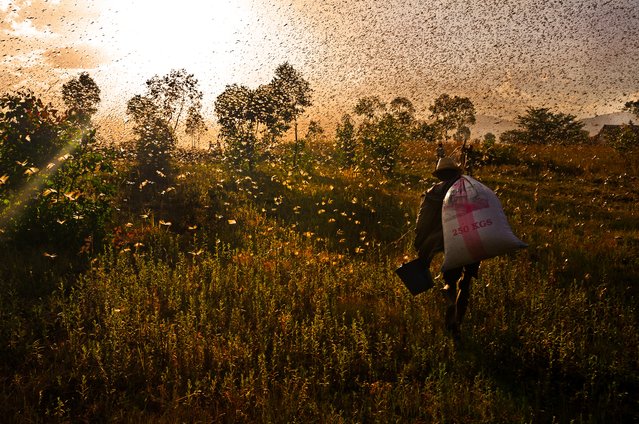
“Locusts & Men”. Oppression, interaction, collaboration. In the life cycle of nature nothing is lost, but the coexistence of different species is sometimes difficult. In Madagascar periodically returns the archaic antagonism between man and the migratory locust, in a circle of life where the two species are looking for space and food for their survival. Photo location: Madagascar, 2013. (Photo and caption by Michele Martinelli/National Geographic Photo Contest)

“Locusts & Men”. Oppression, interaction, collaboration. In the life cycle of nature nothing is lost, but the coexistence of different species is sometimes difficult. In Madagascar periodically returns the archaic antagonism between man and the migratory locust, in a circle of life where the two species are looking for space and food for their survival. At the end of the day a man walks home carrying on his shoulders the heavy bag which contains the locusts captured during the day. The insects provide nutritious meals for the man and his family. Photo location: Madagascar, 2013. (Photo and caption by Michele Martinelli/National Geographic Photo Contest)

ATTENTION! All pictures are presented in high resolution. To see Hi-Res images – just TWICE click on any picture. In other words, click small picture – opens the BIG picture. Click BIG picture – opens VERY BIG picture.
Details
03 Dec 2013 10:59:00
A dachshund portraying a racehorse, trots down Duval Street in Key West, Florida, December 31, 2014. About 175 dachshunds and other dogs participated in the event that preludes four warm-weather takeoffs on New York City's Times Square ball drop. (Photo by Steve Panariello/Reuters/Florida Keys News Bureau)

A dachshund portraying a racehorse, trots down Duval Street in Key West, Florida, December 31, 2014. About 175 dachshunds and other dogs participated in the event that preludes four warm-weather takeoffs on New York City's Times Square ball drop. (Photo by Steve Panariello/Reuters/Florida Keys News Bureau)
Details
03 Jan 2015 12:45:00
NASA's rover Opportunity visits Victoria Crater, viewed from orbit by the High Resolution Imaging Science Experiment on NASA's Mars Reconnaissance Orbiter in october of 2006. Opportunity is a small dot on the crater's lip, at top right. Opportunity first reached the crater's rim on September 27, 2006. (Photo by NASA/JPL-Caltech/University of Arizona/The Atlantic)

“NASA's Mars rover Opportunity just celebrated its ninth anniversary on Mars – a mission that was originally meant to last just 90 days...” – The Atlantic. Photo: NASA's rover Opportunity visits Victoria Crater, viewed from orbit by the High Resolution Imaging Science Experiment on NASA's Mars Reconnaissance Orbiter in october of 2006. Opportunity is a small dot on the crater's lip, at top right. Opportunity first reached the crater's rim on September 27, 2006. (Photo by NASA/JPL-Caltech/University of Arizona via The Atlantic)


Details
14 Feb 2013 10:58:00
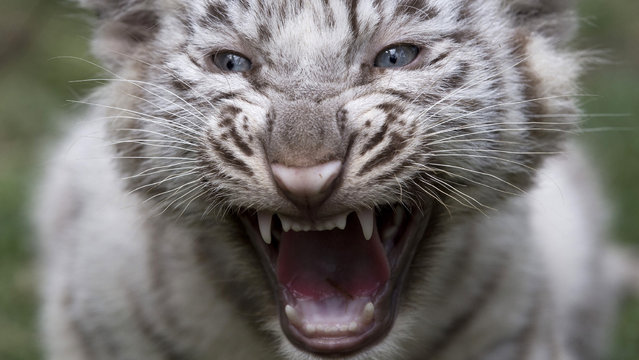
A white tiger cub growls at the Buenos Aires Zoo in Argentina, Thursday, March 21, 2013. The cub's mother, Cleo, a captive Bengal white tiger, gave birth to two females and two males on January 14. (Photo by Natacha Pisarenko/AP Photo)

A white tiger cub growls at the Buenos Aires Zoo in Argentina, Thursday, March 21, 2013. The cub's mother, Cleo, a captive Bengal white tiger, gave birth to two females and two males on January 14. (Photo by Natacha Pisarenko/AP Photo)

P.S. All pictures are presented in high resolution. To see Hi-Res images – just TWICE click on any picture. In other words, click small picture – opens the BIG picture. Click BIG picture – opens VERY BIG picture (if available; this principle works anywhere on the site AvaxNews).
Details
23 Mar 2013 14:12:00
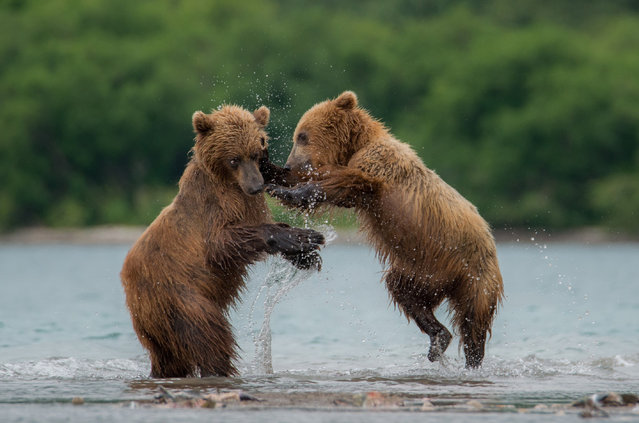
Kamchatka brown bears at Kurile Lake in Kamchatka peninsula’s volcanic terrain, Russia on August, 2017. Kamchatka brown bears are generally not dangerous to humans, and only 1% of encounters result in attack. (Photo by Igor Ivanko/Anadolu Agency/Getty Images)

Kamchatka brown bears at Kurile Lake in Kamchatka peninsula’s volcanic terrain, Russia on August, 2017. Kamchatka brown bears are generally not dangerous to humans, and only 1% of encounters result in attack. (Photo by Igor Ivanko/Anadolu Agency/Getty Images)
Details
03 Sep 2017 07:17:00