Loading...
Done
A young girl plays on the glass bottom platform of the Oriental Pear TV Tower as she travels with her family on the second day of the Chinese Lunar New Year holiday, also known as Spring Festival, in Shanghai, China on February 18, 2018. Some 287 million tourists travelled in China during the first four days of the week-long Chinese Lunar New Year holiday, up 11.1 percent from the same period last year, new data showed Sunday (18 February 2018). Tourism revenue rose 11.6 percent to 352.7 billion yuan (55.61 billion U.S. dollars) in the four days, the China National Tourism Administration (CNTA) said. On Sunday alone, some 73 million tourist trips were made across the country, up 15.3 percent, while tourism revenue rose 16.6 percent to 94.4 billion yuan. (Photo by Imaginechina/Rex Features/Shutterstock)

A young girl plays on the glass bottom platform of the Oriental Pear TV Tower as she travels with her family on the second day of the Chinese Lunar New Year holiday, also known as Spring Festival, in Shanghai, China on February 18, 2018. Some 287 million tourists travelled in China during the first four days of the week-long Chinese Lunar New Year holiday, up 11.1 percent from the same period last year, new data showed Sunday. (Photo by Imaginechina/Rex Features/Shutterstock)
Details
21 Feb 2018 00:03:00
Revellers take part in the annual “Naval Battle” of Vallecas in Madrid, Spain July 19, 2015. The slogan for this year's water battle is “Get wet for Alfon, freedom for Alfon”, referring to Alfonso Fernandez Ortega, a Vallecas resident who was sentenced to four years in prison in June. The festival was started spontaneously in 1981 when some neighbours started to throw water at one another due to high temperatures during the Virgen del Carmen Festival. (Photo by Juan Medina/Reuters)

Revellers take part in the annual “Naval Battle” of Vallecas in Madrid, Spain July 19, 2015. The slogan for this year's water battle is “Get wet for Alfon, freedom for Alfon”, referring to Alfonso Fernandez Ortega, a Vallecas resident who was sentenced to four years in prison in June. The festival was started spontaneously in 1981 when some neighbours started to throw water at one another due to high temperatures during the Virgen del Carmen Festival. (Photo by Juan Medina/Reuters)
Details
20 Jul 2015 10:01:00
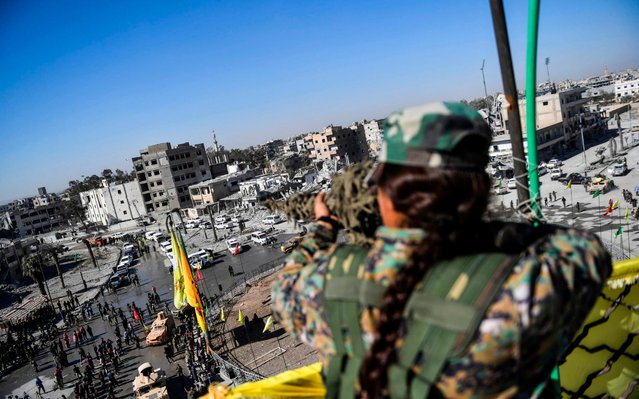
A female sniper of the Syrian Democratic Forces (SDF) monitors the area during a celebration at the iconic Al- Naim square in Raqa on October 19, 2017, after retaking the city from Islamic State (IS) group fighters. The SDF fighters flushed jihadist holdouts from Raqa' s main hospital and municipal stadium, wrapping up a more than four- month offensive against what used to be the inner sanctum of IS' s self- proclaimed “caliphate”. (Photo by Bulent Kilic/AFP Photo)

A female sniper of the Syrian Democratic Forces (SDF) monitors the area during a celebration at the iconic Al- Naim square in Raqa on October 19, 2017, after retaking the city from Islamic State (IS) group fighters. The SDF fighters flushed jihadist holdouts from Raqa' s main hospital and municipal stadium, wrapping up a more than four- month offensive against what used to be the inner sanctum of IS' s self- proclaimed “caliphate”. (Photo by Bulent Kilic/AFP Photo)
Details
21 Oct 2017 07:51:00
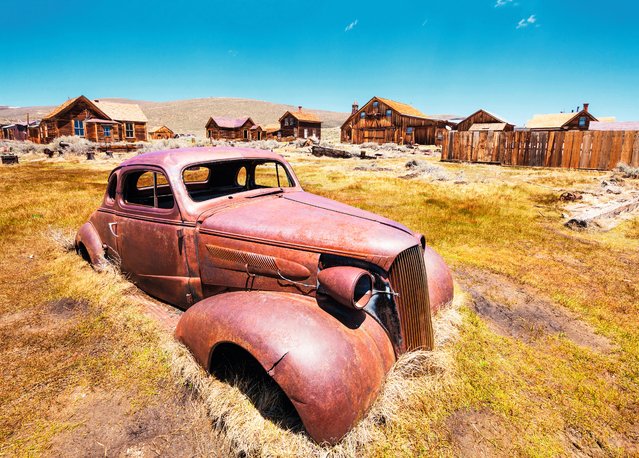
Bodie, Mono County, California. Gold was discovered at Bodie in 1859 (just after the initial California gold rush) and it went from mining camp to boomtown. Its decline began in 1880, when word spread of new boomtowns elsewhere. The Standard Consolidated Mine closed in 1913, and four years later the Bodie Railway was abandoned. By 1940 the population was down to 40. Today, Bodie is maintained in a state of arrested decay as a visitor attraction. (Photo by Alamy Stock Photo)

Kieron Connolly’s new book of photographs of more than 100 once-busy and often elegant buildings gives an idea of how the world might look if humankind disappeared. Here: Bodie, Mono County, California. Gold was discovered at Bodie in 1859 (just after the initial California gold rush) and it went from mining camp to boomtown. Its decline began in 1880, when word spread of new boomtowns elsewhere. The Standard Consolidated Mine closed in 1913, and four years later the Bodie Railway was abandoned. By 1940 the population was down to 40. Today, Bodie is maintained in a state of arrested decay as a visitor attraction. (Photo by Alamy Stock Photo)
Details
07 Sep 2016 09:50:00
A man takes a selfie next to a flooded street due to the overflowing of the Mapocho river during heavy rains in Santiago on April 17, 2016. Four million people in Santiago were without tap water Sunday after unusually heavy rain pounding central Chile triggered landslides that fouled the city's water supply and forced the closure of the world's biggest copper mine, officials said. (Photo by Martin Bernetti/AFP Photo)

A man takes a selfie next to a flooded street due to the overflowing of the Mapocho river during heavy rains in Santiago on April 17, 2016. Four million people in Santiago were without tap water Sunday after unusually heavy rain pounding central Chile triggered landslides that fouled the city's water supply and forced the closure of the world's biggest copper mine, officials said. (Photo by Martin Bernetti/AFP Photo)
Details
18 Apr 2016 10:05:00
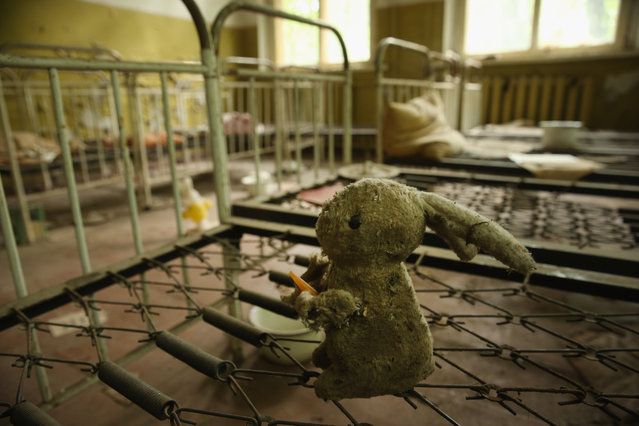
A stuffed rabbit doll sits among children's beds standing in the abandoned kindergarten of Kopachi village located inside the Chernobyl Exclusion Zone on September 29, 2015 near Chornobyl, Ukraine. Kopachi, a village that before 1986 had a population of 1,114, lies only a few kilometers south of the former Chernobyl nuclear power plant, where in 1986 workers inadvertantly caused reactor number four to explode, creating the worst nuclear accident in history. Radiation fallout was so high that authorities bulldozed and buried all of Kopachi's structures except for the kindergarten. (Photo by Sean Gallup/Getty Images)

A stuffed rabbit doll sits among children's beds standing in the abandoned kindergarten of Kopachi village located inside the Chernobyl Exclusion Zone on September 29, 2015 near Chornobyl, Ukraine. Kopachi, a village that before 1986 had a population of 1,114, lies only a few kilometers south of the former Chernobyl nuclear power plant, where in 1986 workers inadvertantly caused reactor number four to explode, creating the worst nuclear accident in history. (Photo by Sean Gallup/Getty Images)
Details
27 Apr 2016 09:28:00
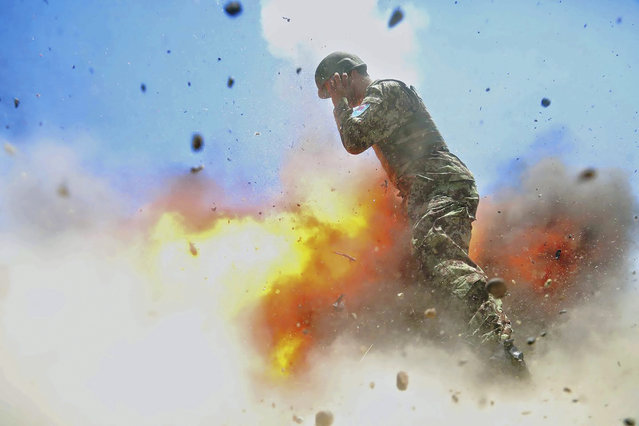
U.S Army combat camera photographer Spc. Hilda Clayton took this photo July 2, 2013 that was released by the U.S. Army, that shows an Afghan soldier engulfed in flame as a mortar tube explodes during an Afghan National Army live-fire training exercise in Laghman Province, Afghanistan. The accident killed Clayton and four Afghan National Army soldiers. (Photo by Spc. Hilda Clayton/U.S. Army via AP Photo)

U.S Army combat camera photographer Spc. Hilda Clayton took this photo July 2, 2013 that was released by the U.S. Army, that shows an Afghan soldier engulfed in flame as a mortar tube explodes during an Afghan National Army live-fire training exercise in Laghman Province, Afghanistan. The accident killed Clayton and four Afghan National Army soldiers. (Photo by Spc. Hilda Clayton/U.S. Army via AP Photo)
Details
26 May 2017 09:09:00
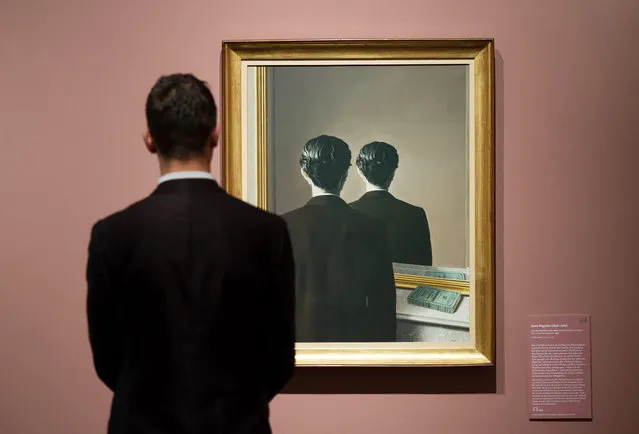
In this October 5, 2016 photo a man looks at the work “Not to be Reproduced” by Rene Magritte at the Kunsthalle art gallery in Hamburg, Germany. The exhibition, which runs from Oct. 7,  2016 until Jan. 22,  2017, features more than 150 masterpieces of surrealism from four of the most significant European private collections of the 20th century. (Photo by Daniel Reinhardt/DPA via AP Photo)

In this October 5, 2016 photo a man looks at the work “Not to be Reproduced” by Rene Magritte at the Kunsthalle art gallery in Hamburg, Germany. The exhibition, which runs from Oct. 7, 2016 until Jan. 22, 2017, features more than 150 masterpieces of surrealism from four of the most significant European private collections of the 20th century. (Photo by Daniel Reinhardt/DPA via AP Photo)
Details
07 Oct 2016 10:29:00