Loading...
Done
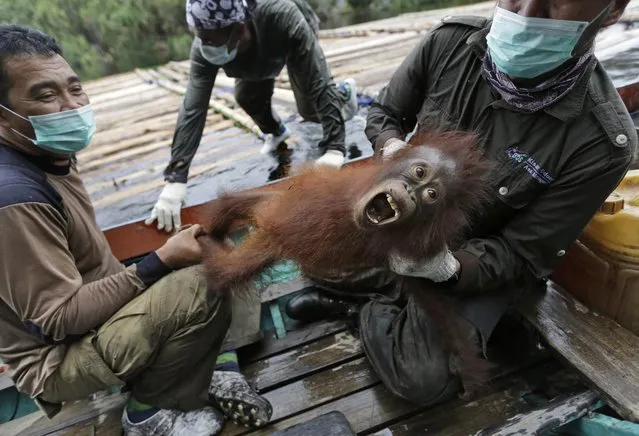
In this January 7, 2016, photo, conservationists of Borneo Orangutan Survival Foundation hold a baby orangutan rescued along with its mother during a rescue and release operation for orangutans trapped in a swath of jungle in Sungai Mangkutub, Central Kalimantan, Indonesia. Last year's forest fires drove orangutans closer to the river bank, where they had to live in an over-populated swath of forest as thin as 30 meters wide along the river. (Photo by Dita Alangkara/AP Photo)

In this January 7, 2016, photo, conservationists of Borneo Orangutan Survival Foundation hold a baby orangutan rescued along with its mother during a rescue and release operation for orangutans trapped in a swath of jungle in Sungai Mangkutub, Central Kalimantan, Indonesia. Last year's forest fires drove orangutans closer to the river bank, where they had to live in an over-populated swath of forest as thin as 30 meters wide along the river. (Photo by Dita Alangkara/AP Photo)
Details
25 Jan 2016 11:36:00
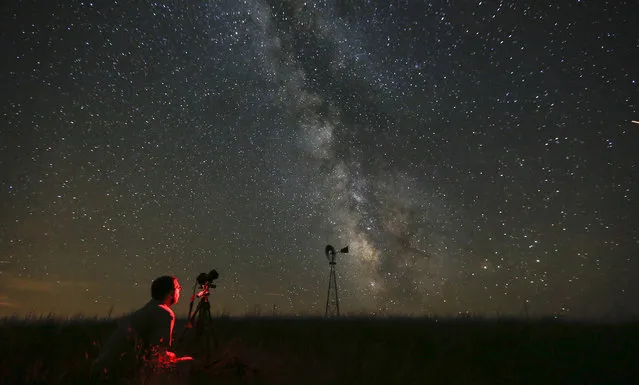
In this Wednesday, July 23, 2014 file photo, Omaha photographer Lane Hickenbottom photographs the night sky in a pasture near Callaway, Neb. With no moon in the sky, the Milky Way was visible to the naked eye. More than one-third of the world’s population can no longer see the Milky Way because of man-made lights, according to a scientific paper by Light Pollution Science and Technology Institute's Fabio Falchi and his team members, published on Friday, June 10, 2016. (Photo by Travis Heying/The Wichita Eagle via AP Photo)

In this Wednesday, July 23, 2014 file photo, Omaha photographer Lane Hickenbottom photographs the night sky in a pasture near Callaway, Neb. With no moon in the sky, the Milky Way was visible to the naked eye. More than one-third of the world’s population can no longer see the Milky Way because of man-made lights, according to a scientific paper by Light Pollution Science and Technology Institute's Fabio Falchi and his team members, published on Friday, June 10, 2016. (Photo by Travis Heying/The Wichita Eagle via AP Photo)
Details
11 Jun 2016 12:37:00
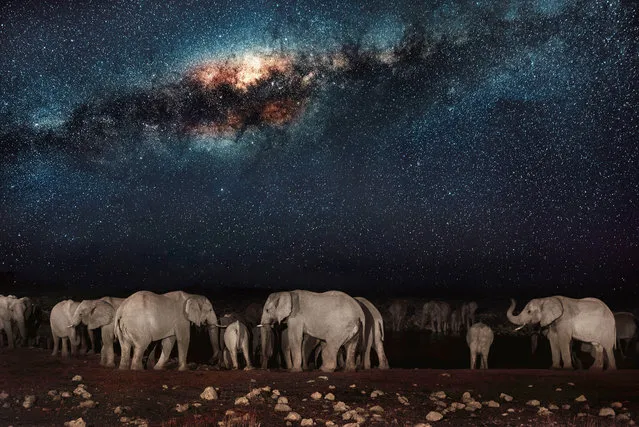
This watering hole is the social hub of the veldt; the scrubby grasslands that stretch across Namibia. The scorched earth supports sometimes fragile populations of magnificent wildlife – from endangered predators to plentiful herds of game. But these gentle giraffes and elephants need to be careful: lions don’t sleep at night, they hunt! The spectacular starscape above southern Africa is unchanged since explorers first mapped the continent. The photographer, Pietro Olivetta from Italy, said he had to be patient to capture these shots – but it was worth the wait. (Photo by Pietro Olivetta/Caters News)

This watering hole is the social hub of the veldt; the scrubby grasslands that stretch across Namibia. The scorched earth supports sometimes fragile populations of magnificent wildlife – from endangered predators to plentiful herds of game. But these gentle giraffes and elephants need to be careful: lions don’t sleep at night, they hunt! The spectacular starscape above southern Africa is unchanged since explorers first mapped the continent. The photographer, Pietro Olivetta from Italy, said he had to be patient to capture these shots – but it was worth the wait. (Photo by Pietro Olivetta/Caters News)
Details
20 Feb 2017 00:05:00
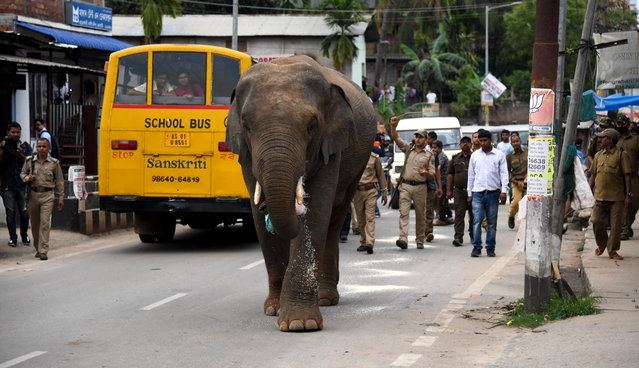
Indian forest officials and police personnel try to chase away a wild male elephant at Hengrabari area in Guwahati on April 30, 2019. The elephant came down from Amchang Wildlife Sanctuary in search of food and later forest official tranquillized it, local media reported. As the pressure of population pushes human habitation closer to forests incidents of wild animals straying into cities is increasingly reported. (Photo by Biju Boro/AFP Photo)

Indian forest officials and police personnel try to chase away a wild male elephant at Hengrabari area in Guwahati on April 30, 2019. The elephant came down from Amchang Wildlife Sanctuary in search of food and later forest official tranquillized it, local media reported. As the pressure of population pushes human habitation closer to forests incidents of wild animals straying into cities is increasingly reported. (Photo by Biju Boro/AFP Photo)
Details
02 May 2019 00:07:00
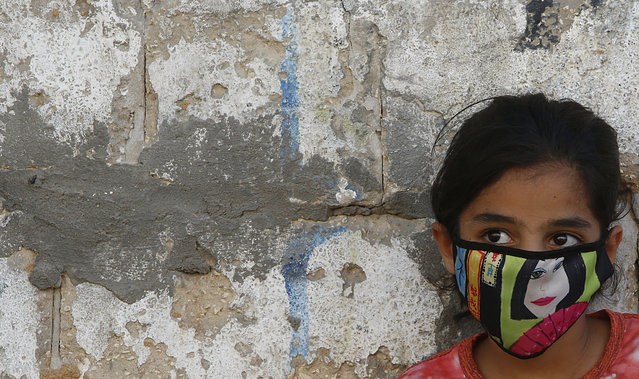
A Palestinian girl wear a face mask during a lockdown imposed following the discovery of coronavirus cases in the Gaza Strip, Thursday, August 27, 2020. On Wednesday Gaza's Hamas rulers extended a full lockdown in the Palestinian enclave for three more days as coronavirus cases climbed after the detection this week of the first community transmissions of the virus in the densely populated, blockaded territory. (Photo by Hatem Moussa/AP Photo)

A Palestinian girl wear a face mask during a lockdown imposed following the discovery of coronavirus cases in the Gaza Strip, Thursday, August 27, 2020. On Wednesday Gaza's Hamas rulers extended a full lockdown in the Palestinian enclave for three more days as coronavirus cases climbed after the detection this week of the first community transmissions of the virus in the densely populated, blockaded territory. (Photo by Hatem Moussa/AP Photo)
Details
29 Aug 2020 00:07:00
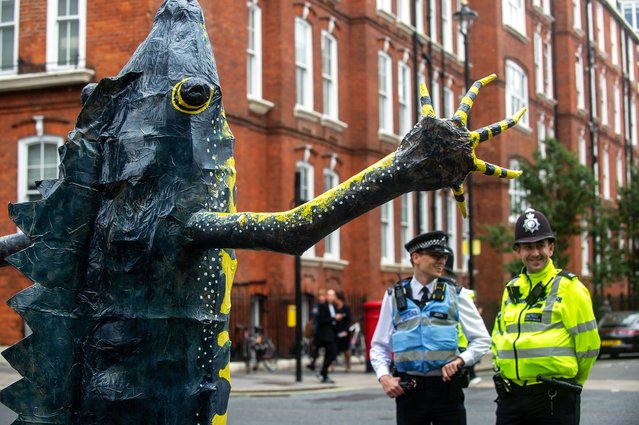
Hundreds of people from a range of NGOs and campaign groups protest to demand the immediate restoration of nature at DEFRA – Department for Environment Food & Rural Affairs on September 28, 2023 in London, England. The 2023 State of Nature Report revealed that approximately one in six species in Great Britain, including turtle doves and hazel dormice, are at risk of extinction, citing climate change, intensive farming, and pollution as major threats, with a 19% average decline in monitored plant and animal populations since 1970. (Photo by Guy Smallman/Getty Images)

Hundreds of people from a range of NGOs and campaign groups protest to demand the immediate restoration of nature at DEFRA – Department for Environment Food & Rural Affairs on September 28, 2023 in London, England. The 2023 State of Nature Report revealed that approximately one in six species in Great Britain, including turtle doves and hazel dormice, are at risk of extinction, citing climate change, intensive farming, and pollution as major threats, with a 19% average decline in monitored plant and animal populations since 1970. (Photo by Guy Smallman/Getty Images)
Details
09 Dec 2024 04:11:00
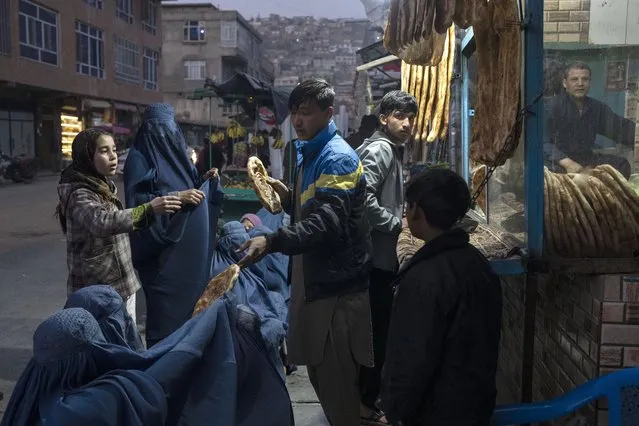
A man distributes bread to Burka-wearing Afghan women outside a bakery in Kabul, Afghanistan, Thursday, December 2, 2021. According to U.N. figures from early November, almost 24 million people in Afghanistan, around 60% percent of the population, suffer from acute hunger, including 8.7 million living in near famine. Increasing numbers of malnourished children have filled hospital wards. (Photo by Petros Giannakouris/AP Photo)

A man distributes bread to Burka-wearing Afghan women outside a bakery in Kabul, Afghanistan, Thursday, December 2, 2021. According to U.N. figures from early November, almost 24 million people in Afghanistan, around 60% percent of the population, suffer from acute hunger, including 8.7 million living in near famine. Increasing numbers of malnourished children have filled hospital wards. (Photo by Petros Giannakouris/AP Photo)
Details
17 Dec 2021 10:10:00
This photo taken on February 10, 2025 shows a captured green iguana being held by hunters after it was brought down by a slingshot in Pingtung. Taiwan's iguana population has exploded since the spikey-backed giant lizards were introduced from Central and South America more than 20 years ago as exotic pets. Many escaped or were dumped by their owners and have bred rapidly in the warm climate of southern Taiwan, invading neighbourhoods and ravaging farmers' crops. (Photo by I-Hwa Cheng/AFP Photo)

This photo taken on February 10, 2025 shows a captured green iguana being held by hunters after it was brought down by a slingshot in Pingtung. Taiwan's iguana population has exploded since the spikey-backed giant lizards were introduced from Central and South America more than 20 years ago as exotic pets. Many escaped or were dumped by their owners and have bred rapidly in the warm climate of southern Taiwan, invading neighbourhoods and ravaging farmers' crops. (Photo by I-Hwa Cheng/AFP Photo)
Details
02 Mar 2025 04:03:00