Loading...
Done
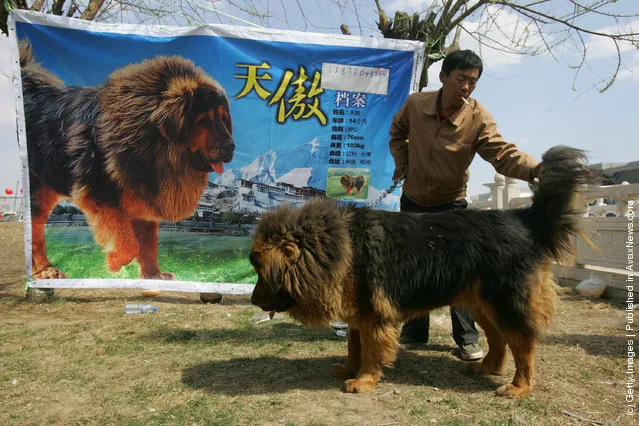
Tibetan Mastiff

“The Tibetan Mastiff also known as Do-khyi (variously translated as “home guard”, “door guard”, “dog which may be tied”, “dog which may be kept”), reflects its use as a guardian of herds, flocks, tents, villages, monasteries, and palaces, much as the old English ban-dog (also meaning tied dog) was a dog tied outside the home as a guardian. However, in nomad camps and in villages, the Do-khyi is traditionally allowed to run loose at night and woe be unto the stranger who walks abroad after dark”. – Wikipedia

Photo: A man displays a Tibetan Mastiff he raised during the Tibetan Mastiff exposition on April 7, 2007 in Langfang of Hebei Province, China. (Photo by China Photos/Getty Images)
Details
05 Oct 2011 14:27:00
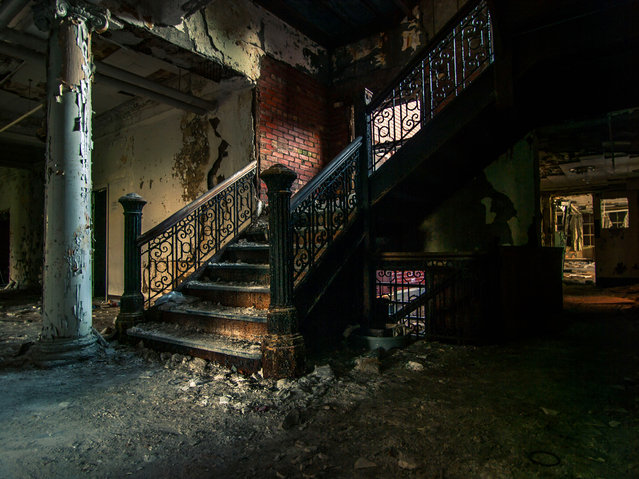
These chilling images prove there is no sign of life at this abandoned tuberculosis treatment hospital. Johnny Joo, 24, captured the eerie shots of the desolate TB ward, in Perrysburg, New York. Where equipment lies gathering rust and walls are left crumbling. (Photo by Johnny Joo/Caters News)

These chilling images prove there is no sign of life at this abandoned tuberculosis treatment hospital. Johnny Joo, 24, captured the eerie shots of the desolate TB ward, in Perrysburg, New York. Where equipment lies gathering rust and walls are left crumbling. The photojournalist, from Cleveland, Ohio, stumbled upon the facility, which shut its doors in 1995, before shooting what remains of the historic site. Johnny said the facility, named after Buffalo Mayor James Nobel Adam, remains something of an unknown quantity as it is surrounded by more than 500 acres of forest land. (Photo by Johnny Joo/Caters News)
Details
30 Jan 2015 10:37:00
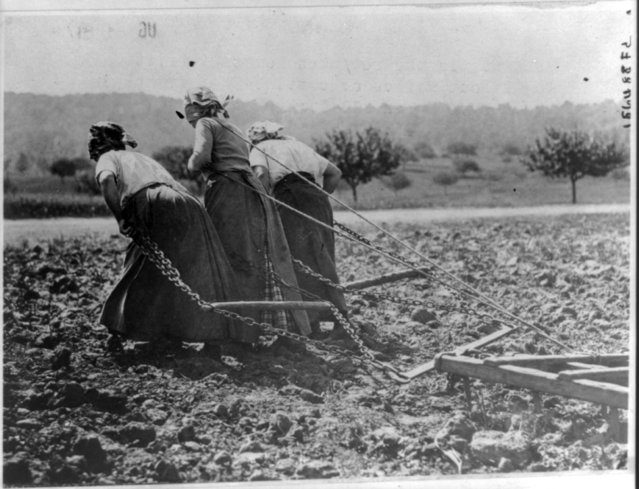
Peasants in the re-taken Somme District work in the fields, circa 1916- 1917, in this Library of Congress handout photo. (Photo by Reuters/Bain Collection/Library of Congress)

Peasants in the re-taken Somme District work in the fields, circa 1916- 1917, in this Library of Congress handout photo. For women 100 years ago, opportunities to work beyond the home and take part in political life were very limited. As the 20th century progressed, hard-won progress included gradually improved voting rights, while the upheaval of war pushed doors ajar as women worked as part of the war effort. U.S. Library of Congress archive photos show women's workplaces ranging from a flour mill in England to a coal mine in Belgium or Lincoln Motor Co.'s welding department in Detroit. International Women's Day is celebrated on March 8. (Photo by Reuters/Bain Collection/Library of Congress)
Details
03 Mar 2016 11:39:00
Bomb Explodes At Jerusalem Bus Stop

Israeli police inspectors stand next to a bus damaged in an explosion March 23, 2011 in Jersalem, Israel. A bomb exploded near a crowded bus, wounding passengers in what appeared to be the first militant attack in the city in several years.
Details
23 Mar 2011 16:17:00
Cute little sea lions by Jon Cornforth

In Canada, a small sea lion seems very narcissistic, put on a variety of expressions and gestures to the camera, self-shot was exhilaration, it does not know the photographer Jon Cornforth next to it quietly photographed its body posture.
Details
23 Jun 2015 09:03:00
Carlos Boozer

Carlos Boozer #5 of the Chicago Bulls grabs a rebound next to David West #30 of the New Orleans Hornets at the United Center on March 7, 2011 in Chicago, Illinois. The Bulls defeated the Hornets 85-77.


Details
07 Mar 2011 15:44:00


Adam Ghiggio from Australia poses next to mutant mannequins which are lined up to be used as displays for the new video game “Rage” at the Los Angeles Convention Center on June 5, 2011 in Los Angeles, California. The Electronic Entertainment Expo officially starts on Tuesday. (Photo by Kevork Djansezian/Getty Images)
Details
06 Jun 2011 08:46:00
Women walk next to soldiers in Surcubamba, Peru, Thursday, May 21, 2015. (Photo by Rodrigo Abd/AP Photo)

Women walk next to soldiers in Surcubamba, Peru, Thursday, May 21, 2015. The Joint Command of the Peruvian Armed Forces organized a humanitarian mission to Surcubamba, where health care was provided to families from nearby villages in this region called VRAEM, the acronym for Valley of the Apurimac, Ene and Mantaro rivers, where sixty percent of Peru's cocaine originates. (Photo by Rodrigo Abd/AP Photo)
Details
24 May 2015 09:38:00