Loading...
Done
Japanese Yuuka Hasumi, 17, and Ibuki Ito, 17, also from Japan, who want to become K-pop stars, perform during their street performance in Hongdae area of Seoul, South Korea, March 21, 2019. Hasumi put high school in Japan on hold and flew to South Korea in February to try her chances at becoming a K-pop star, even if that means long hours of vocal and dance training, no privacy, no boyfriend, and even no phone. “It is tough”, Hasumi said. “Going through a strict training and taking my skill to a higher level to a perfect stage, I think that's when it is good to make a debut”. (Photo by Kim Hong-Ji/Reuters)

Japanese Yuuka Hasumi, 17, and Ibuki Ito, 17, also from Japan, who want to become K-pop stars, perform during their street performance in Hongdae area of Seoul, South Korea, March 21, 2019. (Photo by Kim Hong-Ji/Reuters)
Details
28 Feb 2021 10:09:00
Legs Photography By Stacey Baker


When you look at the pictures created by Stacey Baker, you immediately think that these photos must have been staged by the photographer to convey some deep meaning. In reality, however, Stacy created her new series called “CitiLegs”, which has about 300 pictures of female legs, by asking passing girls and women in Manhattan, New York if she could photograph their legs. And that is when the realization hits you – “Some people actually dress like that!” What kind of a person would wear neon-green shorts over orange leggings with leopard-patterned boots, the toes of which are completely torn? Yes, there is a possibility that such a person might be insane; however, there are just too many “crazy” photos in this series! (Photo by Stacey Baker)
Details
19 Nov 2014 14:23:00
Vintage G.I. Joe figurers are on display at the 2003 Hasbro International G.I. Joe Collectors' Convention June 27, 2003 in Burlingame, California. Hundreds of G.I. Joe fans from around the country are attending the convention to buy, sell and trade G.I. Joe and military action figures. (Photo by Justin Sullivan/Getty Images)

“G.I. Joe is a line of action figures produced by the toy company Hasbro. The term G.I. stands, in popular usage, for Government Issued and after the First World War became a generic term for U.S. soldiers. The origin of the term dates to World War I, when much of the equipment issued to U.S. soldiers was stamped “G.I.”, meaning that it was made from galvanized iron. The development of G.I. Joe led to the coining of the term “action figure”. G.I. Joe's appeal to children has made it an American icon among toys”. – Wikipedia. Photo: Vintage G.I. Joe figurers are on display at the 2003 Hasbro International G.I. Joe Collectors' Convention June 27, 2003 in Burlingame, California. (Photo by Justin Sullivan/Getty Images)
Details
27 Mar 2014 07:46:00
Pineapple

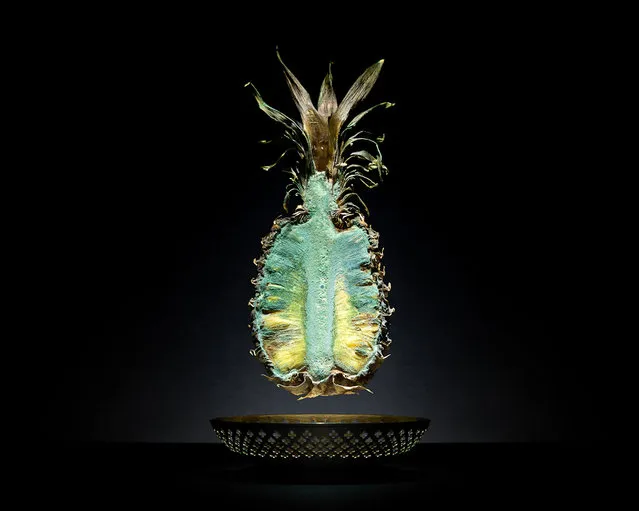
“One Third” – a project on food waste by an Austrian photography Klaus Pichler. According to a UN study one third of the world's food goes to waste – the largest part thereof in the industrialized nations of the global north. Equally, 925 million people around the world are threatened by starvation. The series “One Third” describes the connection between individual wastage of food and globalized food production.

Photo: Pineapple. Place of production: Guayaquil, Ecuador. Cultivation method: Outdoor plantation • Time of harvest: All- season. Transporting distance: 10.666 km (linear distance) • Means of transportation: Aircraft, truck. Carbon footprint (total) per kg: 11,94 kg • Water requirement (total) per kg: 360 l. Price: 2,10 € / kg. (Photo by Klaus Picher)
Details
02 May 2012 11:01:00
“Whether that means getting up way before the sun, like I do most days, going out somewhere that I’m not comfortable or just trying to get different angles or styles of photos, I am trying to display the crazy beauty of the ocean, and usually moments that literally last less than a split second”. (Photo by Ryan Pernoski/Caters News Agency)

These kaleidoscopic images are the work of one persistent photographer’s efforts to capture vibrant hues at the exact moment a wave breaks. Ryan Pernofski‘s stunning shots feature brilliant yellows, reds, blues and purples as an array of sunlight hits the water at the perfect time. What’s even more impressive: Ryan, a 27-year-old Australian, began shooting his popular masterpieces without using a professional camera, taking his iPhone out into the water instead. Ryan began experimenting with this method in 2012, using an underwater housing to protect his phone, as he could not afford a professional camera. (Photo by Ryan Pernoski/Caters News Agency)
Details
09 Jun 2018 00:05:00
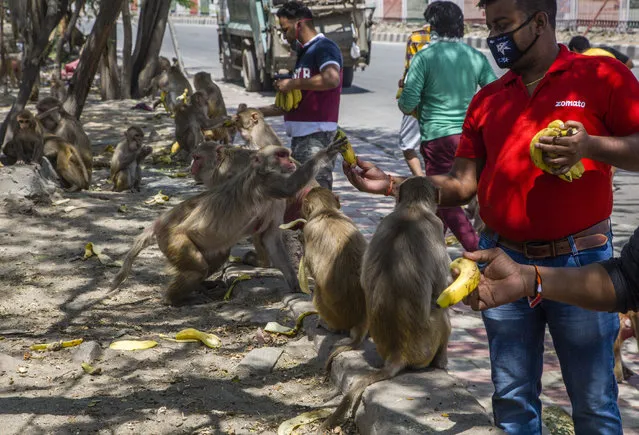
Men give bananas to monkeys gathered on the side of the road as India remains under an unprecedented lockdown over the highly contagious coronavirus (COVID-19) on April 08, 2020 in New Delhi, India. Wild animals, including monkeys, are roaming human settlements in India as people are staying indoors due to the 21-day lockdown. With India's 1.3 billion population and tens of millions of cars off the roads, wildlife is moving towards areas inhabited by humans. Wild animals in many countries have been seen roaming streets. A study says some 60 percent of the new diseases found around the globe every year are zoonotic, meaning they originate in animals and are passed on to humans. COVID-19 is a zoonotic disease that is suspected to have come from the wet markets of Wuhan, China. (Photo by Yawar Nazir/Getty Images)

Men give bananas to monkeys gathered on the side of the road as India remains under an unprecedented lockdown over the highly contagious coronavirus (COVID-19) on April 08, 2020 in New Delhi, India. Wild animals, including monkeys, are roaming human settlements in India as people are staying indoors due to the 21-day lockdown. (Photo by Yawar Nazir/Getty Images)
Details
12 Apr 2020 00:05:00
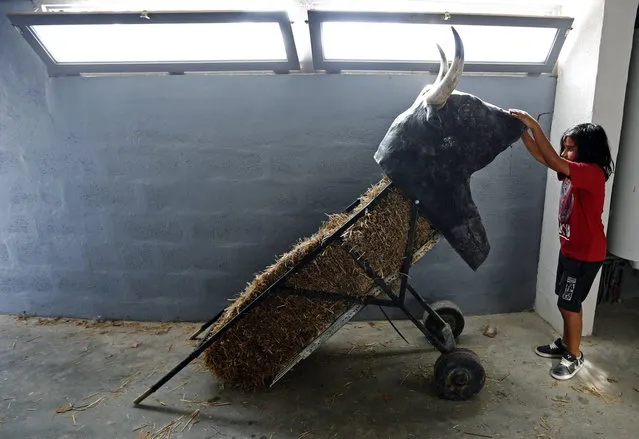
Nino, a ten-year-old toreador apprentice of the French Tauromachy Centre, nicknamed El Nino, touches a practice bull at the bullring of Garons, near Nimes, September 25, 2013. (Photo by Jean-Paul Pelissier/Reuters)

Nino, a ten-year-old toreador apprentice of the French Tauromachy Centre, nicknamed El Nino, touches a practice bull at the bullring of Garons, near Nimes, September 25, 2013. Since 1983, the French Tauromachy Centre in Nimes has trained some 1,000 youths in the art of bullfighting. Twenty of them have gone on to become professional matadors, facing fighting bulls in the arena. Twice a week, students take courses with a matador to learn the movements and gestures of the bullfighter in the ring, but without an animal present. Students train with calves in the surrounding fields during spring, and regularly participate in beginner's bullfights (becerradas) without killing calves. Solal has been taking courses for three years and Nino, for just a year now. Both are normally enrolled in French public schools, but have one thought in mind – bullfighting. They share a passion linked to the city of Nimes, famous for its ferias and bullring. (Photo by Jean-Paul Pelissier/Reuters)

Details
06 Nov 2013 10:12:00
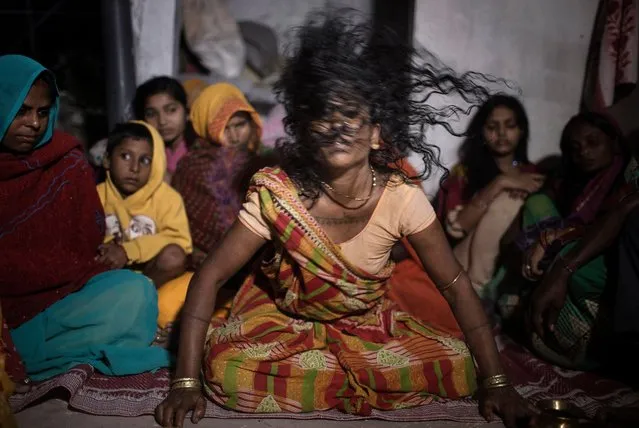
Marani Devi Chaudhary (C), aged 40, performs a ritual in front of shaman Paltan Yadav (unseen) at her home in Rajaur village in Dhanusha district, Nepal, 02 November 2017. The shaman identified Marani Devi to be possessed by their lineage god who was dissatisfied by their worship is thought by the family to have caused them misfortune and is even feared lead to their death. Therefore Marani Devi spent 1,500 USD to perform a healing ritual at the Ghost Festival held at the banks of Kamala River in Dhanusha district two days later. Every family or community has their own sacred god, called 'Kuldevta' in Nepali which means family deity or lineage god. Only family members or people within communities of the same caste can worship to the deity. They have their own rules and regulations of worship which varies from one family and community to another. Being unable to follow the rules and regulations or carry out worship is believed to cause misfortune. (Photo by Narendra Shrestha/EPA/EFE)

Marani Devi Chaudhary (C), aged 40, performs a ritual in front of shaman Paltan Yadav (unseen) at her home in Rajaur village in Dhanusha district, Nepal, 02 November 2017. The shaman identified Marani Devi to be possessed by their lineage god who was dissatisfied by their worship is thought by the family to have caused them misfortune and is even feared lead to their death. (Photo by Narendra Shrestha/EPA/EFE)
Details
17 Nov 2017 06:53:00