Loading...
Done
Student of Meiji University Yuki Hou licks a screen of Taste the TV (TTTV), a prototype lickable TV screen that can imitate the flavours of various foods, during its demonstration at the university in Tokyo, Japan, December 22, 2021. (Photo by Kim Kyung-Hoon/Reuters)

Student of Meiji University Yuki Hou licks a screen of Taste the TV (TTTV), a prototype lickable TV screen that can imitate the flavours of various foods, during its demonstration at the university in Tokyo, Japan, December 22, 2021. (Photo by Kim Kyung-Hoon/Reuters)
Details
25 Sep 2022 04:29:00
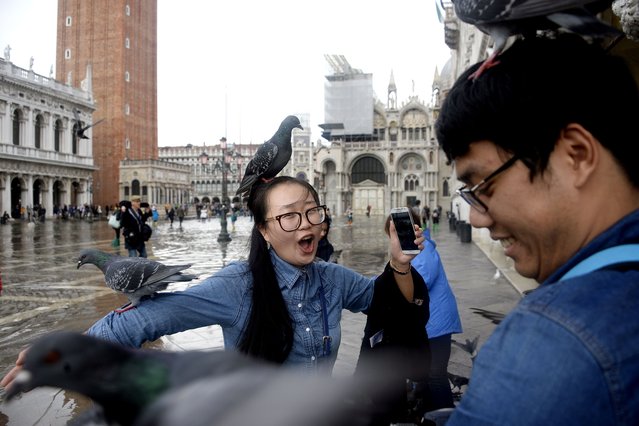
Tourists pose with pigeons in the flooded St. Mark's Square in Venice, on November 7, 2014. The high water, a combination of high tides and a strong Scirocco wind in the Adriatic Sea, stood at 110 centimeters early on November 7. The city has for years been wrestling with the problems posed by the threat of rising sea levels. (Photo by Olivier Morin/AFP Photo)

Tourists pose with pigeons in the flooded St. Mark's Square in Venice, on November 7, 2014. The high water, a combination of high tides and a strong Scirocco wind in the Adriatic Sea, stood at 110 centimeters early on November 7. The city has for years been wrestling with the problems posed by the threat of rising sea levels. (Photo by Olivier Morin/AFP Photo)
Details
08 Nov 2014 13:06:00
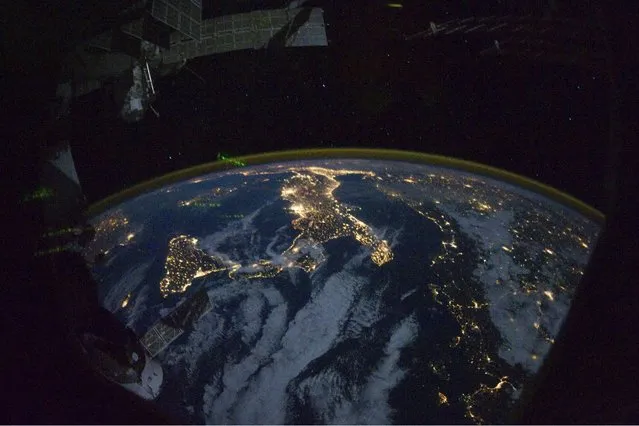
This image provided by NASA shows parts of Europe and Africa very easily recognizable in this night time image shot by one of the Expedition 25 crew members aboard the International Space Station flying 220 miles above Earth on Thursday Oct. 28, 2010. The view “looks” northward over Sicily and the “boot” of Italy, with the Mediterranean Sea representing most of the visible water in the view and the Adriatic Sea to the right of center. Tunisia is partially visible at left. Part of a docked Russian spacecraft and other components of the ISS are in the foreground. (Photo by AP photo/NASA)

This image provided by NASA shows parts of Europe and Africa very easily recognizable in this night time image shot by one of the Expedition 25 crew members aboard the International Space Station flying 220 miles above Earth on Thursday October 28, 2010. The view “looks” northward over Sicily and the “boot” of Italy, with the Mediterranean Sea representing most of the visible water in the view and the Adriatic Sea to the right of center. Tunisia is partially visible at left. Part of a docked Russian spacecraft and other components of the ISS are in the foreground. (Photo by AP Photo/NASA)
Details
11 May 2013 12:29:00
A picture made available on 07 March 2016 shows visitors petting and holding a Fennec fox, native to the Sahara, in the petting room at the Little Zoo Cafe, a business built to capitalize on Thais' love for exotic animals, and food, on the outskirts of Bangkok, Thailand, 05 March 2016. (Photo by Barbara Walton/EPA)

A picture made available on 07 March 2016 shows visitors petting and holding a Fennec fox, native to the Sahara, in the petting room at the Little Zoo Cafe, a business built to capitalize on Thais' love for exotic animals, and food, on the outskirts of Bangkok, Thailand, 05 March 2016. The cafe boasts Fennec foxes, Meerkat, native to parts of Africa, Silver Fox, Raccoon and Chinchillas, along with a menu of Thai food and Cheesecake, among other sweet deserts. Nature is a faraway fantasy in the bustling exhaust-filled cement city of Bangkok, fuelling a demand to own and be close to exotic pets. The trend to be near to a species that was once wild, in a city environment, far from the natural setting, has drawn criticism but continues to grow. (Photo by Barbara Walton/EPA)

Details
13 Mar 2016 09:38:00
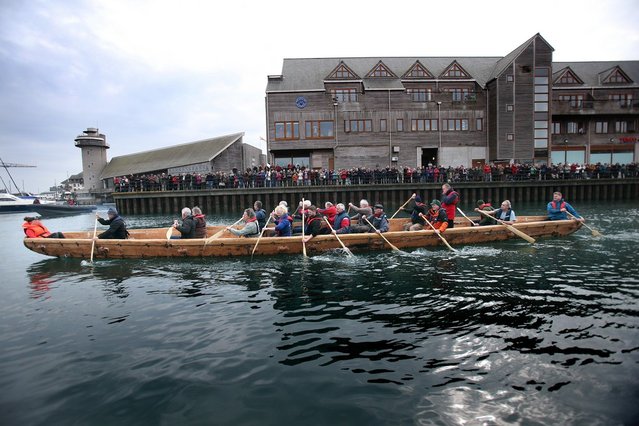
Crew in Britain's first ever full-size reconstructed sea-going Bronze Age boat, paddle out to sea near to the National Maritime Museum as it makes its maiden voyage on March 6, 2013 in Falmouth, England. With a crew of of 18, equipped with Bronze-Age-style wooden paddles, the 15 metre long experimental vessel – a replica of the sort of craft used for long-distance trade between Britain and the continent 4000 years ago – will be used to test prehistoric seafaring methods in a project in collaboration with the University of Exeter and the Falmouth-based National Maritime Museum Cornwall. (Photo by Matt Cardy)

Crew in Britain's first ever full-size reconstructed sea-going Bronze Age boat, paddle out to sea near to the National Maritime Museum as it makes its maiden voyage on March 6, 2013 in Falmouth, England. (Photo by Matt Cardy)
Details
07 Mar 2013 08:48:00
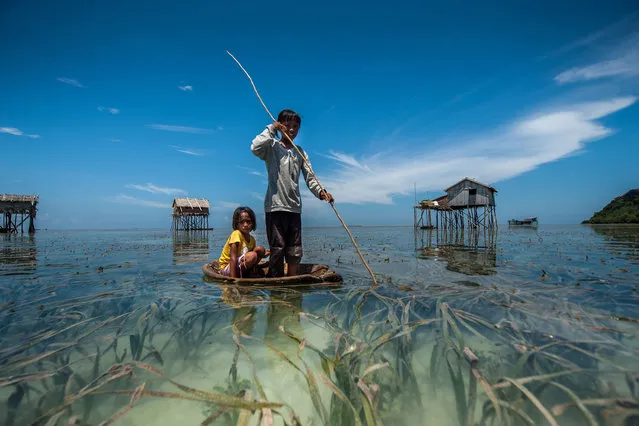
The Bajau people of Malaysia live their lives completely at sea, living in wooden huts and spending their days fishing. Sailing over crystal clear waters, the Bajau people of Malaysia live their lives almost entirely at sea. (Photo by Ng Choo Kia/Hotspot Media/SIPA Press)

The Bajau people of Malaysia live their lives completely at sea, living in wooden huts and spending their days fishing. Sailing over crystal clear waters, the Bajau people of Malaysia live their lives almost entirely at sea. Photographer Ng Choo Kia joined the Bajau people on their pirogues, which are long narrow canoes made from single tree trunks, and documented their daily life in a series of pictures. (Photo by Ng Choo Kia/Hotspot Media/SIPA Press)
Details
05 May 2015 10:49:00
A Romanian female soldier adjusts her helmet before taking part in weapons training with US Marines female counterparts at the Capu Midia Surface to Air Firing Range, on the Black Sea coast in Romania, Monday, March 20, 2017. About 1,200 US and Romanian troops take part in the Spring Storm 17 exercise, meant to simulate defense of the Romanian Black Sea coastline and urban areas. (Photo by Vadim Ghirda/AP Photo)

A Romanian female soldier adjusts her helmet before taking part in weapons training with US Marines female counterparts at the Capu Midia Surface to Air Firing Range, on the Black Sea coast in Romania, Monday, March 20, 2017. About 1,200 US and Romanian troops take part in the Spring Storm 17 exercise, meant to simulate defense of the Romanian Black Sea coastline and urban areas. (Photo by Vadim Ghirda/AP Photo)
Details
21 Mar 2017 08:12:00
As the sun rises, Gentoo penguins start their day on Wednesday, February 17, 2016, on Sea Lion Island, Falkland Islands. Sea Lion Island, which lies about 10 miles to the south of mainland East Falkland, is the southern most human-inhabited island of the more than 750 islands and islets of the Falkland Islands. (Photo by Jahi Chikwendiu/The Washington Post)

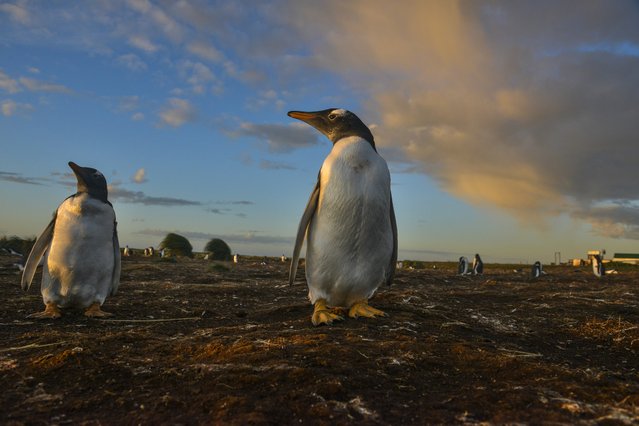
As the sun rises, Gentoo penguins start their day on Wednesday, February 17, 2016, on Sea Lion Island, Falkland Islands. Sea Lion Island, which lies about 10 miles to the south of mainland East Falkland, is the southern most human-inhabited island of the more than 750 islands and islets of the Falkland Islands. (Photo by Jahi Chikwendiu/The Washington Post)
Details
02 Sep 2016 13:05:00