Loading...
Done
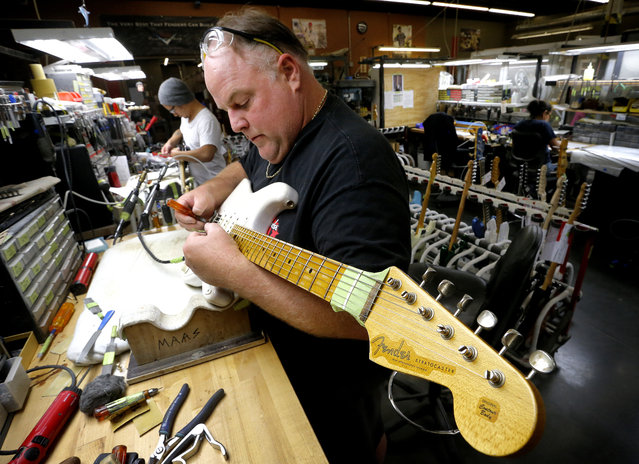
A finished Fender Stratocaster is adjusted by Kenneth Maas in the Fender Custom Shop in Corona, Calif. on Tuesday, October 15, 2013. Leo Fender developed the instrument in a small workshop in Fullerton, Calif. six decades ago. (Photo by Matt York/AP Photo)

“Jimi Hendrix made it shriek. Buddy Holly made it swing. Stevie Ray Vaughn made it snarl. Some of the most legendary guitarists in music history have elicited unforgettable sounds from the Fender Stratocaster, the distinctive double-cutaway guitar born in a small Fullerton, Calif., workshop 60 years ago this month”. – Associated Press. Photo: A finished Fender Stratocaster is adjusted by Kenneth Maas in the Fender Custom Shop in Corona, Calif. on Tuesday, October 15, 2013. Leo Fender developed the instrument in a small workshop in Fullerton, Calif. six decades ago. (Photo by Matt York/AP Photo)
Details
22 Apr 2014 10:52:00
Giant gathering by Tony Wu. “The first indication that something extraordinary was going on were the blows, huge numbers of them – the exhalations of huge numbers of whales. Entering the water, the photographer witnessed an extraordinary scene. Hundreds, possibly thousands, of sperm whales were twirling and twisting through the water, bumping and rubbing against each other, and there was a cacophony of sound – the pulsation, buzz, creak and crackle of whale communication. The picture shows just a fraction of the scene, with the whales stacked up below. Undoubtedly, this was a clan gathering”. (Photo by Tony Wu/Unforgettable Underwater Photography/NHM)

A new book published by the UK Natural History Museum showcases some of the most memorable underwater photographs taken over the last few decades in its annual wildlife photographer of the year competition. Here: Giant gathering by Tony Wu. “The first indication that something extraordinary was going on were the blows, huge numbers of them – the exhalations of huge numbers of whales. Entering the water, the photographer witnessed an extraordinary scene”. (Photo by Tony Wu/Unforgettable Underwater Photography/NHM)
Details
17 Apr 2018 00:03:00
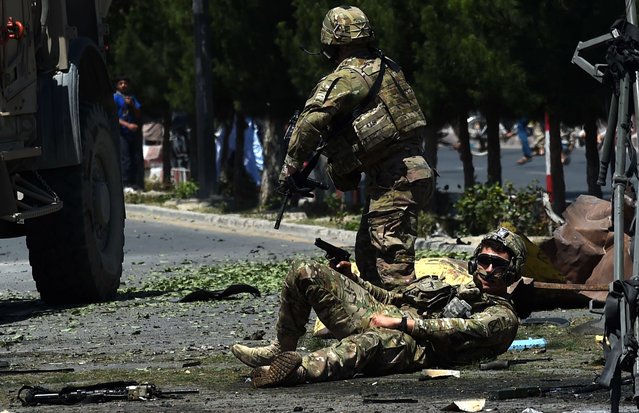
An injured NATO soldier lies on the ground following a suicide car bomb attack that targeted foreign military vehicles in the Afghan capital Kabul on June 30,2015. A powerful blast hit downtown Kabul on June 30 as a suicide car bomber targeted foreign military vehicles, officials said, with casualties feared. (Photo by Wakil Kohsar/AFP Photo)

An injured NATO soldier lies on the ground following a suicide car bomb attack that targeted foreign military vehicles in the Afghan capital Kabul on June 30,2015. A powerful blast hit downtown Kabul on June 30 as a suicide car bomber targeted foreign military vehicles, officials said, with casualties feared. The blast came on the main road to the airport, around 500 meters (550 yards) from the US embassy and near a base for foreign troops.“It was a suicide car bomber targeting a convoy of foreign forces in Kabul”, interior ministry spokesman Sediq Sediq said. (Photo by Wakil Kohsar/AFP Photo)
Details
01 Jul 2015 13:03:00
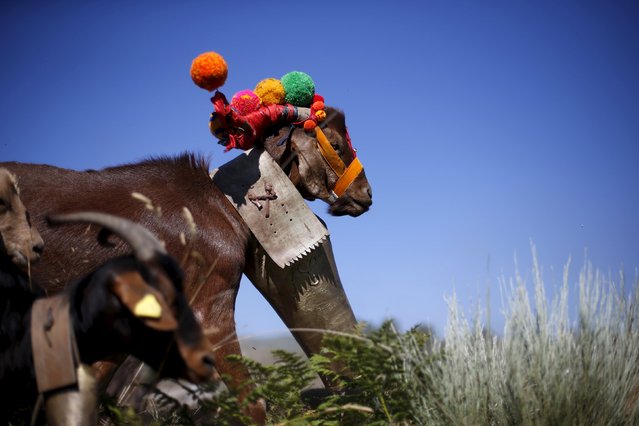
Sheep walk as they are herded to summer pastures in Serra da Estrela, near Seia, Portugal June 27, 2015. (Photo by Rafael Marchante/Reuters)

Sheep walk as they are herded to summer pastures in Serra da Estrela, near Seia, Portugal June 27, 2015. In late June, shepherds young and old in the Seia region of central Portugal start guiding sheep, goats and cattle to the Serra da Estrela, the country’s highest mountains, in search of better pastures. There they stay until the end of September. Modern-day shepherds may have mobile phones to keep in touch with family and friends, but their lifestyle has changed little for centuries. The sound of cowbells and the bark of longhaired mastiffs starts early in the morning as the animals – often decorated with traditional woollen balls on their horns – are herded up steep, narrow paths. (Photo by Rafael Marchante/Reuters)
Details
14 Jul 2015 13:48:00
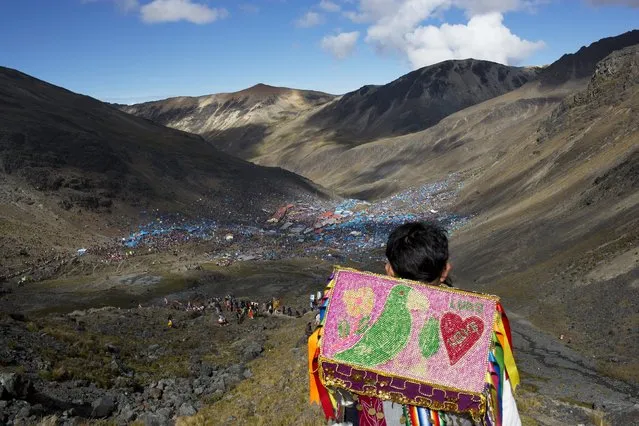
In this May 24, 2016 photo, a young boy descends the Qullqip'unqu mountain looking out at the tens of thousands of pilgrims gathered to celebrate the three-day festival Qoyllur Rit’i, translated from the Quechua language as Snow Star, in the Andean Sinakara Valley, in Peru's Cusco region. The celebration that mixes Catholic and indigenous beliefs honors Jesus as well as the area’s glacier, which is considered sacred among some indigenous people. While the native celebration is far older, the Christian part of the ritual stretches back to the 1700s, when Jesus is said to have appeared to a young shepherd in the form of another boy. (Photo by Rodrigo Abd/AP Photo)

In this May 24, 2016 photo, a young boy descends the Qullqip'unqu mountain looking out at the tens of thousands of pilgrims gathered to celebrate the three-day festival Qoyllur Rit’i, translated from the Quechua language as Snow Star, in the Andean Sinakara Valley, in Peru's Cusco region. The celebration that mixes Catholic and indigenous beliefs honors Jesus as well as the area’s glacier, which is considered sacred among some indigenous people. While the native celebration is far older, the Christian part of the ritual stretches back to the 1700s, when Jesus is said to have appeared to a young shepherd in the form of another boy. (Photo by Rodrigo Abd/AP Photo)
Details
04 Jun 2016 11:52:00
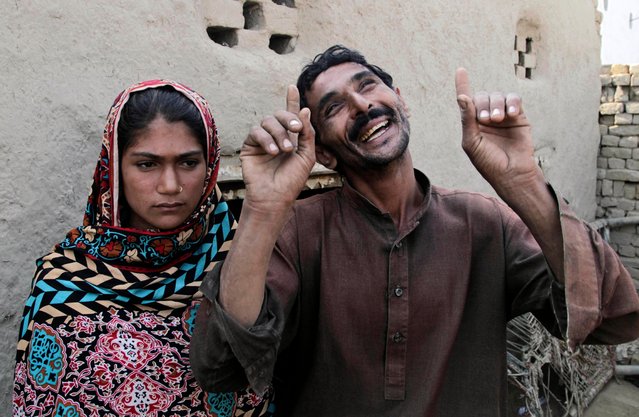
In this Tuesday, December 20, 2016 photo, Mohammad Ramzan, right, reacts while talking to The Associated Press with his young bride Saima in Jampur, Pakistan. Saima was given as a bride to the older man by her father so he could marry the groom’s sister, a practice of exchanging girls that is entrenched in conservative regions of Pakistan. It even has its own name in Urdu: Watta Satta, “give and take”. A mix of interests – family obligations, desire for sons, a wish to hand off a girl to a husband – can lead to a young teen in an a marriage she never sought. (Photo by K.M. Chaudhry/AP Photo)

In this Tuesday, December 20, 2016 photo, Mohammad Ramzan, right, reacts while talking to The Associated Press with his young bride Saima in Jampur, Pakistan. Saima was given as a bride to the older man by her father so he could marry the groom’s sister, a practice of exchanging girls that is entrenched in conservative regions of Pakistan. It even has its own name in Urdu: Watta Satta, “give and take”. A mix of interests – family obligations, desire for sons, a wish to hand off a girl to a husband – can lead to a young teen in an a marriage she never sought. (Photo by K.M. Chaudhry/AP Photo)
Details
31 Dec 2016 10:08:00
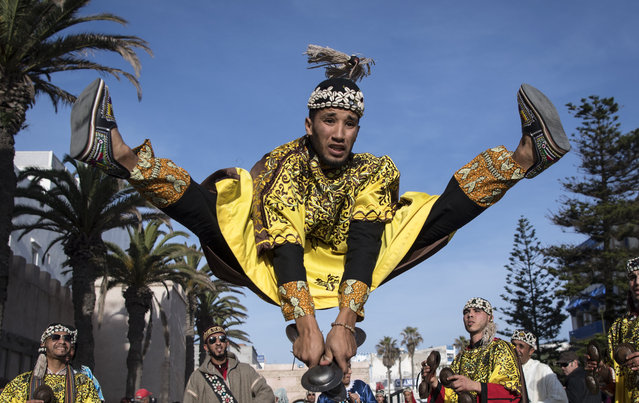
A Gnawa traditional group performs in the city of Essaouira on December 14, 2019, to celebrate the decision of adding the Gnawa culture to UNESCO's list of Intangible Cultural Heritage of Humanity. Gnawa culture, a centuries-old Moroccan practice rooted in music, African rituals and Sufi traditions, was added to UNESCO's list of Intangible Cultural Heritage of Humanity earlier in the week. Gnawa refers to a “set of musical productions, fraternal practices and therapeutic rituals where the secular mixes with the sacred”, according to the nomination submitted by Morocco. Often dressed in colourful outfits, Gnawa musicians play the guenbri, a type of lute with three strings, accompanied by steel castanets called krakebs. (Photo by Fadel Senna/AFP Photo)

A Gnawa traditional group performs in the city of Essaouira on December 14, 2019, to celebrate the decision of adding the Gnawa culture to UNESCO's list of Intangible Cultural Heritage of Humanity. Gnawa culture, a centuries-old Moroccan practice rooted in music, African rituals and Sufi traditions, was added to UNESCO's list of Intangible Cultural Heritage of Humanity earlier in the week. Gnawa refers to a “set of musical productions, fraternal practices and therapeutic rituals where the secular mixes with the sacred”, according to the nomination submitted by Morocco. Often dressed in colourful outfits, Gnawa musicians play the guenbri, a type of lute with three strings, accompanied by steel castanets called krakebs. (Photo by Fadel Senna/AFP Photo)
Details
18 Dec 2019 00:05:00
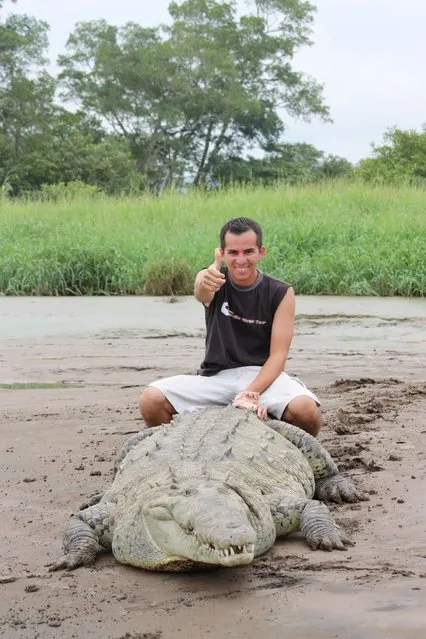
A tour guide shows a thumbs up as he sits on top of a crocodile on the Tarcoles river in Tarcoles, Costa Rica. (Photo and caption by Barcroft Media)

To most of us, hand-feeding crocodiles might sound like a one-way ticket to a watery grave. But for Jose Eduardo Chaves Salas, 32, coming within inches of the fearsome creatures’ razor-sharp teeth is all in a day’s work. He runs Jose's Crocodile River Tour on the Tarcoles River in Costa Rica, where tourists can watch him feed crocs up to 17 feet long. Photo: A tour guide shows a thumbs up as he sits on top of a crocodile on the Tarcoles river in Tarcoles, Costa Rica. (Photo and caption by Barcroft Media)
Details
20 Oct 2013 09:06:00