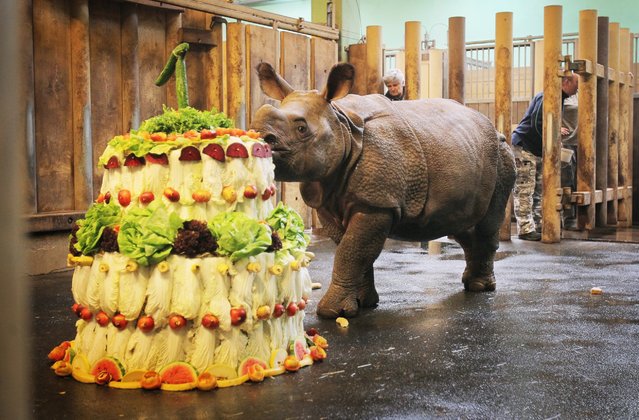
A female Indian rhinoceros called Maruska eats a vegetable birthday cake on her first birthday celebration at the Plzen Zoo on February 3, 2015 in Plzen, Czech Republic. (Photo by Ladislav Nemec/Isifa)
No. 10: Sphynx. A suede-like coat is the sphynx's most unmistakable feature, but he's also curious, smart and a clown who craves applause for his antics. In fact, he loves attention so much that you may want to consider getting him a fellow sphynx playmate. (Photo by Quentin Descotte)
A pug dressed as Yoda from the movie Star Wars walks along the runway at the 9th Annual Pug Parade on February 25, 2006 in Bradenton, Florida. 117 pugs competed for 10 prizes in 6 categories. Proceeds from the event benefit the Sarasota County Humane Society. (Photo by Phillippe Diederich/Getty Images)
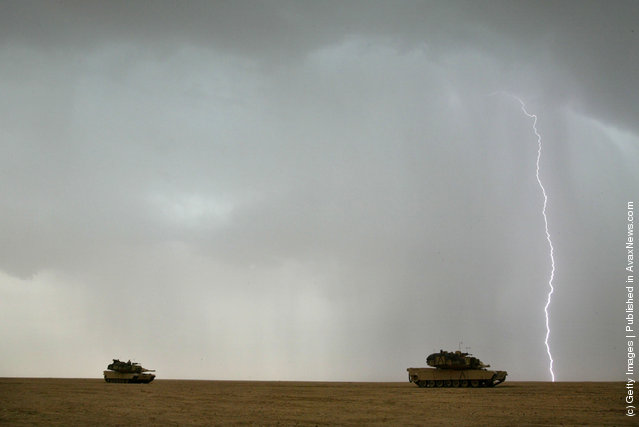
A lighting bolt flashes in the sky as U.S. Army M1A1 Abram tanks roll through the desert December 9, 2002 near the Iraqi border in Kuwait. (Photo by Joe Raedle/Getty Images)
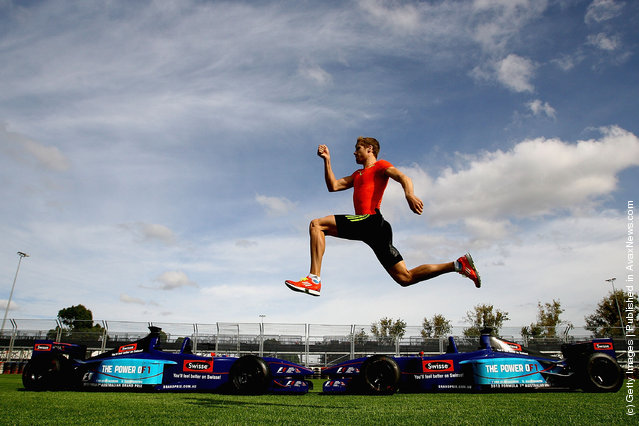
Henry Frayne of Australia shows his ability to triple jump the lenghth of more than two Formula 1 cars during a press conference at Albert Park on February 29, 2012 in Melbourne, Australia. (Photo by Robert Prezioso/Getty Images)
India's Central Reserve Police Force personnel take part in a rehearsal for the Republic Day parade on a cold winter morning in New Delhi January 8, 2014. (Photo by Ahmad Masood/Reuters)
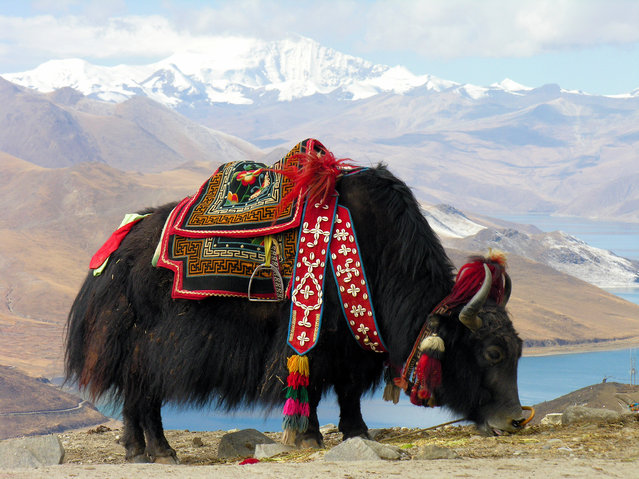
Yak near Yamdrok lake, Tibet. It is a long-haired bovinae found throughout the Himalayan region of south Central Asia, the Tibetan Plateau and as far north as Mongolia and Russia. The Tibetan economy is dominated by subsistence agriculture. Due to limited arable land, the primary occupation of the Tibetan Plateau is raising livestock, such as sheep, cattle, goats, camels, yaks, dzo, and horses. The Tibetan yak is an integral part of Tibetan life. (Photo by Dennis Jarvis)
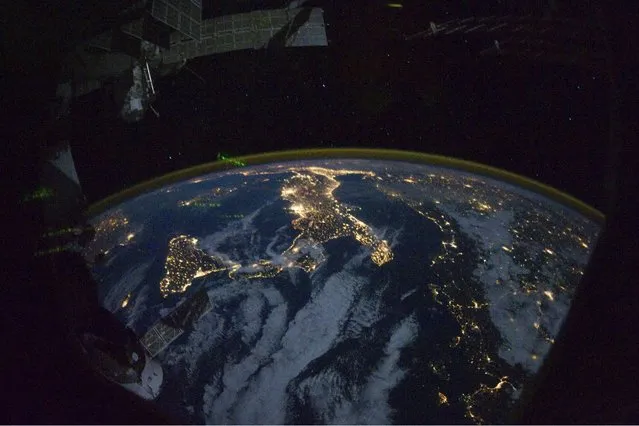
This image provided by NASA shows parts of Europe and Africa very easily recognizable in this night time image shot by one of the Expedition 25 crew members aboard the International Space Station flying 220 miles above Earth on Thursday October 28, 2010. The view “looks” northward over Sicily and the “boot” of Italy, with the Mediterranean Sea representing most of the visible water in the view and the Adriatic Sea to the right of center. Tunisia is partially visible at left. Part of a docked Russian spacecraft and other components of the ISS are in the foreground. (Photo by AP Photo/NASA)