Loading...
Done
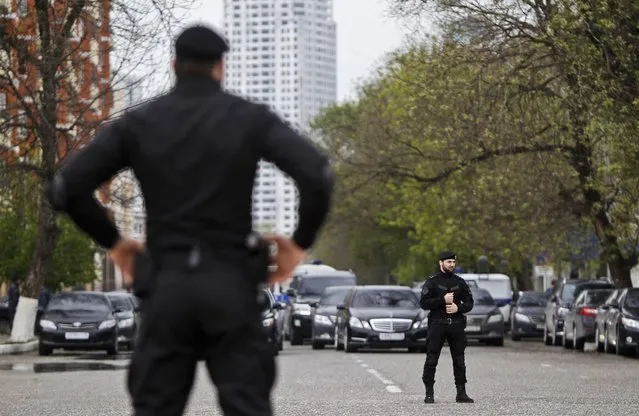
Special forces officers stand guard during a government-organised event marking Chechen language day in the centre of the Chechen capital Grozny April 25, 2013. (Photo by Maxim Shemetov/Reuters)

“What did I know about Chechnya before last week? For someone who grew up in the 1990s the very word Chechnya meant a string of grainy images on TV showing people in battered camouflage outfits, shooting at each other amid destruction and ruin. Fear, wahhabis, Shamil Basayev, terrorism, mountains: these were the words that used to spring to my mind when someone mentioned Chechnya”. – Maxim Shemetov. Photo: Special forces officers stand guard during a government-organised event marking Chechen language day in the centre of the Chechen capital Grozny April 25, 2013. (Photo by Maxim Shemetov/Reuters)
Details
14 May 2013 12:02:00
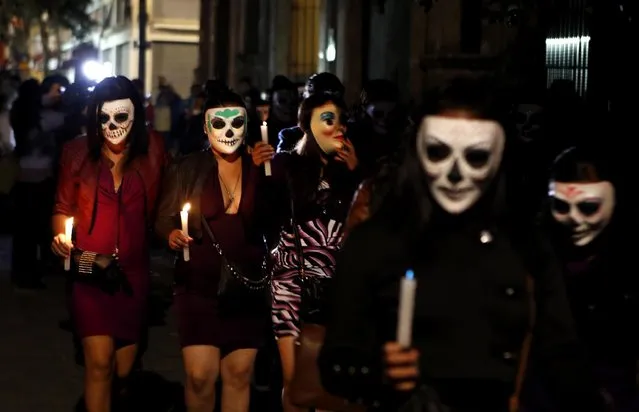
s*x workers, wearing decorative skull masks, march through the streets in downtown Mexico City, Friday, October 28, 2016. The women march with candles to an altar dedicated to their departed colleagues, many who died violently at the hands of their customers. This annual procession, tied to the Day of the Dead festivities, has taken place for more than 20 years. (Photo by Eduardo Verdugo/AP Photo)

s*x workers, wearing decorative skull masks, march through the streets in downtown Mexico City, Friday, October 28, 2016. The women march with candles to an altar dedicated to their departed colleagues, many who died violently at the hands of their customers. This annual procession, tied to the Day of the Dead festivities, has taken place for more than 20 years. (Photo by Eduardo Verdugo/AP Photo)
Details
31 Oct 2016 11:28:00
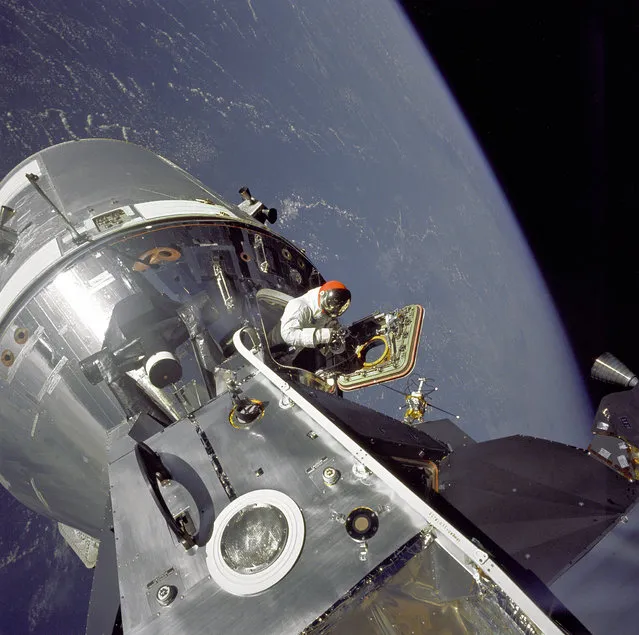
Apollo 9 Command/Service Modules (CSM) nicknamed “Gumdrop” and Lunar Module (LM), nicknamed “Spider” are shown docked together as Command Module pilot David R. Scott stands in the open hatch. Astronaut Russell L. Schweickart, Lunar Module pilot, took this photograph of Scott during his EVA as he stood on the porch outside the Lunar Module. Apollo 9 was an Earth orbital mission designed to test docking procedures between the CSM and LM as well as test fly the Lunar Module in the relative safe confines of Earth orbit. (Photo by NASA)

Apollo 9 Command/Service Modules (CSM) nicknamed “Gumdrop” and Lunar Module (LM), nicknamed “Spider” are shown docked together as Command Module pilot David R. Scott stands in the open hatch. Astronaut Russell L. Schweickart, Lunar Module pilot, took this photograph of Scott during his EVA as he stood on the porch outside the Lunar Module. Apollo 9 was an Earth orbital mission designed to test docking procedures between the CSM and LM as well as test fly the Lunar Module in the relative safe confines of Earth orbit. (Photo by NASA)
Details
20 Jul 2014 11:47:00
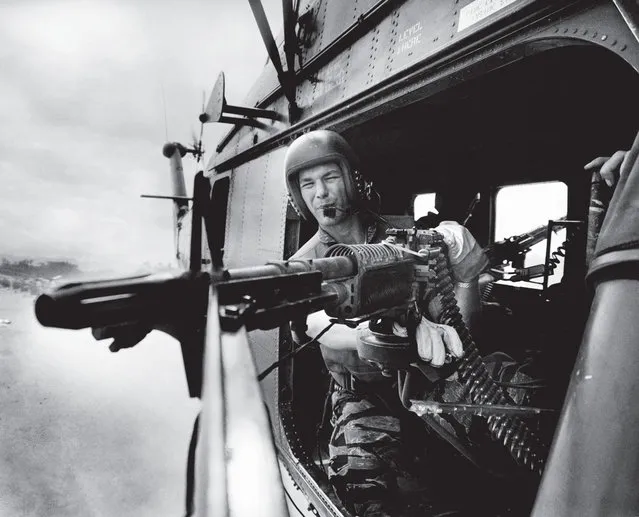
Man your battle stations: The crew chief of helicopter Yankee Papa 13, lance corporal James C. Farley, mans an M-60 machine gun during a mission near Da Nang, Vietnam on March 31, 1965. (Photo by Larry Burrows/Time & Life Pictures)

In the spring of 1965, within weeks of 3,500 American Marines arriving in Vietnam, a 39-year-old Briton named Larry Burrows began work on a feature for LIFE magazine, chronicling the day-to-day experience of U.S. troops on the ground – and in the air – in the midst of the rapidly widening war. The photographs in this gallery focus on a calamitous March 31, 1965, helicopter mission; Burrows’ “report from Da Nang”, featuring his pictures and his personal account of the harrowing operation, was published two weeks later as a now-famous cover story in the April 16, 1965, issue of LIFE.

Photo: Man your battle stations: The crew chief of helicopter Yankee Papa 13, lance corporal James C. Farley, mans an M-60 machine gun during a mission near Da Nang, Vietnam on March 31, 1965. (Photo by Larry Burrows/Time & Life Pictures)
Details
07 Apr 2013 07:08:00
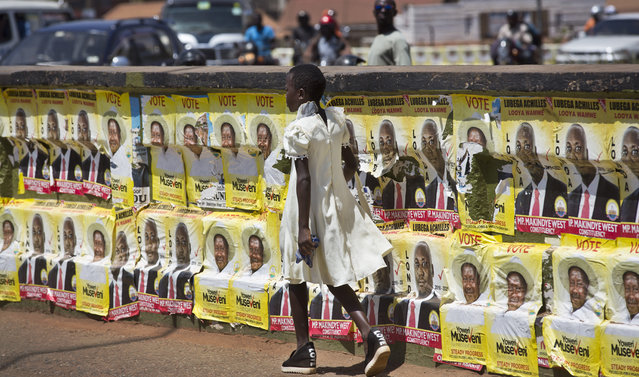
A girl walks past campaign posters for long-time President Yoweri Museveni, as well as for local members of Parliament, on a street in Kampala, Uganda Wednesday, February 17, 2016. On the eve of presidential elections, a heavy police and military presence could be seen in the capital Kampala. (Photo by Ben Curtis/AP Photo)

A girl walks past campaign posters for long-time President Yoweri Museveni, as well as for local members of Parliament, on a street in Kampala, Uganda Wednesday, February 17, 2016. On the eve of presidential elections, a heavy police and military presence could be seen in the capital Kampala. (Photo by Ben Curtis/AP Photo)
Details
18 Feb 2016 13:39:00
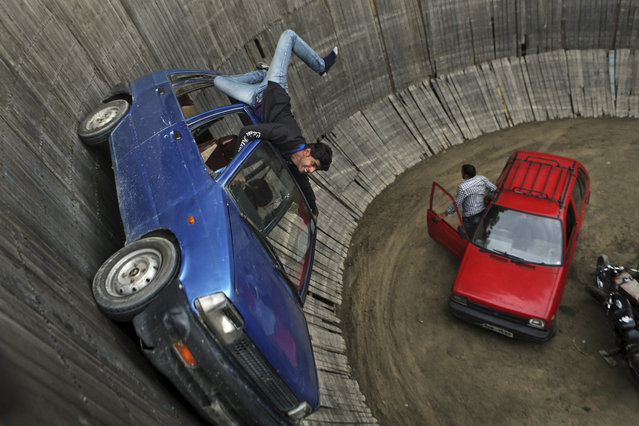
A stuntman performs in a car at the “Well of Death” at an exhibition in Srinagar, India, Friday, May 23, 2014. In the Well of Death, stunt drivers on motorbikes and cars drive in circles around the vertical walls of the well-shaped construction. (Photo by Dar Yasin/AP Photo)

A stuntman performs in a car at the “Well of Death” at an exhibition in Srinagar, India, Friday, May 23, 2014. In the Well of Death, stunt drivers on motorbikes and cars drive in circles around the vertical walls of the well-shaped construction. (Photo by Dar Yasin/AP Photo)
Details
24 May 2014 13:08:00
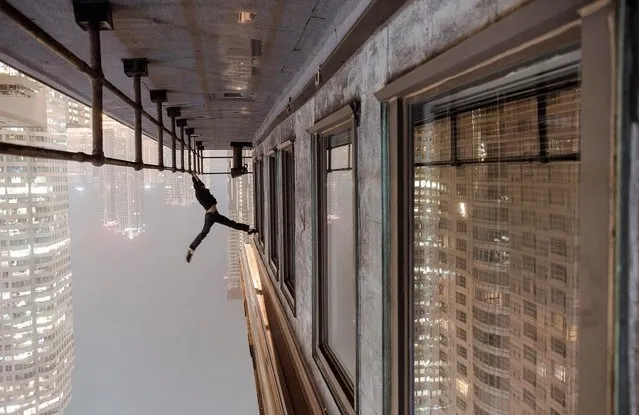
“Hung up”. (Photo by Roof Topper)

“Been on more roofs than santa clause” – Roof Topper. Photo: “Hung up”. (Photo by Roof Topper)
Details
13 Jul 2014 11:08:00
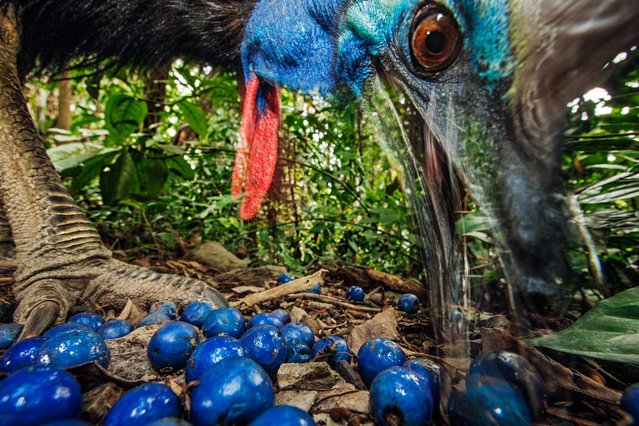
“Cassowaries are large, flightless birds related to emus and (more distantly) to ostriches, rheas, and kiwis”, writes Olivia Judson in the September issue of National Geographic magazine. (Photo by Christian Ziegler/National Geographic)

“Cassowaries are large, flightless birds related to emus and (more distantly) to ostriches, rheas, and kiwis”, writes Olivia Judson in the September issue of National Geographic magazine. How large? People-size: Adult males stand well over five foot five and top 110 pounds. Females are even taller, and can weigh more than 160 pounds. Dangerous when roused, they’re shy and peaceable when left alone. But even birds this big and tough are prey to habitat loss. The dense New Guinea and Australia rain forests where they live have dwindled. Today cassowaries might number 1,500 to 2,000. And because they help shape those same forests – by moving seeds from one place to another – “if they vanish”, Judson writes, “the structure of the forest would gradually change” too. (Photo by Christian Ziegler/National Geographic)
Details
06 Jan 2014 12:21:00