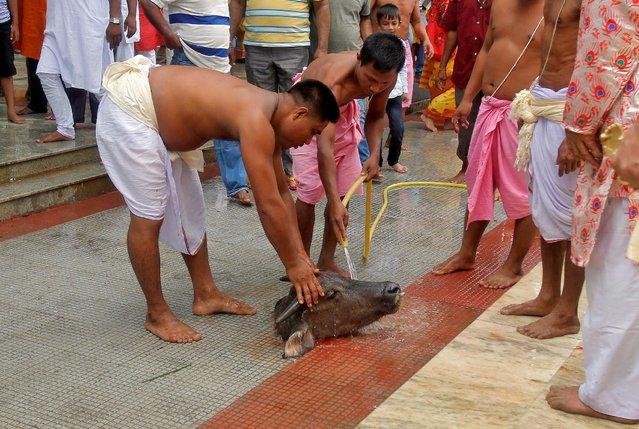
Hindu priests wash the head of a buffalo calf which was sacrificed as part of a ritual at a temple during the Durga Puja festival in Agartala, India, October 10, 2016. (Photo by Jayanta Dey/Reuters)
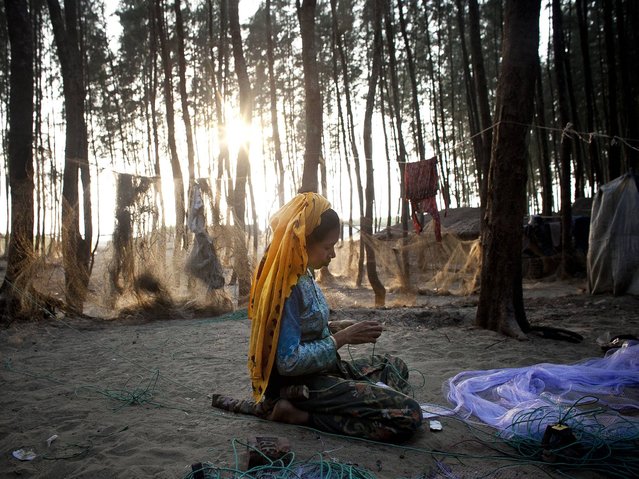
32 year old Mahada Khatum repairs a fishing net outside her home in the Shamalapur Rohingya refugee settlement on April 11, 2014 in Chittagong district, Bangladesh. Some years ago she escaped violence and discrimination from the Zomgara Baharchara village in the Meherulla district of Myanmar. (Photo by Getty Images/Stringer)
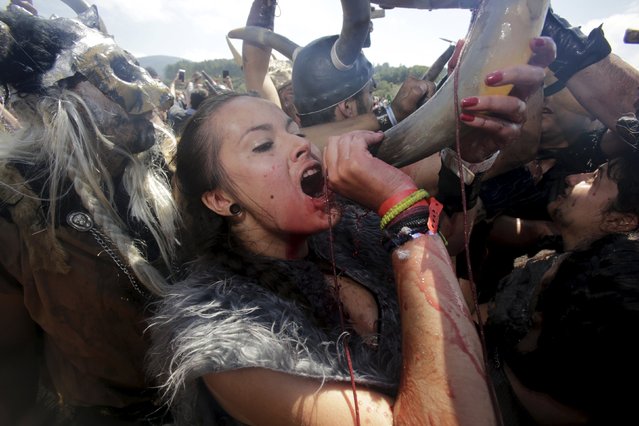
A woman dressed as a Viking drinks local red wine during the annual Viking festival of Catoira in north-western Spain August 2, 2015. The festival re-enacts past Viking raids in the area and is celebrated annually on the first Sunday in August. (Photo by Miguel Vidal/Reuters)
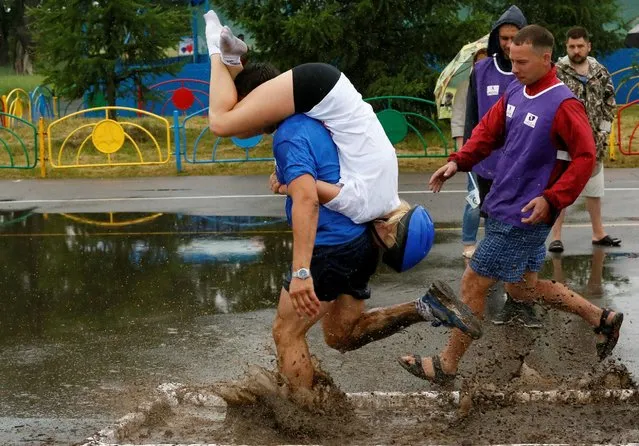
A man carries his wife over an obstacle while competing in the Wife Carrying Championship to mark City Day in Krasnoyarsk, Siberia, Russia, June 25, 2016. (Photo by Ilya Naymushin/Reuters)
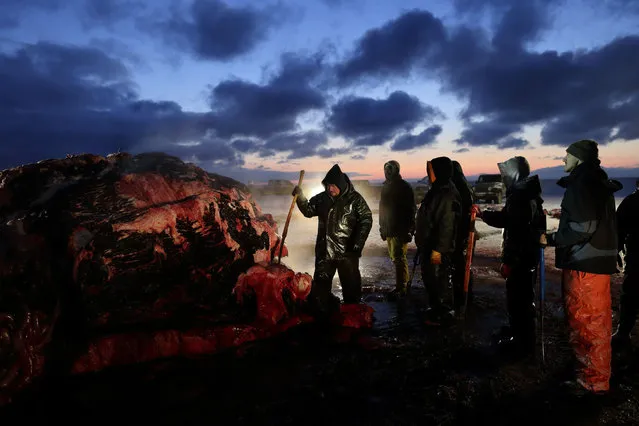
In this October 7, 2014, photo, Fredrick Brower, center, helps cut up a bowhead whale caught by Inupiat subsistence hunters on a field near Barrow, Alaska. Drawing on tradition, and keeping within the closely monitored Aboriginal subsistence whaling guidelines, a bowhead whale is carved and divided by a crew armed with knives and hooks, and then shared according to custom. (Photo by Gregory Bull/AP Photo)
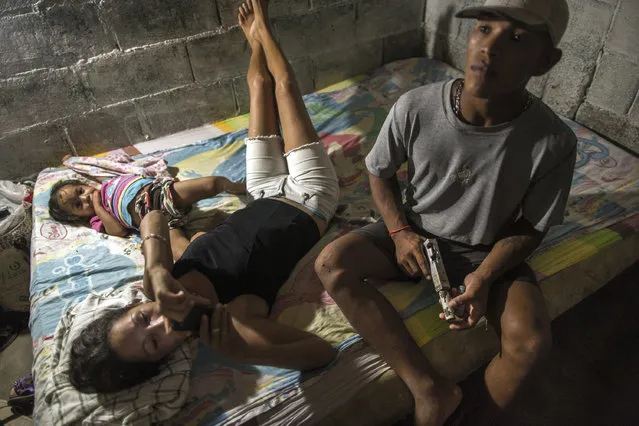
In this November 7, 2016 photo, “El Menor”, a member of “Los Cainos” self-defense group formed by the Marval fishing family, holds a homemade gun before starting a night patrol to help protect fishermen from pirate attacks in Punta de Araya, Sucre state, Venezuela. Pirates are terrorizing the coastal state of Sucre, once home to the world's fourth-largest tuna fleet and a thriving fishing industry. (Photo by Rodrigo Abd/AP Photo)
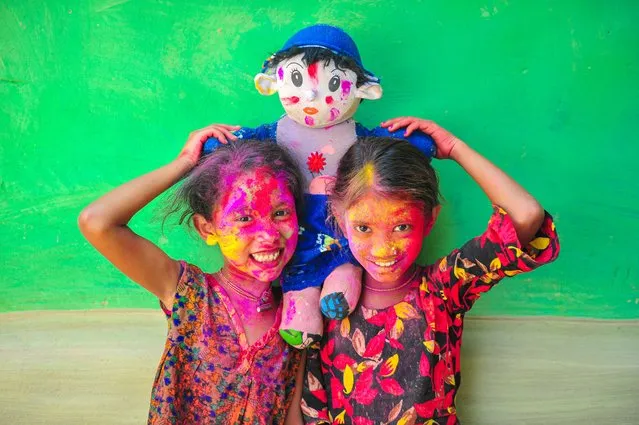
Bangladeshi children from Khan Tea garden posing for photos on March 23, 2022 with their faces painted after adorning with colors like Rainbows on the celebration of the annual Hindu festival of colors, known as Holi festival marking the onset of spring. (Photo by Md Rafayat Haque Khan/Eyepix Group/Rex Features/Shutterstock)
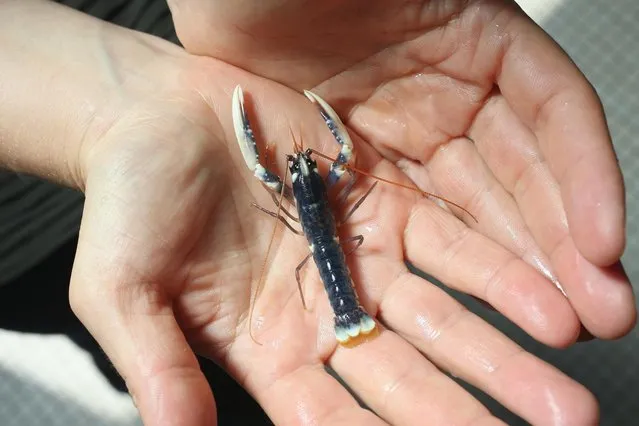
Isabel Schmalenbach, an environmental scientist with the Helgoland Biological Institute (Biologische Anstalt Helgoland), part of the Alfred Wegener Institute for Polar and Marine Research, holds a one-year old baby European lobster (Homarus gammarus) raised at the institute on August 3, 2013 on Helgoland Island, Germany. Later in the day Schmalenbach and her colleagues released a total of 415 one-year old lobsters into the North Sea as part of an effort to repopulate the lobster population around Helgoland (also called Heligoland). In the 19th century local fishermen caught up to 80,000 lobsters a year in the surrounding waters, combined with the heavy allied bombing of the island during and after World War II, as well as other environmental factors, decimated the lobster population. (Photo by Sean Gallup)