Loading...
Done
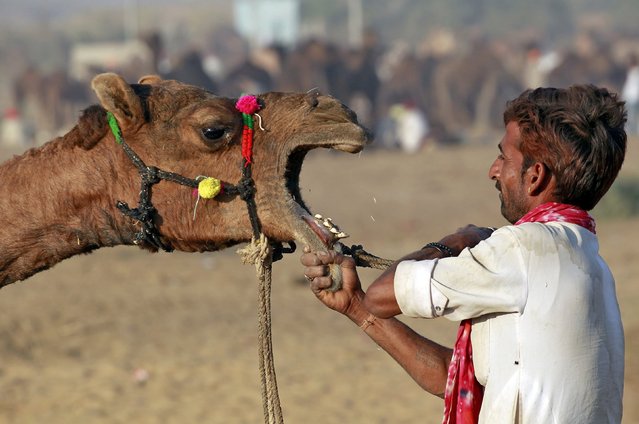
A camel herder removes the rope from the mouth of a camel at the Pushkar Fair in Rajasthan, India, November 22, 2015. Thousands of animals, mainly camels, are brought to the annual fair to be traded. (Photo by Jitendra Prakash/Reuters)

A camel herder removes the rope from the mouth of a camel at the Pushkar Fair in Rajasthan, India, November 22, 2015. Thousands of animals, mainly camels, are brought to the annual fair to be traded. (Photo by Jitendra Prakash/Reuters)
Details
23 Nov 2015 08:07:00
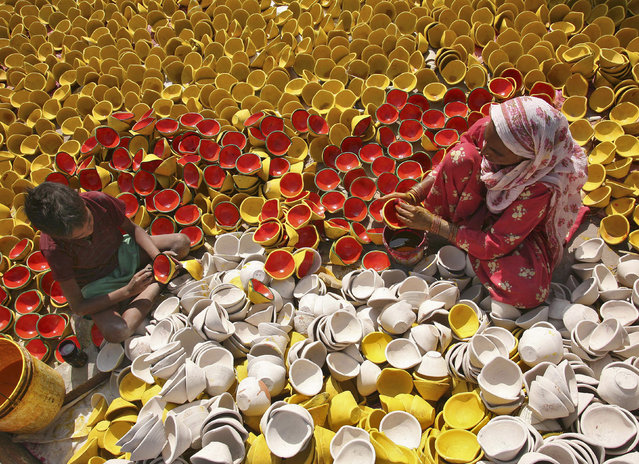
Potters colour earthen lamps at a workshop ahead of the Hindu festival of Diwali in Amritsar October 15, 2014. Earthen lamps are sold in large numbers during Diwali, the annual Hindu festival of lights, as people use them to decorate their homes. (Photo by Munish Sharma/Reuters)

Potters colour earthen lamps at a workshop ahead of the Hindu festival of Diwali in Amritsar October 15, 2014. Earthen lamps are sold in large numbers during Diwali, the annual Hindu festival of lights, as people use them to decorate their homes. (Photo by Munish Sharma/Reuters)
Details
21 Oct 2014 12:01:00
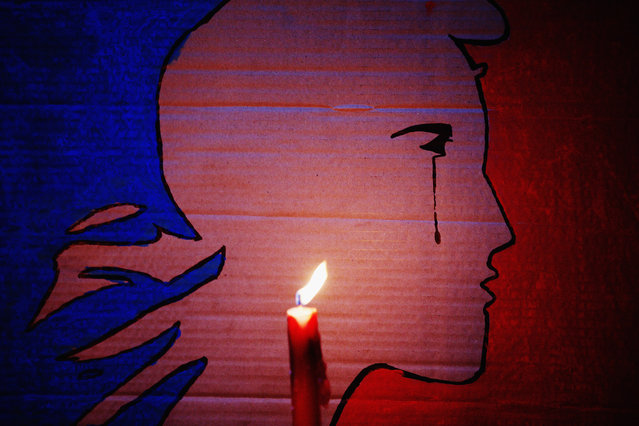
A candle burns during a vigil in Aotea Square to remember victims of the Paris attacks on November 14, 2015 in Auckland, New Zealand. According to reports, over 150 people were killed in a series of bombings and shootings across Paris, including at a soccer game at the Stade de France and a concert at the Bataclan theater. (Photo by Hannah Peters/Getty Images)

A candle burns during a vigil in Aotea Square to remember victims of the Paris attacks on November 14, 2015 in Auckland, New Zealand. According to reports, over 150 people were killed in a series of bombings and shootings across Paris, including at a soccer game at the Stade de France and a concert at the Bataclan theater. (Photo by Hannah Peters/Getty Images)
Details
16 Nov 2015 08:08:00
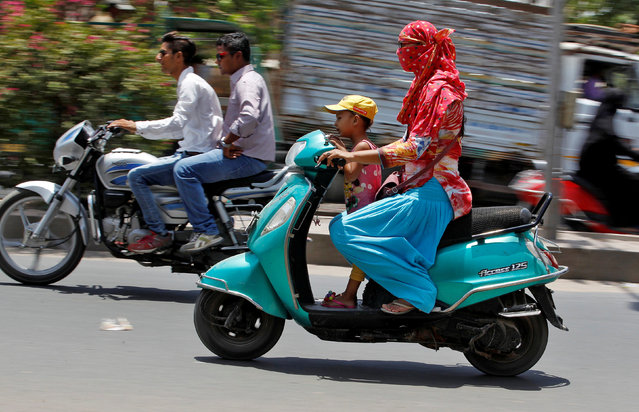
A woman shields her face from the sun as she rides her scooter in Ahmedabad, India May 20, 2016. (Photo by Amit Dave/Reuters)

A woman shields her face from the sun as she rides her scooter in Ahmedabad, India May 20, 2016. (Photo by Amit Dave/Reuters)
Details
23 May 2016 09:28:00
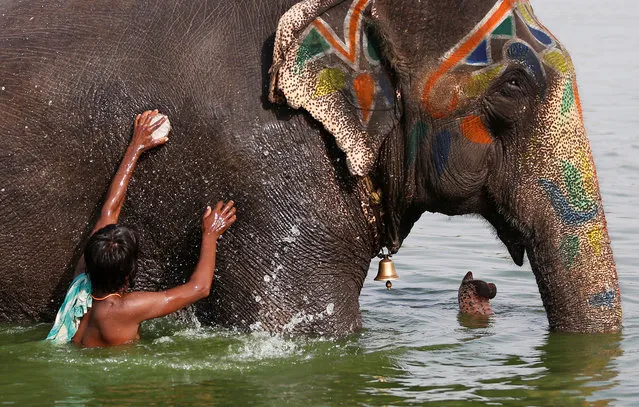
A mahout bathes his elephant in the river Sabarmati on a hot summer day in Ahmedabad, India May 21, 2017. (Photo by Amit Dave/Reuters)

A mahout bathes his elephant in the river Sabarmati on a hot summer day in Ahmedabad, India May 21, 2017. (Photo by Amit Dave/Reuters)
Details
31 May 2017 06:42:00
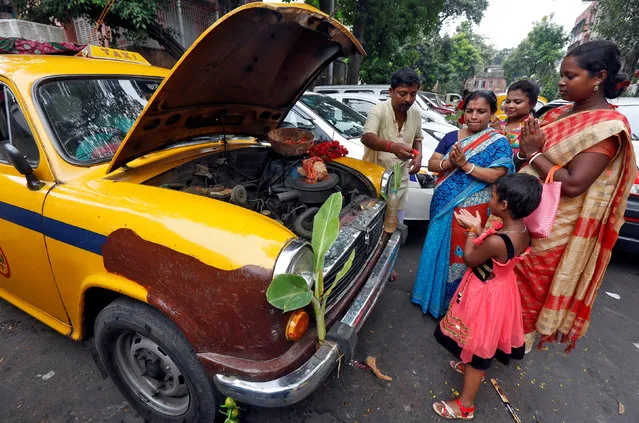
Family members of a taxi driver offer prayer in front of their taxi during the Vishwakarma Puja or the festival of the Hindu deity of architecture and machinery in Kolkata, India, September 17, 2017. (Photo by Rupak De Chowdhuri/Reuters)

Family members of a taxi driver offer prayer in front of their taxi during the Vishwakarma Puja or the festival of the Hindu deity of architecture and machinery in Kolkata, India, September 17, 2017. (Photo by Rupak De Chowdhuri/Reuters)
Details
22 Sep 2017 07:09:00
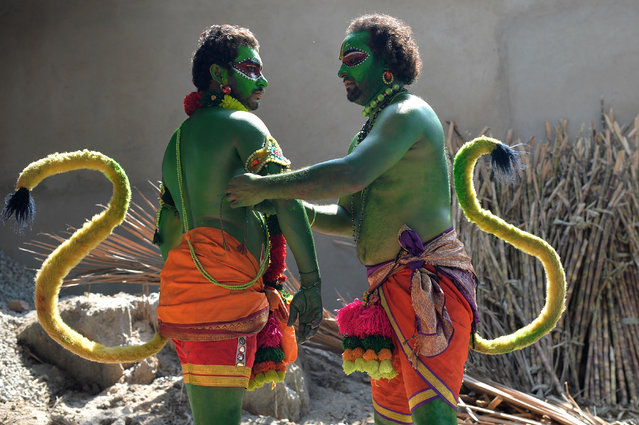
Indian artists dress up as the Hindu deity “Hanuman” – the monkey God in Hindu mythology – to mark the Rama Navami festival in Bangalore on March 25, 2018. Rama Navami is a spring Hindu festival that celebrates the birthday of the deity Rama. He is particularly important to the Vaishnavism tradition of Hinduism, as the seventh avatar of Vishnu. (Photo by Manjunath Kiran/AFP Photo)

Indian artists dress up as the Hindu deity “Hanuman” – the monkey God in Hindu mythology – to mark the Rama Navami festival in Bangalore on March 25, 2018. Rama Navami is a spring Hindu festival that celebrates the birthday of the deity Rama. He is particularly important to the Vaishnavism tradition of Hinduism, as the seventh avatar of Vishnu. (Photo by Manjunath Kiran/AFP Photo)
Details
27 Mar 2018 00:03:00
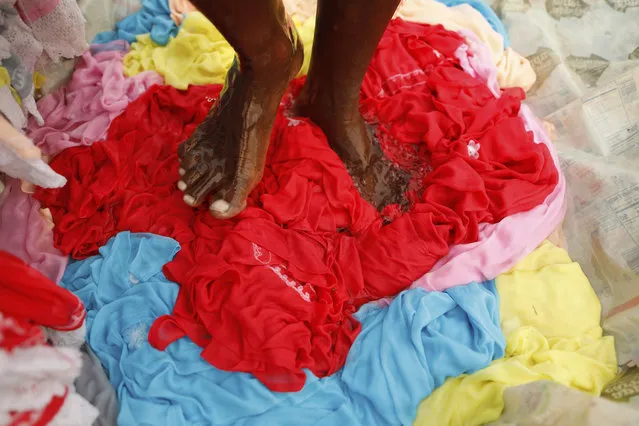
A dhobi, or a washerman washes cloths on the banks of the River Gomti in Lucknow, India, Saturday, September 12, 2020. Dhobis are traditional laundry workers who wash clothes by hand and dry them in the sun, an occupation which has been in existence for generations. Most cities in India have a Dhobi Ghat, or washermen's area, where the city's pile of clothes is laundered. This practice is still popular in India, despite of modern technology. Around 1,000 families work in Lucknow's Dhobi Ghat. However, in light of the novel coronavirus, their wages have decreased drastically. With each family earning around US$100-200 per month. (Photo by Rajesh Kumar Singh/AP Photo)

A dhobi, or a washerman washes cloths on the banks of the River Gomti in Lucknow, India, Saturday, September 12, 2020. Dhobis are traditional laundry workers who wash clothes by hand and dry them in the sun, an occupation which has been in existence for generations. Most cities in India have a Dhobi Ghat, or washermen's area, where the city's pile of clothes is laundered. This practice is still popular in India, despite of modern technology. Around 1,000 families work in Lucknow's Dhobi Ghat. However, in light of the novel coronavirus, their wages have decreased drastically. With each family earning around US$100-200 per month. (Photo by Rajesh Kumar Singh/AP Photo)
Details
25 Sep 2020 00:03:00