Loading...
Done
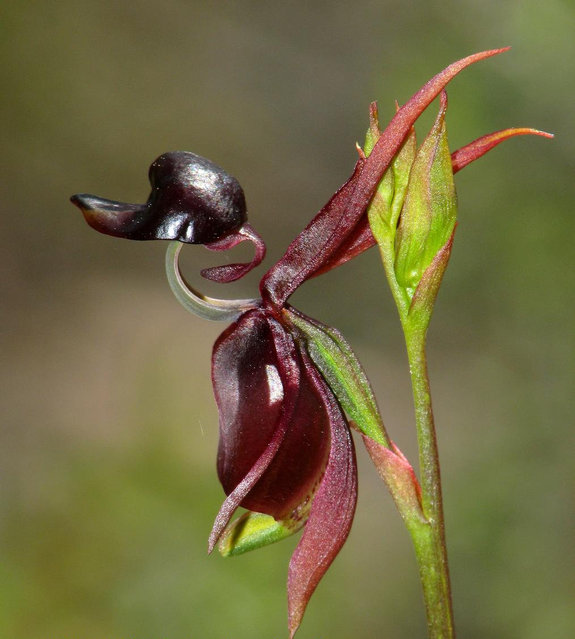
The Flying Duck Orchid

Caleana major, the Flying Duck Orchid is a small orchid found in eastern and southern Australia. This terrestrial plant features a remarkable flower, resembling a duck in flight. The flower is an attractant to insects, such as male sawflies which pollinate the flower in a process known as pseudocopulation. In 1986 this orchid was featured on an Australian postage stamp.


See Also: Monkey Orchid
Details
22 Apr 2013 10:56:00
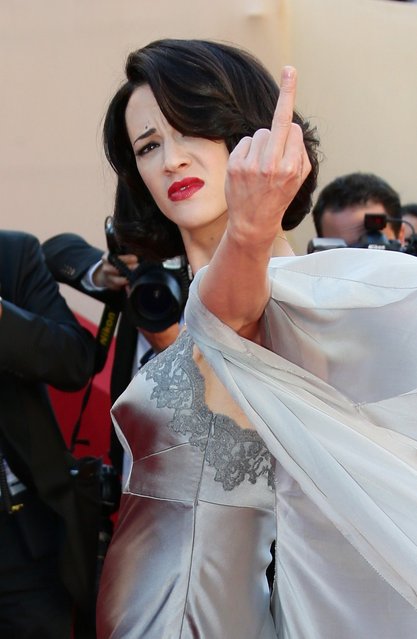
Actress Asia Argento attends the “Zulu” Premiere and Closing Ceremony during the 66th Annual Cannes Film Festival at the Palais des Festivals on May 26, 2013 in Cannes, France.  (Photo by Vittorio Zunino Celotto/Getty Images)

Actress Asia Argento attends the “Zulu” Premiere and Closing Ceremony during the 66th Annual Cannes Film Festival at the Palais des Festivals on May 26, 2013 in Cannes, France. (Photo by Vittorio Zunino Celotto)
Details
27 May 2013 11:39:00
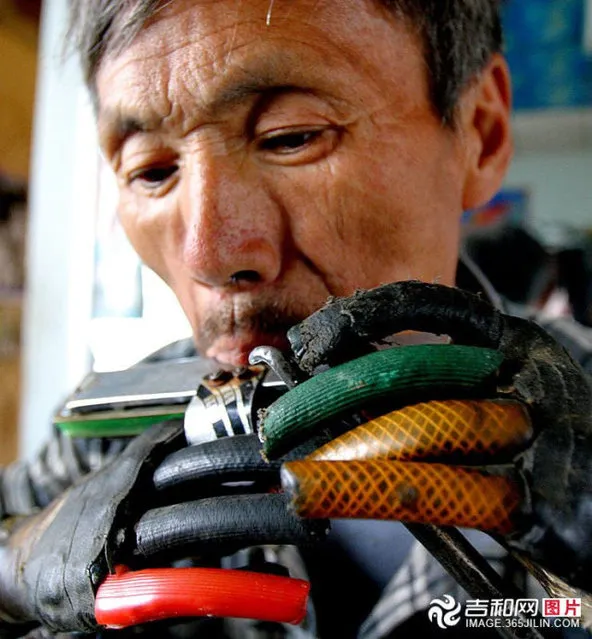
Farmer Builds Own Bionic Arms

Sun Jifa, a farmer in China, had his life changed forever when an explosive he planned on using for fishing went off prematurely. He lost his arms and when he couldn’t afford high-end, hospital-made prosthetics he opted for a cheaper set. Finding those to be less than acceptable, Sun started building his own pair of arms, which he currently wears. It’s an incredible story of ingenuity and personal strength.
Details
14 Jun 2013 10:02:00
Book Sculpture by Justin Rowe

Justin Rowe creates these magical sculptures from hand cut books and found images with the help of just a touch of gum arabic and 24 carat gold or palladium leaf. Some are very much in the realms of fairy stories like the one above, but my favourites are the stories below where Justin’s skill brings the book’s own illustrations to life.
Details
18 Nov 2013 12:58:00


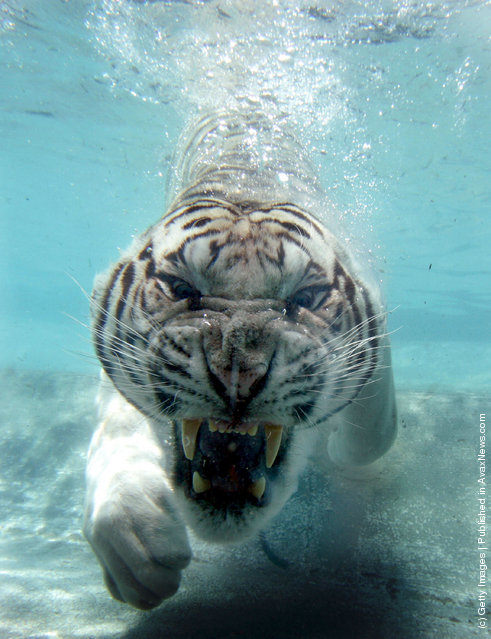
Odin, a five year-old White Bengal Tiger dives for a piece of meat thrown to him by a trainer during a big cat show at Six Flags Discovery Kingdom June 1, 2007 in Vallejo, California. Unlike most cats that are afraid of water, Odin loves diving in the pool to retrieve bits of meat fed to him by his trainers. (Photo by Justin Sullivan/Getty Images)
Details
25 Apr 2011 10:32:00
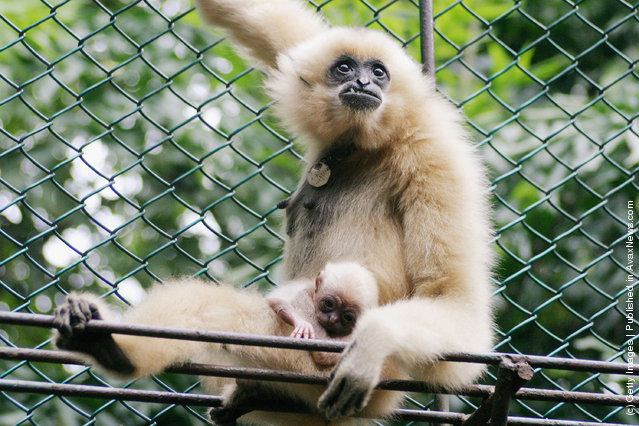
Newborn White-Cheeked Gibbon Nomascus

“Nomascus is the second most speciose genus of gibbons (family Hylobatidae). Originally this genus was a subgenus of Hylobates, and all individuals were considered one species, Hylobates concolor. Species within Nomascus are characterized by 52 chromosomes. Some species are all black, some light with a distinct black tuft of crown fur, and some by distinct, light-colored cheek patches. Nomascus is found from southern China (Yunnan) to southern Vietnam, and also on Hainan Island. One of the genus' species, Nomascus nasutus, has been deemed “the most critically endangered ape species in the world”. All of the species in this genus are endangered or critically endangered”. – Wikipedia

Photo: A newborn White-Cheeked Gibbon clings to its mother in the Nanning Zoo on April 12, 2004 in Nanning, Guangxi province, China. The White-Cheeked Gibbon's natural habitat is Southern China as well as Vietnam and Laos. They are classified as highly endangered and are on the brink of extinction due to poaching and reduction of natural rainforests. (Photo by Getty Images)

Details
12 Aug 2011 11:51:00
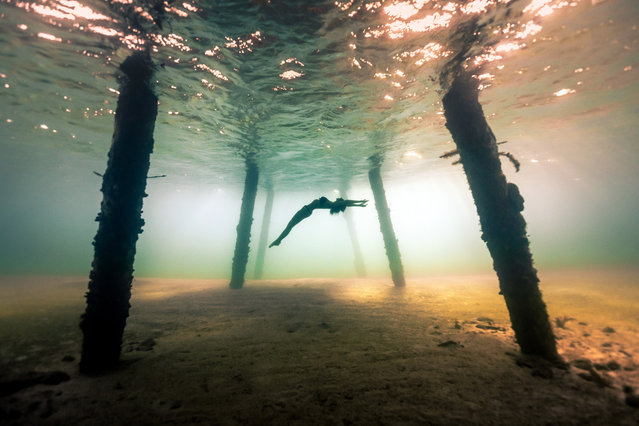
A diver swims in the shallow water under a pier. (Photo by Alex Voyer/Caters News Agency)

A series of beautiful shots of divers swimming near sunken ships have emerged. Alex Voyer, 39, was sailing around the Caribbean on a 60-foot boat when he stopped for a dive. The images show amazing shipwrecks as free divers explore the seabed. Here: A diver swims in the shallow water under a pier. (Photo by Alex Voyer/Caters News Agency)
Details
27 Aug 2018 00:03:00
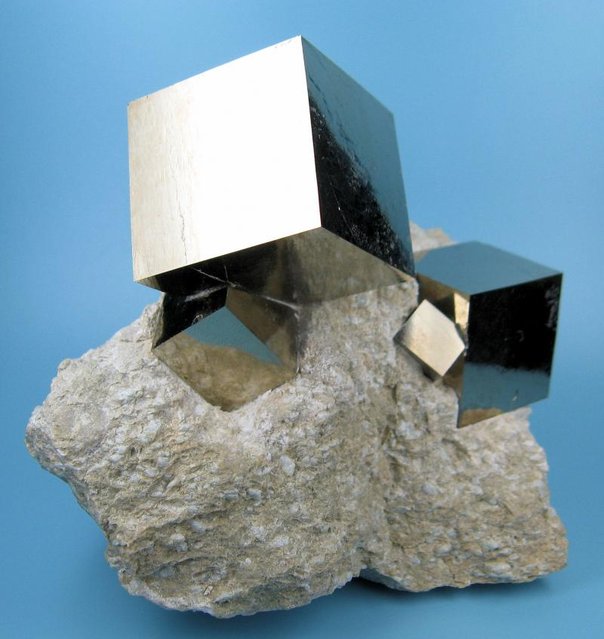
Pyrite Cubic Crystals

The mineral pyrite, or iron pyrite, also known as fool's gold, is an iron sulfide with the formula FeS2. This mineral's metallic luster and pale brass-yellow hue give it a superficial resemblance to gold, hence the well-known nickname of fool's gold. The color has also led to the nicknames brass, brazzle, and Brazil, primarily used to refer to pyrite found in coal.
In crystallography, the cubic (or isometric) crystal system is a crystal system where the unit cell is in the shape of a cube. This is one of the most common and simplest shapes found in crystals and minerals.
Details
23 Nov 2013 13:31:00