Loading...
Done
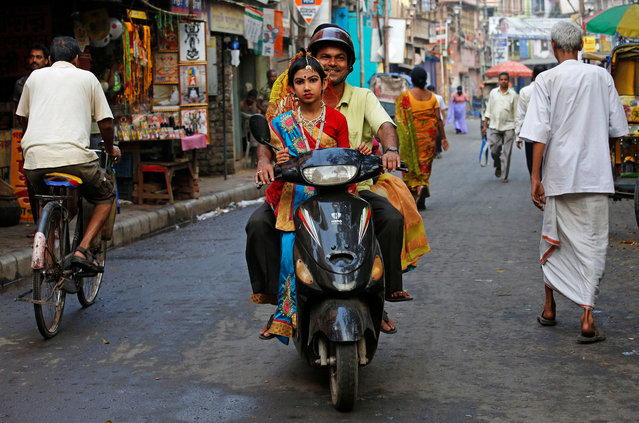
A man carries his daughter, dressed as Kumari, on a scooter, as they arrive to attend rituals to celebrate the Navratri Festival, on a road outside the Adyapeath Temple, on the outskirts of Kolkata, India on March 25, 2018. (Photo by Rupak De Chowdhuri/Reuters)

A man carries his daughter, dressed as Kumari, on a scooter, as they arrive to attend rituals to celebrate the Navratri Festival, on a road outside the Adyapeath Temple, on the outskirts of Kolkata, India on March 25, 2018. (Photo by Rupak De Chowdhuri/Reuters)
Details
06 Apr 2018 00:05:00
An Indian Hindu married woman offers prayers during Karva Chauth festival in Jammu, India, Sunday, October 24, 2021. Hindu married women decorate their hands with henna, wear colorful bangles and observe a fast to pray for the longevity and well being of their husbands during this festival. (Photo by Channi Anand/AP Photo)

An Indian Hindu married woman offers prayers during Karva Chauth festival in Jammu, India, Sunday, October 24, 2021. Hindu married women decorate their hands with henna, wear colorful bangles and observe a fast to pray for the longevity and well being of their husbands during this festival. (Photo by Channi Anand/AP Photo)
Details
30 Oct 2021 08:47:00
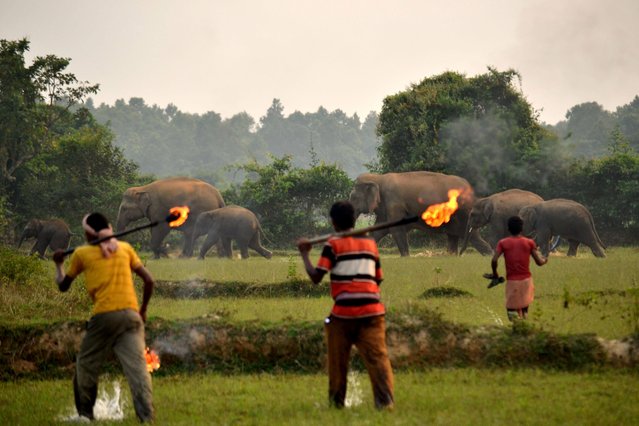
These heartbreaking photo show a confused family of elephants attempting to navigate a railway line built straight through their habitat on October 16, 2012. Taken by Biplab Hazra in Bishnupur, India, the images show the extreme lengths the inhabitants of the town go to to deter elephants from damaging their crops and property. As the images show, villagers often resort to extreme tactics in an effort to drive the elephants out  with one shocking photograph revealing firebombs being launched at a mother and calf as they cross the road. Elephants encroaching out of their habitats is an increasingly common occurrence with deforestation in much of India. (Photo by Biplab Hazra/Caters News Agency)

These heartbreaking photo show a confused family of elephants attempting to navigate a railway line built straight through their habitat on October 16, 2012. Taken by Biplab Hazra in Bishnupur, India, the images show the extreme lengths the inhabitants of the town go to to deter elephants from damaging their crops and property. As the images show, villagers often resort to extreme tactics in an effort to drive the elephants out with one shocking photograph revealing firebombs being launched at a mother and calf as they cross the road. Elephants encroaching out of their habitats is an increasingly common occurrence with deforestation in much of India. (Photo by Biplab Hazra/Caters News Agency)
Details
26 Jan 2019 00:05:00
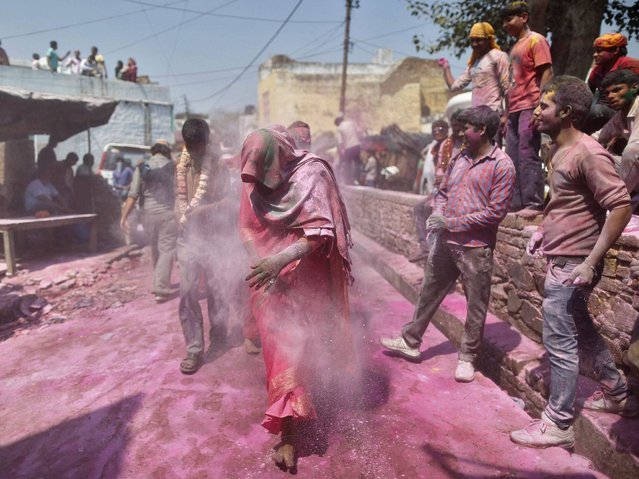
In a Holi tradition unique to Barsana and Nandgaon villages, men sing provocative songs to gain the attention of women, who then “beat” them with bamboo sticks called “lathis”. (Photo by Anindito Mukherjee/Reuters)

A woman covers her face as men throw colored powder at her during “Lathmar Holi” at the village of Barsana in the northern Indian state of Uttar Pradesh March 9, 2014. (Photo by Anindito Mukherjee/Reuters)
Details
13 Mar 2014 08:05:00
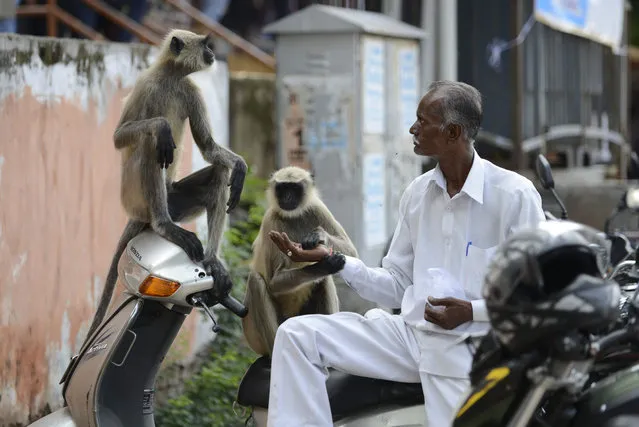
An Indian man feeds peanuts to monkeys along a busy street in Ahmedabad on July 31, 2016. Feeding animals is sacred in Hindu society. (Photo by Sam Panthaky/AFP Photo)

An Indian man feeds peanuts to monkeys along a busy street in Ahmedabad on July 31, 2016. Feeding animals is sacred in Hindu society. (Photo by Sam Panthaky/AFP Photo)
Details
03 Aug 2016 11:57:00
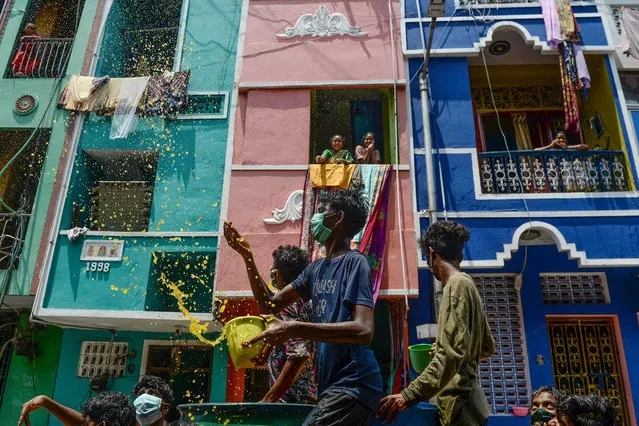
Volunteers throw a mixture of water, neem herb and turmeric as an alleged natural disinfectant on a street in a residential area during a government-imposed nationwide lockdown as a preventive measure against the COVID-19 coronavirus, in Chennai on April 7, 2020. (Photo by Arun Sankar/AFP Photo)

Volunteers throw a mixture of water, neem herb and turmeric as an alleged natural disinfectant on a street in a residential area during a government-imposed nationwide lockdown as a preventive measure against the COVID-19 coronavirus, in Chennai on April 7, 2020. (Photo by Arun Sankar/AFP Photo)
Details
20 Apr 2020 00:03:00
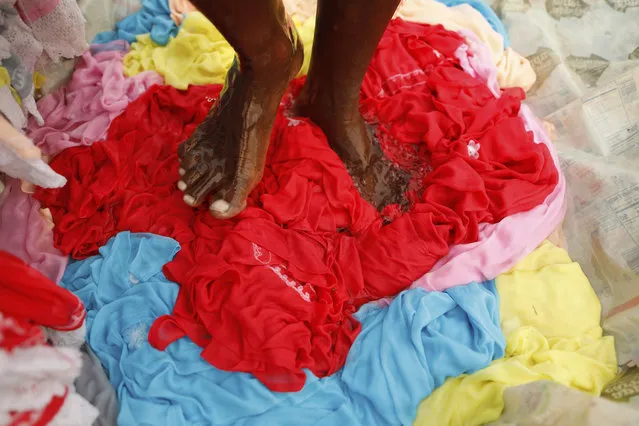
A dhobi, or a washerman washes cloths on the banks of the River Gomti in Lucknow, India, Saturday, September 12, 2020. Dhobis are traditional laundry workers who wash clothes by hand and dry them in the sun, an occupation which has been in existence for generations. Most cities in India have a Dhobi Ghat, or washermen's area, where the city's pile of clothes is laundered. This practice is still popular in India, despite of modern technology. Around 1,000 families work in Lucknow's Dhobi Ghat. However, in light of the novel coronavirus, their wages have decreased drastically. With each family earning around US$100-200 per month. (Photo by Rajesh Kumar Singh/AP Photo)

A dhobi, or a washerman washes cloths on the banks of the River Gomti in Lucknow, India, Saturday, September 12, 2020. Dhobis are traditional laundry workers who wash clothes by hand and dry them in the sun, an occupation which has been in existence for generations. Most cities in India have a Dhobi Ghat, or washermen's area, where the city's pile of clothes is laundered. This practice is still popular in India, despite of modern technology. Around 1,000 families work in Lucknow's Dhobi Ghat. However, in light of the novel coronavirus, their wages have decreased drastically. With each family earning around US$100-200 per month. (Photo by Rajesh Kumar Singh/AP Photo)

Details
25 Sep 2020 00:03:00
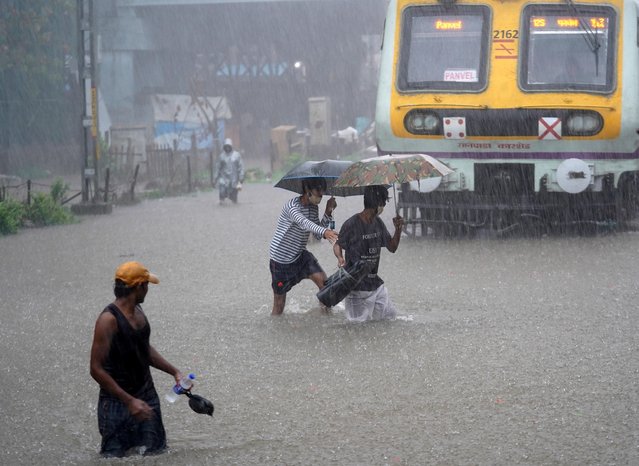
People cross waterlogged railway tracks next to a parked passenger train during heavy rains in Mumbai, India, June 9, 2021. (Photo by Hemanshi Kamani/Reuters)

People cross waterlogged railway tracks next to a parked passenger train during heavy rains in Mumbai, India, June 9, 2021. (Photo by Hemanshi Kamani/Reuters)
Details
10 Jun 2021 08:01:00