Loading...
Done
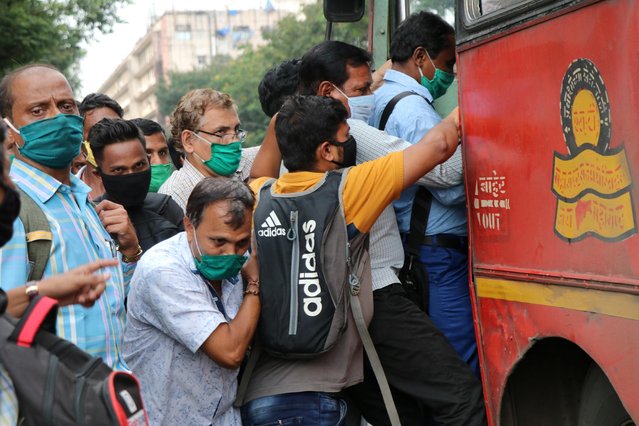
People board a passenger bus during rush hour at a bus terminal, amidst the coronavirus disease (COVID-19) outbreak, in Mumbai, India, September 9, 2020. (Photo by Niharika Kulkarni/Reuters)

People board a passenger bus during rush hour at a bus terminal, amidst the coronavirus disease (COVID-19) outbreak, in Mumbai, India, September 9, 2020. (Photo by Niharika Kulkarni/Reuters)
Details
15 Sep 2020 00:05:00
A dhobi, or a washerman washes cloths on the banks of the River Gomti in Lucknow, India, Saturday, September 12, 2020. Dhobis are traditional laundry workers who wash clothes by hand and dry them in the sun, an occupation which has been in existence for generations. Most cities in India have a Dhobi Ghat, or washermen's area, where the city's pile of clothes is laundered. This practice is still popular in India, despite of modern technology. Around 1,000 families work in Lucknow's Dhobi Ghat. However, in light of the novel coronavirus, their wages have decreased drastically. With each family earning around US$100-200 per month. (Photo by Rajesh Kumar Singh/AP Photo)

A dhobi, or a washerman washes cloths on the banks of the River Gomti in Lucknow, India, Saturday, September 12, 2020. Dhobis are traditional laundry workers who wash clothes by hand and dry them in the sun, an occupation which has been in existence for generations. Most cities in India have a Dhobi Ghat, or washermen's area, where the city's pile of clothes is laundered. This practice is still popular in India, despite of modern technology. Around 1,000 families work in Lucknow's Dhobi Ghat. However, in light of the novel coronavirus, their wages have decreased drastically. With each family earning around US$100-200 per month. (Photo by Rajesh Kumar Singh/AP Photo)
Details
25 Sep 2020 00:03:00
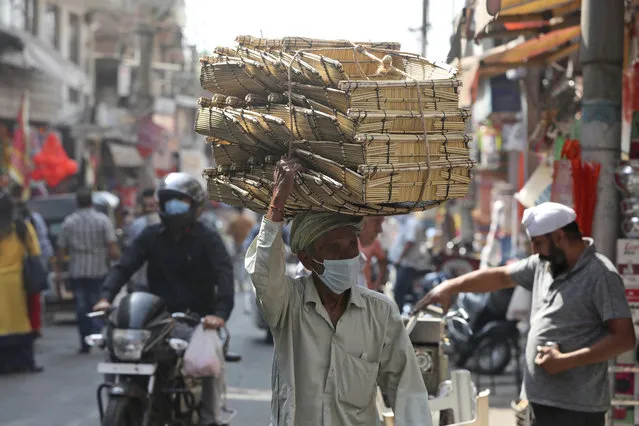
An Indian villager wearing a face mask as a precaution against the coronavirus sells his ware at market in Jammu, India, Friday, October 9, 2020. (Photo by Channi Anand/AP Photo)

An Indian villager wearing a face mask as a precaution against the coronavirus sells his ware at market in Jammu, India, Friday, October 9, 2020. (Photo by Channi Anand/AP Photo)
Details
14 Oct 2020 00:05:00
A boy sits next to sacrificial goats resting during Eid al-Adha in New Delhi, India, 29 June 2023. Muslims around the world celebrate Eid al-Adha or feast of sacrifice, by slaughtering sheep, goats and cows to commemorate Prophet Abraham's willingness to sacrifice his son Ismail at God's command. (Photo by Harish Tyagi/EPA)

A boy sits next to sacrificial goats resting during Eid al-Adha in New Delhi, India, 29 June 2023. Muslims around the world celebrate Eid al-Adha or feast of sacrifice, by slaughtering sheep, goats and cows to commemorate Prophet Abraham's willingness to sacrifice his son Ismail at God's command. (Photo by Harish Tyagi/EPA)
Details
07 Jul 2023 02:48:00
A frontline worker in personal protective equipment (PPE) sprays a flammable liquid on a burning funeral pyre of a man who died from the coronavirus disease (COVID-19), at a crematorium on the outskirts of Mumbai India, April 15, 2021. (Photo by Francis Mascarenhas/Reuters)

A frontline worker in personal protective equipment (PPE) sprays a flammable liquid on a burning funeral pyre of a man who died from the coronavirus disease (COVID-19), at a crematorium on the outskirts of Mumbai, India, April 15, 2021. (Photo by Francis Mascarenhas/Reuters)
Details
21 Apr 2021 10:14:00
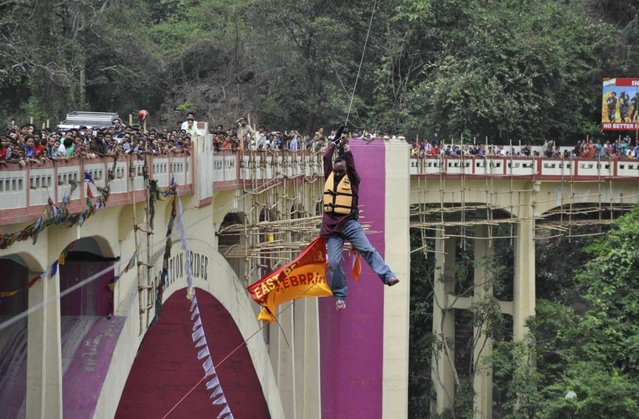
In this Sunday, April 28, 2013 photograph, people watch as Indian Sailendra Nath Roy attempts to cross Teesta river suspended from a zip wire attached to his ponytail moments before his death in Siliguri, West Bengal state, India. Roy who was named a Guinness World Record holder in 2011 for travelling the farthest distance on a zip wire using hair died during the stunt Sunday when he suffered a heart attack. (Photo by AP Photo)

In this Sunday, April 28, 2013 photograph, people watch as Indian Sailendra Nath Roy attempts to cross Teesta river suspended from a zip wire attached to his ponytail moments before his death in Siliguri, West Bengal state, India. Roy who was named a Guinness World Record holder in 2011 for travelling the farthest distance on a zip wire using hair died during the stunt Sunday when he suffered a heart attack. (Photo by AP Photo)
Details
30 Apr 2013 08:21:00
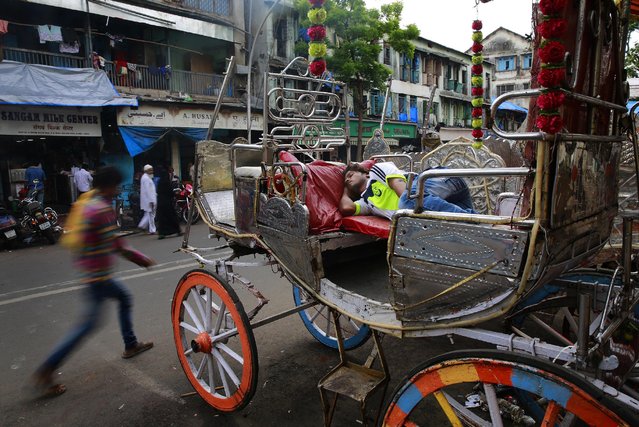
In this June 16, 2015 photo, an Indian coachman sleeps on his Victoria horse-drawn carriage outside a stable in Mumbai, India. Drivers of Mumbai's iconic horse-drawn carriages can't imagine not plying the roads pulling photo-snapping tourists atop their kitsch-covered chariots. Yet that time is coming, thanks to a court order calling such superfluous “joyrides” a form of animal cruelty and banning them in India's financial capital from June 2016. (Photo by Rafiq Maqbool/AP Photo)

In this June 16, 2015 photo, an Indian coachman sleeps on his Victoria horse-drawn carriage outside a stable in Mumbai, India. Drivers of Mumbai's iconic horse-drawn carriages can't imagine not plying the roads pulling photo-snapping tourists atop their kitsch-covered chariots. Yet that time is coming, thanks to a court order calling such superfluous “joyrides” a form of animal cruelty and banning them in India's financial capital from June 2016. (Photo by Rafiq Maqbool/AP Photo)
Details
03 Jul 2015 12:46:00
An Indian women offers early-morning prayers or a “puja” at a ghat early in the morning on the banks of the Betawa River in Orchha in the state of Madhya Pradesh on July 5, 2015. (Photo by Rebecca Conway/AFP Photo)

An Indian women offers early-morning prayers or a “puja” at a ghat early in the morning on the banks of the Betawa River in Orchha in the state of Madhya Pradesh on July 5, 2015. (Photo by Rebecca Conway/AFP Photo)
Details
08 Jul 2015 11:56:00