Loading...
Done
A baby wallaby

“Very small forest-dwelling wallabies are known as pademelons (genus Thylogale) and dorcopsises (genera Dorcopsis and Dorcopsulus). The name wallaby comes from the Eora Aboriginal tribe who were the original inhabitants of the Sydney area. Wallabies are herbivores whose diet consists of a wide range of grasses, vegetables, leaves, and other types of foliage”. – Wikipedia

Photo: A baby wallaby sits in a zoo attendant's lap at Edogawa Natural Zoo on August 4, 2009 in Tokyo, Japan. The staff of the zoo have raised the young wallaby after her mother neglected her. (Photo by Junko Kimura/Getty Images)
Details
07 Sep 2011 13:33:00
Brazil's Victoria Chamorro failed to stop the ball during their women's classification 7th-8th place water polo match against China at the 2016 Summer Olympics in Rio de Janeiro, Brazil, Friday, August 19, 2016. (Photo by Sergei Grits/AP Photo)

Brazil's Victoria Chamorro failed to stop the ball during their women's classification 7th-8th place water polo match against China at the 2016 Summer Olympics in Rio de Janeiro, Brazil, Friday, August 19, 2016. (Photo by Sergei Grits/AP Photo)
Details
20 Aug 2016 12:03:00
A sloth peeks out from behind a door on a floating house in the “Lago do Janauari” near Manaus, Brazil, Tuesday, May 20, 2014. Manaus is one of the host cities for the 2014 World Cup in Brazil. (Photo by Felipe Dana/AP Photo)

A sloth peeks out from behind a door on a floating house in the “Lago do Janauari” near Manaus, Brazil, Tuesday, May 20, 2014. Manaus is one of the host cities for the 2014 World Cup in Brazil. (Photo by Felipe Dana/AP Photo)
Details
24 May 2014 13:25:00
Brazil's Kathellen in action with Australia's Alanna Kennedy during the Australia vs Brazil, Group C match at the FIFA Women's World Cup at Stade La Mosson Stadium on June 13th 2019 in Montpellier, France. (Photo by Eric Gaillard/Reuters)

Brazil's Kathellen in action with Australia's Alanna Kennedy during the Australia vs Brazil, Group C match at the FIFA Women's World Cup at Stade La Mosson Stadium on June 13th 2019 in Montpellier, France. (Photo by Eric Gaillard/Reuters)
Details
17 Jun 2019 00:03:00
#14 Kathellen of Brazil show her dejection after the 2019 FIFA Women's World Cup France Round Of 16 match between France and Brazil at Stade Oceane on June 23, 2019 in Le Havre, France. (Photo by Yves Herman/Reuters)

#14 Kathellen of Brazil show her dejection after the 2019 FIFA Women's World Cup France Round Of 16 match between France and Brazil at Stade Oceane on June 23, 2019 in Le Havre, France. (Photo by Yves Herman/Reuters)
Details
05 Jul 2019 00:01:00
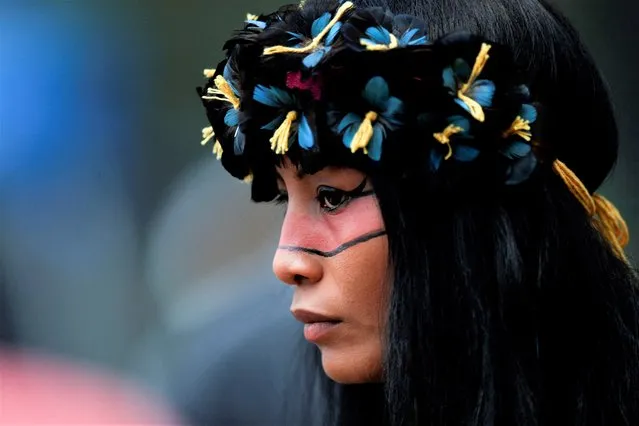
An indigenous woman looks on during the Terra Livre (Free Land) camp, a protest-camp to defend indigenous land and cultural rights that they say are threatened by the right-wing government of Brazil's President Jair Bolsonaro, in Brasilia, Brazil on April 4, 2022. (Photo by Adriano Machado/Reuters)

An indigenous woman looks on during the Terra Livre (Free Land) camp, a protest-camp to defend indigenous land and cultural rights that they say are threatened by the right-wing government of Brazil's President Jair Bolsonaro, in Brasilia, Brazil on April 4, 2022. (Photo by Adriano Machado/Reuters)
Details
24 Apr 2022 04:52:00
Fine Horses And Fierce Eagles Are The wings Of The Kazakh

The Kazakhs are the descendants of Turkic, Mongolic and Indo-Iranian tribes and Huns that populated the territory between Siberia and the Black Sea. They are a semi-nomadic people and have roamed the mountains and valleys of western Mongolia with their herds since the 19th century. The ancient art of eagle hunting is one of many traditions and skills that the Kazakhs have, in recent decades, been able to hold on to. They rely on their clan and herds, believing in pre-Islamic cults of the sky, the ancestors, fire and the supernatural forces of good and evil spirits.
Details
20 Feb 2014 12:12:00
Hikers walk to reach the top of Naqba Rum area in South Sinai, Egypt, November 20, 2015. (Photo by Asmaa Waguih/Reuters)

Hikers walk to reach the top of Naqba Rum area in South Sinai, Egypt, November 20, 2015. Bedouins in the "Sinai is Safe" group guided more than 100 hikers over a 25 km (15 mile) trek over the trails of the White Canyon and the Closed Canyon. The NGO aims to challenge mainstream perceptions of the area by encouraging Nile Valley residents to explore the untamed wilderness with the Bedouin tribes. (Photo by Asmaa Waguih/Reuters)
Details
03 Dec 2015 08:00:00