Loading...
Done
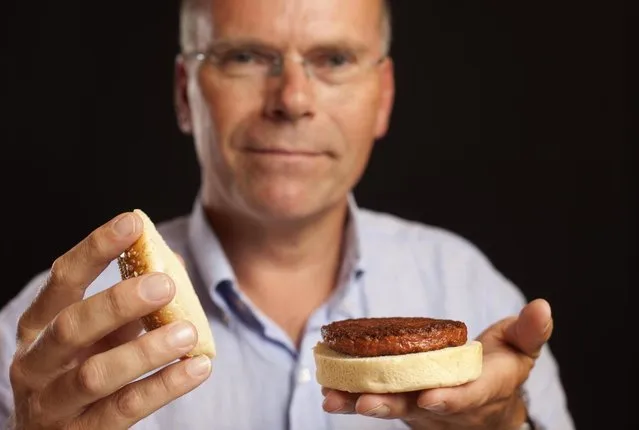
In this handout image provided by Ogilvy, a burger made from cultured beef, which has been developed by Professor Mark Post of Maastricht University in the Netherlands (pictured) is shown to the media during a press conference on August 5, 2013 in London, England. Cultured Beef could help solve the coming food crisis and combat climate change with commercial production of Cultured Beef beginning within ten to twenty years. (Photo by David Parry via Getty Images)

In this handout image provided by Ogilvy, a burger made from cultured beef, which has been developed by Professor Mark Post of Maastricht University in the Netherlands (pictured) is shown to the media during a press conference on August 5, 2013 in London, England. The in-vitro burger, cultured from cattle stem cells, the first example of what its creator says could provide an answer to global food shortages and help combat climate change, was fried in a pan and tasted by two volunteers. The burger is the result of years of research by Dutch scientist Mark Post, a vascular biologist at the University of Maastricht, who is working to show how meat grown in petri dishes might one day be a true alternative to meat from livestock.The meat in the burger has been made by knitting together around 20,000 strands of protein that has been cultured from cattle stem cells in Post's lab. (Photo by David Parry)
Details
06 Aug 2013 08:48:00
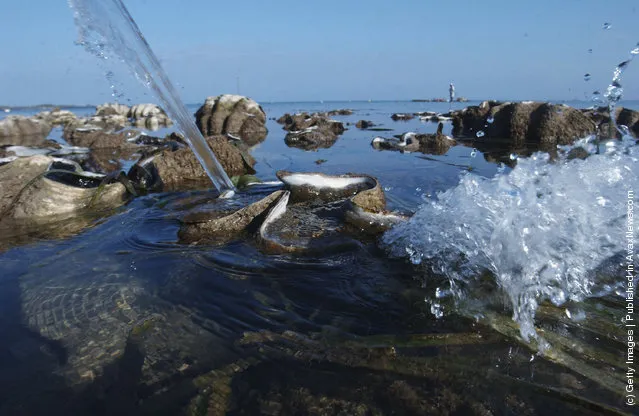
Tridacna Gigas, or Giant Clams

“The giant clam, Tridacna gigas (known as pā’ua in Cook Islands Māori), is the largest living bivalve mollusc. T. gigas is one of the most endangered clam species. It was mentioned as early as 1825 in scientific reports. One of a number of large clam species native to the shallow coral reefs of the South Pacific and Indian oceans, they can weigh more than 200 kilograms (440 lb) measure as much as 120 cm (47 in) across, and have an average lifespan in the wild of 100 years or more”. – Wikipedia

Photo: Tridacna Gigas, or Giant Clams spew water as a traditional fisherman passes by a small sanctuary on January 23, 2004 near Bolinao in the Northern Philippines. The clams, prime builders for coral reefs and providing shelter for spawning fish and other marine life, are exposed by low tides in the sanctuary. Overfishing and pollution throughout the country are not only threatening food security, but are also starting to choke one of the few working clam sanctuaries in the world. (Photo by David Greedy/Getty Images)
Details
01 Oct 2011 13:10:00
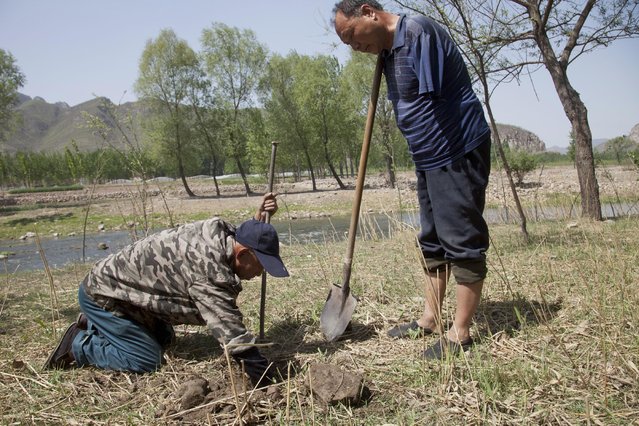
In this April 23, 2015 photo, friends Jia Haixia, left, and Jia Wenqi work to plant a tree in a field in Yeli village near Shijiazhuang city in northern China's Hebei province. For the past 13 years, Jia Wenqi, who has no arms, and Jia Haixia, who is blind, have worked together to plant and water more than 12,000 trees near their village. (Photo by Helene Franchineau/AP Photo)

In this April 23, 2015 photo, friends Jia Haixia, left, and Jia Wenqi work to plant a tree in a field in Yeli village near Shijiazhuang city in northern China's Hebei province. For the past 13 years, Jia Wenqi, who has no arms, and Jia Haixia, who is blind, have worked together to plant and water more than 12,000 trees near their village. (Photo by Helene Franchineau/AP Photo)
Details
13 May 2015 11:21:00
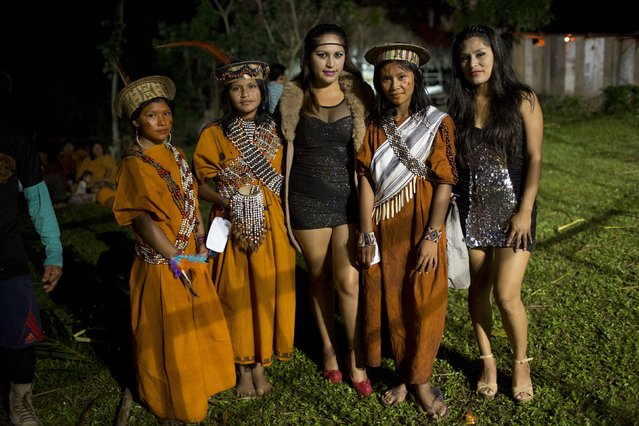
In this June 23, 2015 photo, Ashaninka Indian beauty contestants pose for a photo with members of a visiting music group, hired to perform during the annual founding anniversary festivities, in Otari Nativo, Pichari, Peru. The contestants wear the simple brown dresses of the Ashaninka woman, their faces dotted in a traditional design with a red dye extracted from a spice called achiote. (Photo by Rodrigo Abd/AP Photo)

In this June 23, 2015 photo, Ashaninka Indian beauty contestants pose for a photo with members of a visiting music group, hired to perform during the annual founding anniversary festivities, in Otari Nativo, Pichari, Peru. The contestants wear the simple brown dresses of the Ashaninka woman, their faces dotted in a traditional design with a red dye extracted from a spice called achiote. (Photo by Rodrigo Abd/AP Photo)
Details
16 Jul 2015 11:12:00
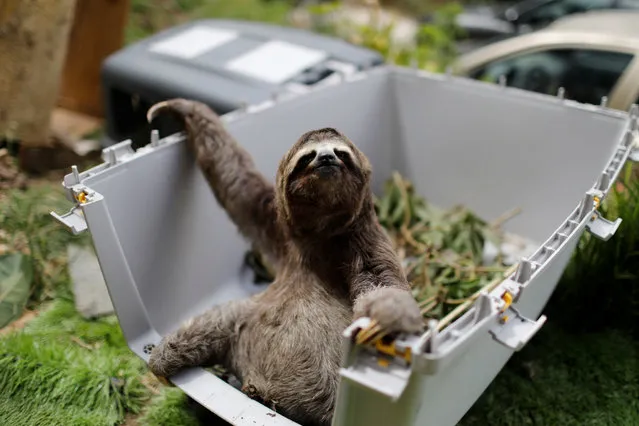
Brown-throated sloth called “43”, rescued by Juan Carlos Rodriguez and his wife Haydee in a residential area, waits in the kennel getting prepared for being released, at the couple's shelter for sloths, in San Antonio, Venezuela on July 30, 2021. (Photo by Leonardo Fernandez Viloria/Reuters)

Brown-throated sloth called “43”, rescued by Juan Carlos Rodriguez and his wife Haydee in a residential area, waits in the kennel getting prepared for being released, at the couple's shelter for sloths, in San Antonio, Venezuela on July 30, 2021. (Photo by Leonardo Fernandez Viloria/Reuters)
Details
18 Sep 2021 08:11:00
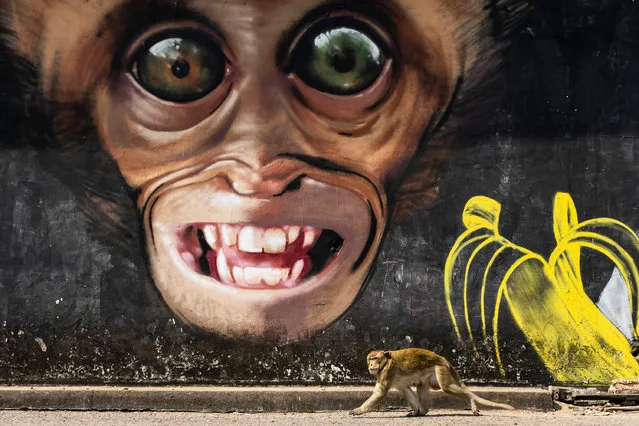
Natural world and wildlife shortlist. Lop Buri in Thailand is home to hundreds of macaques, which local residents consider to be disciples of the Hindu god Hanuman. While some people love them, others fear or even hate them. Despite the inconvenience they often cause, the macaques are generally respected and considered sacred. (Photo by Joan de la Malla/Sony World Photography Awards)

Natural world and wildlife shortlist. Lop Buri in Thailand is home to hundreds of macaques, which local residents consider to be disciples of the Hindu god Hanuman. While some people love them, others fear or even hate them. Despite the inconvenience they often cause, the macaques are generally respected and considered sacred. (Photo by Joan de la Malla/Sony World Photography Awards)
Details
15 Feb 2020 00:05:00
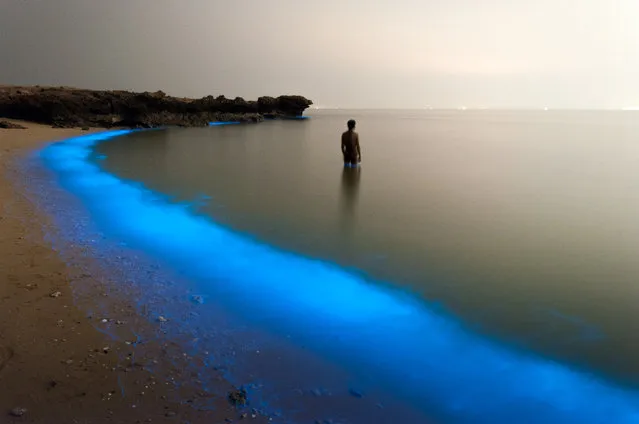
Shortlisted: Pooyan Shadpoor, Houcheraghi. While walking along the shore of Larak, Iran – an island in the Persian Gulf – Shadpoor came across this luminous scene. The “magical lights of (the) plankton ... enchanted me so that I snapped the shot”, he writes. (Photo by Pooyan Shadpoor/2016 EPOTY)

Shortlisted: Pooyan Shadpoor, Houcheraghi. While walking along the shore of Larak, Iran – an island in the Persian Gulf – Shadpoor came across this luminous scene. The “magical lights of (the) plankton ... enchanted me so that I snapped the shot”, he writes. (Photo by Pooyan Shadpoor/2016 EPOTY)
Details
29 Jun 2016 11:02:00
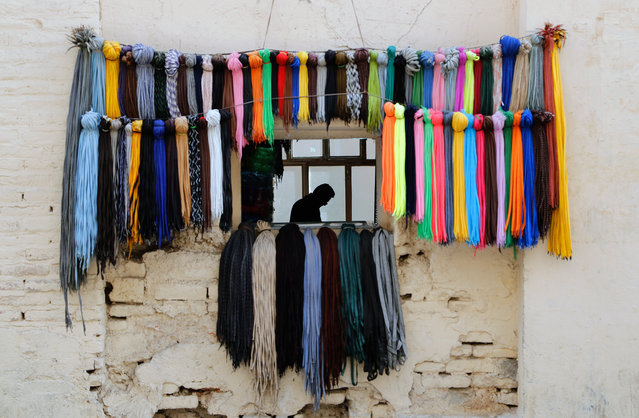
An Iranian man sells colorful ropes at  the Tehrans old Bazaar, the place where the main economy trades take place, in Tehran, Iran, 25 January 2016. Reports state that Iranian officials expected the Iranian economy to grow on an average of eight percent over the coming five years following the lifting of sanctions against Iran. (Photo by Abedin Taherkenareh/EPA)

An Iranian man sells colorful ropes at the Tehrans old Bazaar, the place where the main economy trades take place, in Tehran, Iran, 25 January 2016. Reports state that Iranian officials expected the Iranian economy to grow on an average of eight percent over the coming five years following the lifting of sanctions against Iran. (Photo by Abedin Taherkenareh/EPA)
Details
02 Feb 2016 12:53:00