Loading...
Done
A street performer dressed up as a waiter performs for at Marques de Larios street in downtown Malaga, Spain, July 4, 2016. (Photo by Jon Nazca/Reuters)

A street performer dressed up as a waiter performs for at Marques de Larios street in downtown Malaga, Spain, July 4, 2016. (Photo by Jon Nazca/Reuters)
Details
06 Jul 2016 16:42:00
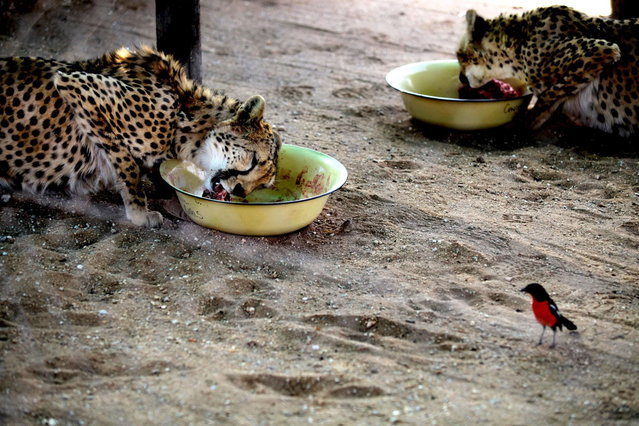
Young cheetahs eat meat at The Cheetah Conservation Fund (CCF) center in Otjiwarongo, Namibia, on August 13, 2013. The CCF started breeding Anatolian livestock dogs to promote cheetah-friendly farming after some 10,000 big cats – the current total worldwide population – were killed or moved off farms in the 1980s.  Up to 1,000 cheetahs were being killed a year, mostly by farmers who saw them as livestock killers. But the use of dogs has slashed losses for sheep and goat farmers and led to less retaliation against the vulnerable cheetah. (Photo by Jennifer Bruce/AFP Photo)

Young cheetahs eat meat at The Cheetah Conservation Fund (CCF) center in Otjiwarongo, Namibia, on August 13, 2013. The CCF started breeding Anatolian livestock dogs to promote cheetah-friendly farming after some 10,000 big cats – the current total worldwide population – were killed or moved off farms in the 1980s. Up to 1,000 cheetahs were being killed a year, mostly by farmers who saw them as livestock killers. But the use of dogs has slashed losses for sheep and goat farmers and led to less retaliation against the vulnerable cheetah. (Photo by Jennifer Bruce/AFP Photo)
Details
29 Aug 2013 10:56:00
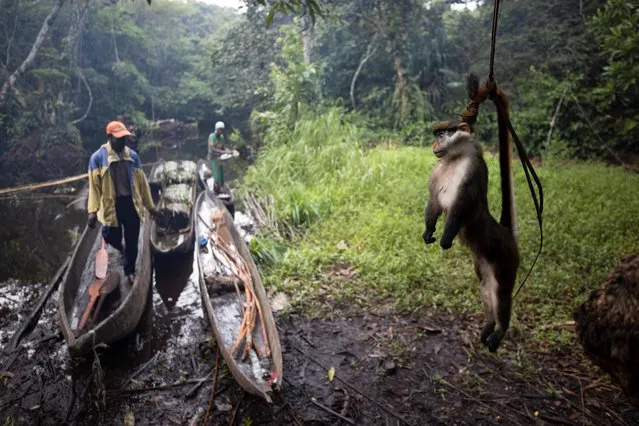
A dead red-tailed monkey hangs by its tail above the ground, in order to keep it away from ants, in the forest near the city of Mbandaka, Democratic Republic of the Congo, April 5, 2019. Bushmeat hunters are emptying Central Africa's forests at a high rate, researchers say. A growing appetite for wild meat in cities has ramped up the scale of hunting. Research shows around 6 million tonnes of bushmeat are sourced annually from the Congo Basin, whose forest spans across six countries and is second in size only to the Amazon. (Photo by Thomas Nicolon/Reuters)

A dead red-tailed monkey hangs by its tail above the ground, in order to keep it away from ants, in the forest near the city of Mbandaka, Democratic Republic of the Congo, April 5, 2019. Bushmeat hunters are emptying Central Africa's forests at a high rate, researchers say. A growing appetite for wild meat in cities has ramped up the scale of hunting. Research shows around 6 million tonnes of bushmeat are sourced annually from the Congo Basin, whose forest spans across six countries and is second in size only to the Amazon. (Photo by Thomas Nicolon/Reuters)
Details
14 Oct 2019 00:03:00
A woman is assisted while crossing a flooded street after the Huayco river overflooded its banks sending torrents of mud and water rushing through the streets, in Huachipa, Peru on March 17, 2017. (Photo by Guadalupe Pardo/Reuters)

A woman is assisted while crossing a flooded street after the Huayco river overflooded its banks sending torrents of mud and water rushing through the streets, in Huachipa, Peru on March 17, 2017. Muddy water spilled onto streets and into homes on Thursday in a new round of unusually heavy rains that has killed at least a dozen people in Peru and now threatens flooding in the capital. (Photo by Guadalupe Pardo/Reuters)
Details
18 Mar 2017 10:24:00
A street scene in London’s Covent Garden with the underground station and a horse and cart in the background in c.1930 and the same street in 2014. (Photo by Museum of London/Streetmuseum app)

“For most Londoners, the most common view they enjoy as they trudge to work is the back of another commuter's head. But now, thanks to the Streetmuseum app, anyone traipsing through the capital's streets can step back in time to see what London looked like in the 19th and 20th century compared with today – all in the same image”. – Joe Krishnan via The Independent. Photo: A street scene in London’s Covent Garden with the underground station and a horse and cart in the background in c.1930 and the same street in 2014. (Photo by Museum of London/Streetmuseum app)
Details
27 Feb 2014 06:48:00
A suspected street robber is arrested by a policeman after a brief chase in the streets, June 20, 2016, in Manila, Philippines. (Photo by Dondi Tawatao/Getty Images)

A suspected street robber is arrested by a policeman after a brief chase in the streets, June 20, 2016, in Manila, Philippines. The president-elect of the Philippines, Rodrigo Duterte, declared a war on crime and drugs after sweeping an election on May 9 and has been living up to his nickname, “the punisher”. Philippine police have been conducting night raids almost on a daily basis and revived a curfew for minors that had not been enforced for years, rounding up minors drinking on the streets. (Photo by Dondi Tawatao/Getty Images)

Details
30 Jun 2016 11:38:00
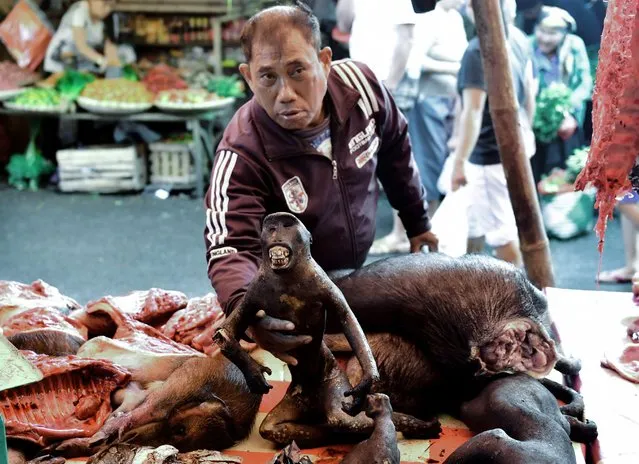
This picture taken on February 18, 2017 shows a customer holding a crested black macaque in Tomohon market in northern Sulawesi, Indonesia. (Photo by Bay Ismoyo/AFP Photo)

This picture taken on February 18, 2017 shows a customer holding a crested black macaque in Tomohon market in northern Sulawesi, Indonesia. Authorities and activists are stepping up efforts to persuade villagers on Sulawesi island to stop consuming the critically endangered crested black macaques, one of many exotic creatures that form part of the local indigenous community' s diet. The macaque' s meat is prized by the ethnic Minahasan people, a largely Christian group in the world' s most populous Muslim- majority country, who have no reservation about eating exotic animals, unlike Indonesia' s Islamic communities. (Photo by Bay Ismoyo/AFP Photo)
Details
04 Apr 2017 10:01:00
Carnival revellers dressed as “Peliqueiros” run along a street in the village of Laza, Spain February 11, 2018. “Peliqueiros”, or ancient tax collectors, pursued villagers through the streets ringing their cowbells and hitting villagers with their sticks. (Photo by Miguel Vidal/Reuters)

Carnival revellers dressed as “Peliqueiros” run along a street in the village of Laza, Spain February 11, 2018. “Peliqueiros”, or ancient tax collectors, pursued villagers through the streets ringing their cowbells and hitting villagers with their sticks. (Photo by Miguel Vidal/Reuters)
Details
12 Feb 2018 07:41:00