Loading...
Done
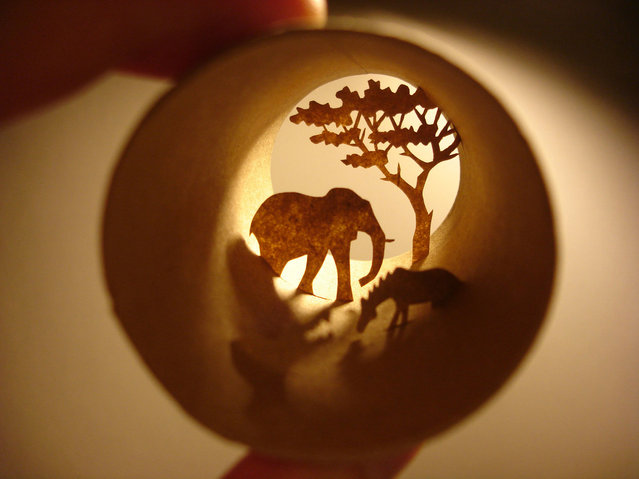
Toilet paper roll art of African wildlife. (Photo by Anastassia Elias/Caters News)

Anastassia Elias spends hours painstakingly cutting out tiny shapes to make detailed models – and then fits them inside used toilet rolls. Elias, 37, uses paper the same color as the cardboard tubes to build up the intricate scenes from wildlife to construction sites. Photo: Toilet paper roll art of African wildlife. (Photo by Anastassia Elias/Caters News)
Details
18 Jul 2013 08:08:00
Glass Gem Coloful PopCorn

A stunning variety selected by Carl Barnes, a part-Cherokee farmer and breeder, from several traditional corn varieties. Given to NS/S by one of his students, Greg Schoen. Produces a diversity of gorgeous translucent, jewel-colored ears, each one unique. A popcorn, the kernels may be ground into cornmeal or popped. This corn became an Internet sensation in 2012.
Details
05 Nov 2013 13:59:00
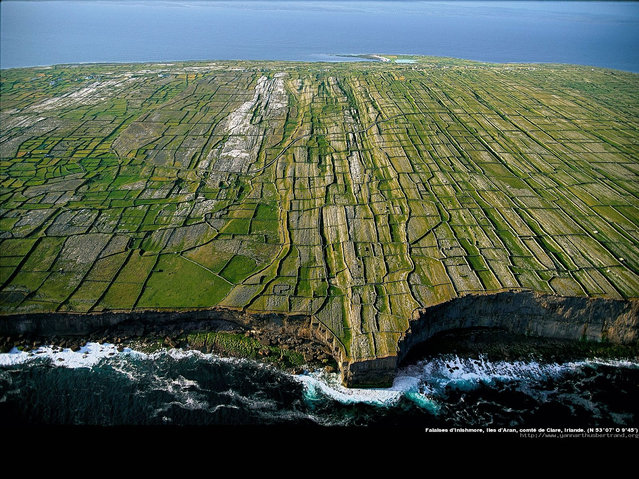
Amazing Photos by Yann Arthus-Bertrand. Part Two

Yann Arthus-Bertrand (born March 13, 1946 in Paris) is a French photographer, journalist, reporter and environmentalist.

Part One
Details
23 Aug 2012 14:31:00
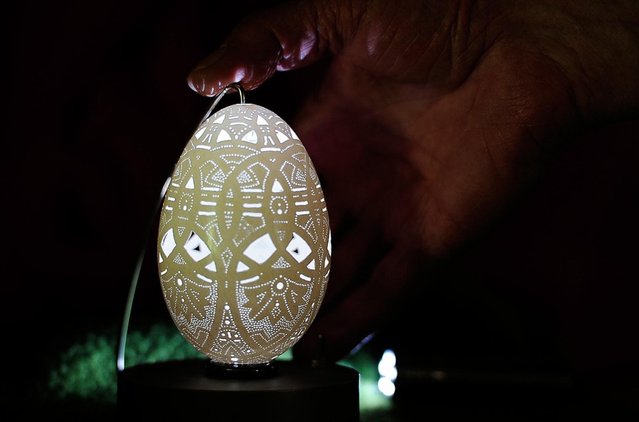
Egg Sculptures By Franc Grom

Slovenian artist Franc Grom, aged 72, makes unbelievably intricate egg sculptures using just a tiny electric drill and enormous patience. According to National Geographic, when finished, each egg contains approximately 2,500 to 3,500 holes. While Slovene artisans usually paint their eggs using a technique called drsanka by lightly scratching intricate patterns into the surfaces of colored eggs, carving them was solely Grom’s idea.
Details
24 Nov 2016 08:00:00
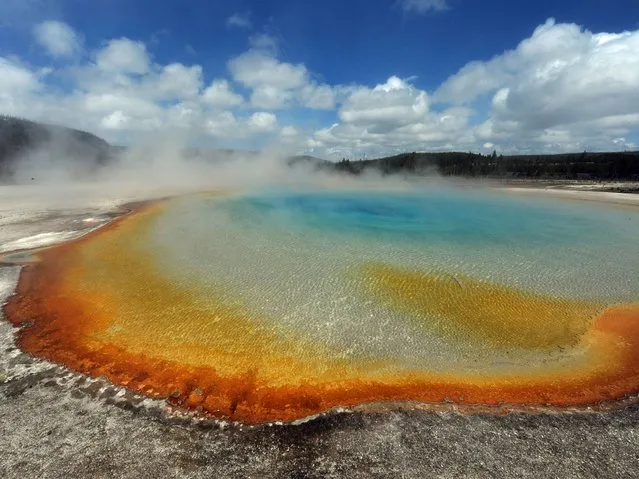
View of the “Sunset Lake” hot spring with it's unique colors caused by brown, orange and yellow algae-like bacteria called Thermophiles, that thrive in the cooling water turning the vivid aqua-blues to a murkier greenish brown, in the Yellowstone National Park, Wyoming on June 1, 2011. (Photo by Mark Ralston/AFP Photo)

View of the “Sunset Lake” hot spring with it's unique colors caused by brown, orange and yellow algae-like bacteria called Thermophiles, that thrive in the cooling water turning the vivid aqua-blues to a murkier greenish brown, in the Yellowstone National Park, Wyoming on June 1, 2011. Yellowstone National Park, was established by the U.S. Congress and signed into law by President Grant on March 1, 1872. The park is located primarily in the U.S. state of Wyoming, though it also extends into Montana and Idaho and was the first national park in the world. It is known for its wildlife and its many geothermal features, especially the Old Faithful Geyser. (Photo by Mark Ralston/AFP Photo)
Details
06 Apr 2014 08:02:00
A young performer cries as she parades during the Bun Festival on Cheung Chau island in Hong Kong Tuesday, May 6, 2014. Bun Festival, the Taoist God of the Sea, is worshipped and evil spirits are believed to be scared away by loud gongs and drums during the procession. The celebration includes bun scrambling, parades, opera performances, and children dressed in colorful costumes. (Photo by Kin Cheung/AP Photo)

A young performer cries as she parades during the Bun Festival on Cheung Chau island in Hong Kong Tuesday, May 6, 2014. Bun Festival, the Taoist God of the Sea, is worshipped and evil spirits are believed to be scared away by loud gongs and drums during the procession. The celebration includes bun scrambling, parades, opera performances, and children dressed in colorful costumes. (Photo by Kin Cheung/AP Photo)
Details
08 May 2014 07:31:00
A Sorb egg painter decorates an Easter egg while using bent spoons full of melted wax as coloring at the annual Easter egg market on March 16, 2013 in Schleife, Germany. Easter is a particularly important time of year for Sorbs, a Slavic minority in eastern Germany, and the period includes the tradition of painting Easter eggs that include visual elements intended to ward off evil. Many Sorbs still speak Sorbian, a language closely related to Polish and Czech.  (Photo by Adam Berry)

A Sorb egg painter decorates an Easter egg while using bent spoons full of melted wax as coloring at the annual Easter egg market on March 16, 2013 in Schleife, Germany. Easter is a particularly important time of year for Sorbs, a Slavic minority in eastern Germany, and the period includes the tradition of painting Easter eggs that include visual elements intended to ward off evil. Many Sorbs still speak Sorbian, a language closely related to Polish and Czech. (Photo by Adam Berry)
Details
19 Mar 2013 06:41:00
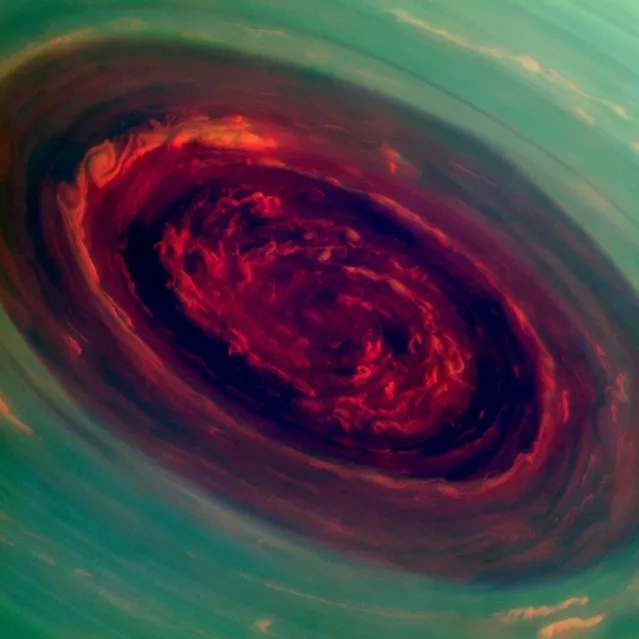
The spinning vortex of Saturn's north polar storm resembles a deep red rose of giant proportions surrounded by green foliage in this false-color image from NASA's Cassini spacecraft. (Photo by NASA/JPL-Caltech/SSI)

NASA's Cassini spacecraft has provided scientists the first close-up, visible-light views of a behemoth hurricane swirling around Saturn's north pole. In high-resolution pictures and video, scientists see the hurricane's eye is about 1,250 miles (2,000 kilometers) wide, 20 times larger than the average hurricane eye on Earth. Thin, bright clouds at the outer edge of the hurricane are traveling 330 mph(150 meters per second). The hurricane swirls inside a large, mysterious, six-sided weather pattern known as the hexagon. Photo: The spinning vortex of Saturn's north polar storm resembles a deep red rose of giant proportions surrounded by green foliage in this false-color image from NASA's Cassini spacecraft. (Photo by NASA/JPL-Caltech/SSI)
Details
31 May 2015 09:11:00