Loading...
Done
A Muslim woman wearing a hijab walks past a lingerie advertisement in downtown Vancouver, British Columbia April 26, 2013. (Photo by Andy Clark/Reuters)

A Muslim woman wearing a hijab walks past a lingerie advertisement in downtown Vancouver, British Columbia April 26, 2013. (Photo by Andy Clark/Reuters)

P.S. All pictures are presented in high resolution. To see Hi-Res images – just TWICE click on any picture. In other words, click small picture – opens the BIG picture. Click BIG picture – opens VERY BIG picture (if available; this principle works anywhere on the site AvaxNews)
Details
27 Apr 2013 14:37:00
In a military base in the Thai province of Chon Buri February 20 U.S. Marines Navy with Thailand began their studies in jungle survival. The event is held in joint military exercises “Cobra Gold 2013”. During a jungle survival program February 20, 2013 taught by Royal Thai Special Forces in Sannapit, Thailand, U.S. Marines learned to catch cobras and drink their fresh blood, not to mention eat forest insects and pull the heads off of chicken. The training was part of Operation Cobra Gold 13, the 32nd edition of international military exercises hosted by the Thai. According to a U.S. Marines press release, Cobra Gold is the largest exercise of its kind in Asia and incorporates troops from five other nations in addition to the U.S. and Thailand. The Daily Mail reports that the Marines were invited to experience the local custom of drinking cobra blood after being taught to catch and kill cobras in the wild. As CNN notes, Cobra blood is believed to be a panacea and aphrodiasic in parts of Southeast Asia. In Jakarta, vendors can earn over $100 a night selling shots of cobra blood mixed with liquor. (Photo by Pornchai Kittiwongsakul/AFP Photo)

During a jungle survival program February 20, 2013 taught by Royal Thai Special Forces in Sannapit, Thailand, U.S. Marines learned to catch cobras and drink their fresh blood, not to mention eat forest insects and pull the heads off of chicken. The training was part of Operation Cobra Gold 13, the 32nd edition of international military exercises hosted by the Thai. According to a U.S. Marines press release, Cobra Gold is the largest exercise of its kind in Asia and incorporates troops from five other nations in addition to the U.S. and Thailand. The Daily Mail reports that the Marines were invited to experience the local custom of drinking cobra blood after being taught to catch and kill cobras in the wild. As CNN notes, Cobra blood is believed to be a panacea and aphrodiasic in parts of Southeast Asia. In Jakarta, vendors can earn over $100 a night selling shots of cobra blood mixed with liquor. (Photo by Pornchai Kittiwongsakul/AFP Photo)
Details
23 Feb 2013 11:52:00
Girls accompany grooms as they sit separate from the brides during a mass wedding for 150 couples in Beit Lahiya town in the northern Gaza Strip July 20, 2015. The wedding was funded by al-Basheer Society for Relief and Development. (Photo by Suhaib Salem/Reuters)

Girls accompany grooms as they sit separate from the brides during a mass wedding for 150 couples in Beit Lahiya town in the northern Gaza Strip July 20, 2015. The wedding was funded by al-Basheer Society for Relief and Development. (Photo by Suhaib Salem/Reuters)
Details
04 Aug 2015 11:36:00
Dancers wearing masks and kimonos perform in the streets at the “Super Yosakoi 2015” dance festival in Tokyo on August 30, 2015. One hundred dance teams with some 5,500 people participated in the two-day summer festival event. (Photo by Yoshikazu Tsuno/AFP Photo)

Dancers wearing masks and kimonos perform in the streets at the “Super Yosakoi 2015” dance festival in Tokyo on August 30, 2015. One hundred dance teams with some 5,500 people participated in the two-day summer festival event. (Photo by Yoshikazu Tsuno/AFP Photo)
Details
31 Aug 2015 12:33:00
The eruption of Cordon Caulle began on June 4, 2011, located in the Region of Los Rios in Chile. For about 12 months, people and animals became accustomed to living with the daily fall of ash, which also caused problems in the air traffic in South America. The explosions and lightning during first days of the eruption could be seen from hundreds of miles around. This photograph was taken on the second night of eruption from the town of Lago Ranco. (Photo and caption by Francisco Negroni/National Geographic Traveler Photo Contest)

The eruption of Cordon Caulle began on June 4, 2011, located in the Region of Los Rios in Chile. For about 12 months, people and animals became accustomed to living with the daily fall of ash, which also caused problems in the air traffic in South America. The explosions and lightning during first days of the eruption could be seen from hundreds of miles around. This photograph was taken on the second night of eruption from the town of Lago Ranco. (Photo and caption by Francisco Negroni/National Geographic Traveler Photo Contest)

ATTENTION! All pictures are presented in high resolution. To see Hi-Res images – just TWICE click on any picture. In other words, click small picture – opens the BIG picture. Click BIG picture – opens VERY BIG picture.
Details
23 Jun 2013 11:24:00
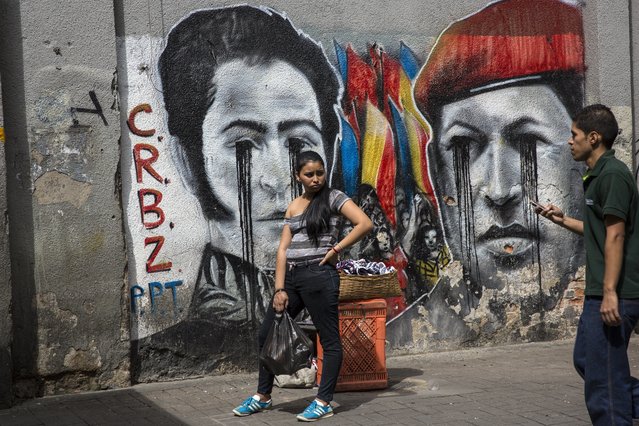
A woman stands in front of graffiti depicting Venezuela's late former President Hugo Chavez, right, and revolutionary hero Simon Bolivar, in downtown Caracas, Venezuela, Wednesday, October 25, 2017. (Photo by Rodrigo Abd/AP Photo)

A woman stands in front of graffiti depicting Venezuela's late former President Hugo Chavez, right, and revolutionary hero Simon Bolivar, in downtown Caracas, Venezuela, Wednesday, October 25, 2017. (Photo by Rodrigo Abd/AP Photo)
Details
12 Dec 2017 06:33:00
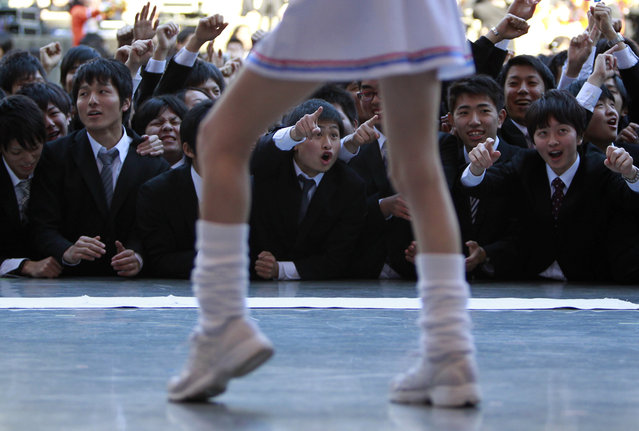
Japanese college students look at cheerleaders during a job-hunting rally in Tokyo January 29, 2014. According to the rally organizers, about 1,500 students from vocational schools attend the rally to boost their morale ahead of their job hunt. (Photo by Yuya Shino/Reuters)

Japanese college students look at cheerleaders during a job-hunting rally in Tokyo January 29, 2014. According to the rally organizers, about 1,500 students from vocational schools attend the rally to boost their morale ahead of their job hunt. (Photo by Yuya Shino/Reuters)
Details
01 Feb 2014 13:10:00
A new species of monkey found in the Democratic Republic of the Congo and identified as Lesula (Cercopithecus lomamiensis) is seen in this undated photograph from an article published September 12, 2012 in the science journal PLOS One. (Photo by Hart J. A., Detwiler K. M., Gilbert C. C./Reuters)

A new species of monkey found in the Democratic Republic of the Congo and identified as Lesula (Cercopithecus lomamiensis) is seen in this undated photograph from an article published September 12, 2012 in the science journal PLOS One. The monkey was first seen in 2007 by researchers John and Terese Hart of the Peabody Museum of Natural History at Yale Research Project. The finding of C. lomamiensis represents only the second new species of African monkey to be discovered in the past 28 years, according to the research article. (Photo by Hart J. A., Detwiler K. M., Gilbert C. C./Reuters)
Details
27 Sep 2012 08:17:00