Loading...
Done
Varanasi: India's City of Death and Life

Varanasi is a city on the banks of the Ganges in Uttar Pradesh, 320 kilometres (200 mi) southeast of the state capital, Lucknow. It is holiest of the seven sacred cities (Sapta Puri) in Hinduism and Jainism. Hindus believe that death at Varanasi brings salvation. It is one of the oldest continuously inhabited cities in the world and the oldest in India.
Details
02 May 2013 12:41:00
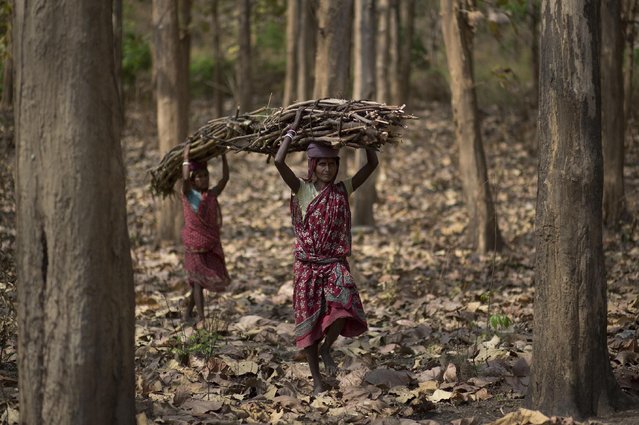
In this Tuesday, March 31, 2015 photo, Indian women walk carrying firewood they collected from a forest at Gobhali village on the outskirts of Gauhati, India. Every evening, hundreds of millions of Indian women hover over crude stoves making dinner for their families. They feed the flames with polluting fuels like kerosene or cow dung, and breathe the acrid smoke wafting from the fires. (Photo by Anupam Nath/AP Photo)

In this Tuesday, March 31, 2015 photo, Indian women walk carrying firewood they collected from a forest at Gobhali village on the outskirts of Gauhati, India. Every evening, hundreds of millions of Indian women hover over crude stoves making dinner for their families. They feed the flames with polluting fuels like kerosene or cow dung, and breathe the acrid smoke wafting from the fires. (Photo by Anupam Nath/AP Photo)
Details
16 Apr 2015 12:29:00
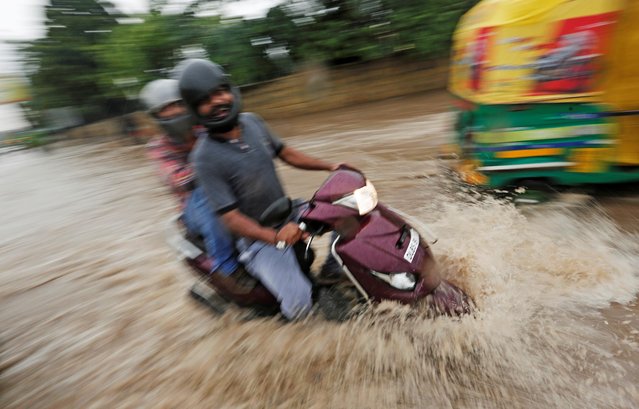
Men ride a scooter through a flooded street after heavy rains in New Delhi, India, August 6, 2019. (Photo by Adnan Abidi/Reuters)

Men ride a scooter through a flooded street after heavy rains in New Delhi, India, August 6, 2019. (Photo by Adnan Abidi/Reuters)
Details
16 Aug 2019 00:03:00
A man dressed as Hindu god Shiva, smokes during an annual Hindu religious festival locally known as Shyam Baba festival in Ajmer, in the desert Indian state of Rajasthan, April 12, 2015. (Photo by Himanshu Sharma/Reuters)

A man dressed as Hindu god Shiva, smokes during an annual Hindu religious festival locally known as Shyam Baba festival in Ajmer, in the desert Indian state of Rajasthan, April 12, 2015. (Photo by Himanshu Sharma/Reuters)
Details
16 Apr 2015 12:45:00
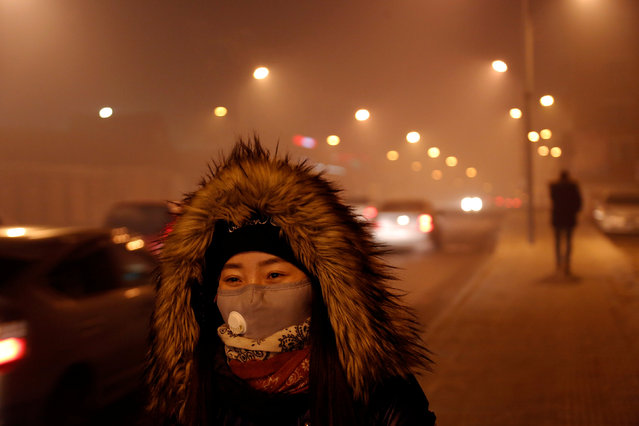
A woman wears a face mask in the part of the city near neighbourhoods known for burning coal for heating in Ulaanbaatar, Mongolia January 26, 2017. Not many people in Ulaanbaatar wear masks to protect themselves against pollution. (Photo by B. Rentsendorj/Reuters)

A woman wears a face mask in the part of the city near neighbourhoods known for burning coal for heating in Ulaanbaatar, Mongolia January 26, 2017. Not many people in Ulaanbaatar wear masks to protect themselves against pollution. (Photo by B. Rentsendorj/Reuters)
Details
09 Feb 2017 00:00:00
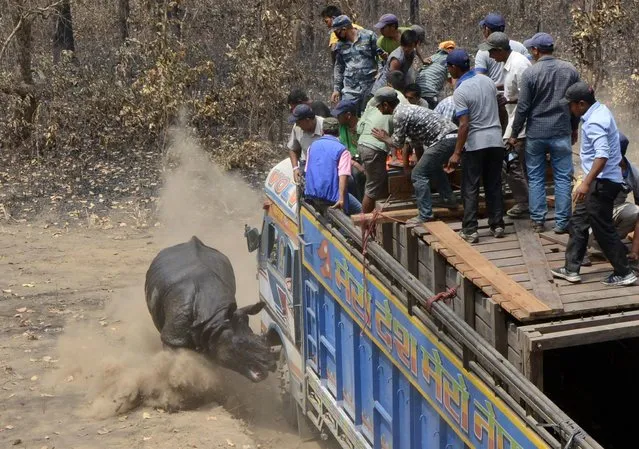
A Nepalese vetinary and technical team release a rhino after it is relocated in Chitwan National Park some of 250 Kilometer South of Kathmandu on April 4, 2017. Conservationists on April 3 captured a rare one-horned rhinoceros in Nepal as part of an attempt to increase the number of the vulnerable animals, which are prized by wildlife poachers. Five rhinos – one male and four female – will be released into a national park in Nepal's far west over the coming week in the hope of establishing a new breeding group. (Photo by Prakash Mathema/AFP Photo)

A Nepalese vetinary and technical team release a rhino after it is relocated in Chitwan National Park some of 250 Kilometer South of Kathmandu on April 4, 2017. Conservationists on April 3 captured a rare one-horned rhinoceros in Nepal as part of an attempt to increase the number of the vulnerable animals, which are prized by wildlife poachers. Five rhinos – one male and four female – will be released into a national park in Nepal's far west over the coming week in the hope of establishing a new breeding group. (Photo by Prakash Mathema/AFP Photo)
Details
05 Apr 2017 09:19:00
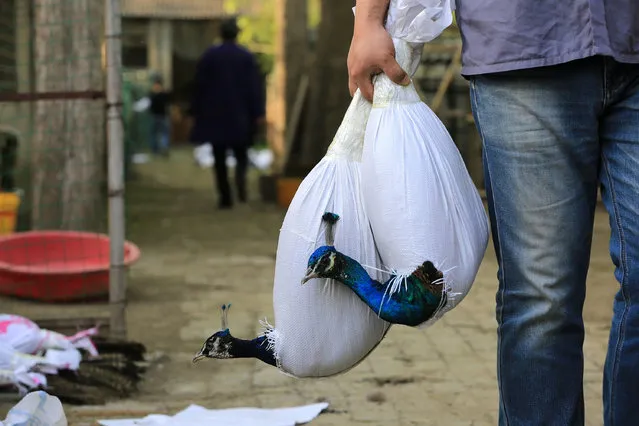
Peacocks are seen covered in bags as a protection of their plume during transportation, in Xiangyang, Hubei province, China April 12, 2017. (Photo by Reuters/Stringer)

Peacocks are seen covered in bags as a protection of their plume during transportation, in Xiangyang, Hubei province, China April 12, 2017. (Photo by Reuters/Stringer)
Details
18 Apr 2017 08:55:00
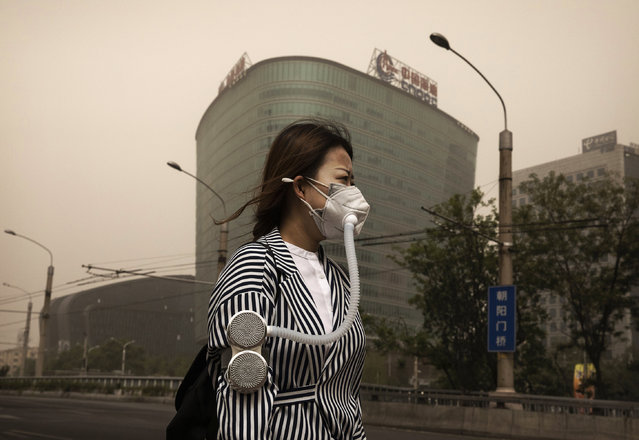
A Chinese woman wears a mask to protect from particles blown in during a sandstorm as she walks in the street on May 4, 2017 in Beijing, China. Sandstorms are common in northern China during the spring season and are caused when heavy winds from Mongolia in the north brings sand and pollutants that can blanket Chinese cities and cause air quality to deteriorate. (Photo by Kevin Frayer/Getty Images)

A Chinese woman wears a mask to protect from particles blown in during a sandstorm as she walks in the street on May 4, 2017 in Beijing, China. Sandstorms are common in northern China during the spring season and are caused when heavy winds from Mongolia in the north brings sand and pollutants that can blanket Chinese cities and cause air quality to deteriorate. (Photo by Kevin Frayer/Getty Images)
Details
12 May 2017 07:06:00