Loading...
Done
Crime Tatoo  Part 1

Tattoos are commonly used among criminals to show gang membership and record the wearer's personal history—such as his or her skills, specialties, accomplishments and convictions. They are also used as a means of personal expression. Certain designs have developed recognized coded meanings. The code systems can be quite complex and because of the nature of what they encode, the tattoo designs are not widely recognized.
Details
23 Apr 2013 10:29:00
Adonna Khare and her Pencil

Originally hailing from a small town in Iowa, Adonna Khare was this year’s recipient of the Art Prize 2012 for her amazingly detailed large-scale pencil on paper works. All of Khare’s work evolve naturally without much pre-planning, essentially building her pieces as she continues to work.
Details
29 May 2015 15:02:00
The Iglu Hotel

Welcome to nature amidst a carefully designed environment made of glistening snow crystals – rebuilt every season from 3000 tons of snow at six locations in the Alps and the Pyrenees. A vivid product for exciting events and one of the most innovative hotel concepts of our times – CO2-neutral and sustainable. A memorable experience awaits you!
Details
10 Jul 2013 11:19:00
Autumn Colours

An autumn leaf sticks to a bench near the Bishops Castle near Wells Cathedral on November 1, 2011 in Wells, England. According to a number of nature watchers the autumn colours are currently reaching their peak following an unusually warm September and October which has led to trees holding onto their leaves longer than normal. (Photo by Matt Cardy/Getty Images)
Details
03 Nov 2011 09:37:00
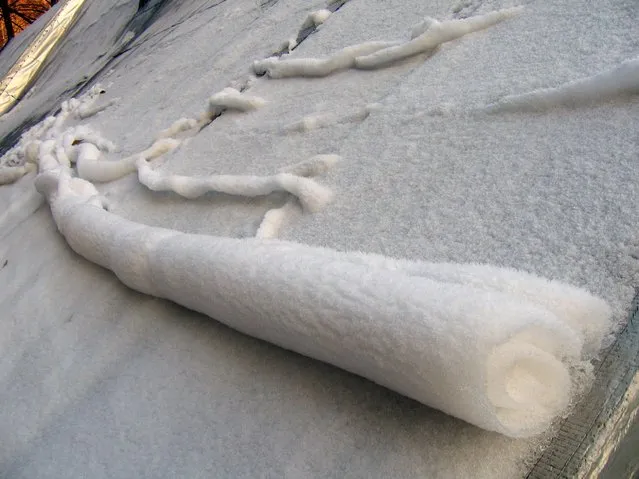
Snow Roller. (Photo by The Daily Omnivore)

“A snow roller is a rare meteorological phenomenon in which large snowballs are formed naturally as chunks of snow are blown along the ground by wind, picking up material along the way, in much the same way that the large snowballs used in snowmen are made”. – Wikipedia. Photo: Snow Roller. (Photo by The Daily Omnivore)
Details
31 Dec 2012 13:04:00
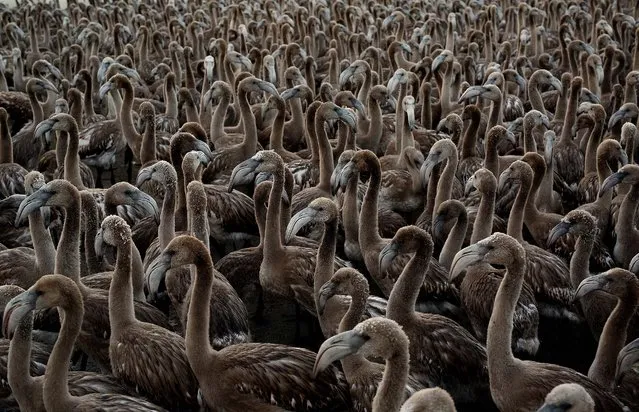
Flamingo chicks walk in an enclosure before they are tagged in Fuente de Piedra, Spain, on Jule 19, 2014. Fuente de Piedra lagoon is a natural reserve with more than 170 different species recorded and one of the main breeding grounds for flamingos in the Iberian Peninsule. Hundreds of flamingo chicks are tagged and checked annually to record the evolution of the species. (Photo by Pablo Blazquez Dominguez/Getty Images)

Flamingo chicks walk in an enclosure before they are tagged in Fuente de Piedra, Spain, on Jule 19, 2014. Fuente de Piedra lagoon is a natural reserve with more than 170 different species recorded and one of the main breeding grounds for flamingos in the Iberian Peninsule. Hundreds of flamingo chicks are tagged and checked annually to record the evolution of the species. (Photo by Pablo Blazquez Dominguez/Getty Images)
Details
21 Jul 2014 10:51:00
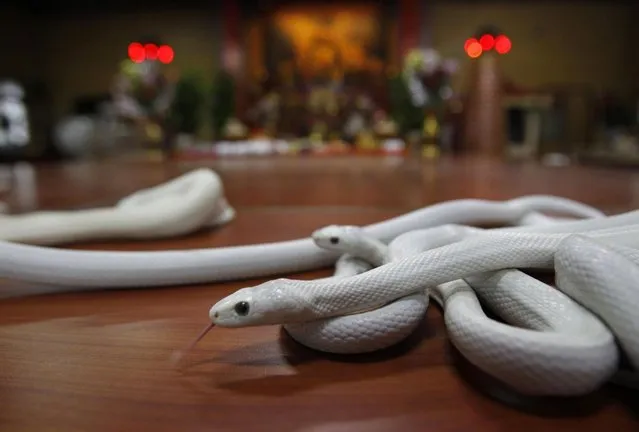
In this photo taken on Wednesday, January 9, 2013, ahead of the Chinese lunar new year of the Snake, following the Chinese zodiac, genetically modified, auspicious, white snakes slither across the altar at the Temple of White Snakes in Taoyuan county, in north western Taiwan. Director of the temple Mr. Lo Chin-shih says the new year of the snake would be a time of steady progress, in contrast to the more turbulent nature of the outgoing year of the dragon. The Chinese new year fall on February 10. (Photo by Wally Santana/AP Photo)

In this photo taken on Wednesday, January 9, 2013, ahead of the Chinese lunar new year of the Snake, following the Chinese zodiac, genetically modified, auspicious, white snakes slither across the altar at the Temple of White Snakes in Taoyuan county, in north western Taiwan. Director of the temple Mr. Lo Chin-shih says the new year of the snake would be a time of steady progress, in contrast to the more turbulent nature of the outgoing year of the dragon. The Chinese new year fall on February 10. (Photo by Wally Santana/AP Photo)
Details
09 Feb 2013 10:53:00
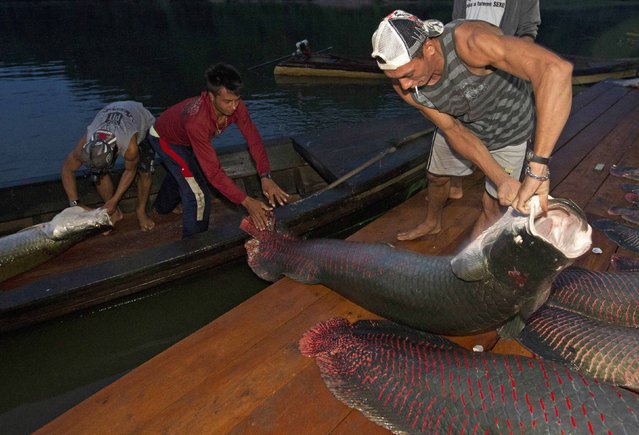
Villagers from the Medio Jurua nature reserve of Brazil's Amazon rainforest arrive with their catch of pirarucus, the largest freshwater fish in South America, after a night of fishing in Manaria Lake, Carauari municipality, September 3, 2012. Catching the pirarucu, a fish that is sought after for its meat and is considered by biologists to be a living fossil, is only allowed once a year by Brazil's environmental protection agency. (Photo by Bruno Kelly/Reuters)

Villagers from the Medio Jurua nature reserve of Brazil's Amazon rainforest arrive with their catch of pirarucus, the largest freshwater fish in South America, after a night of fishing in Manaria Lake, Carauari municipality, September 3, 2012. Catching the pirarucu, a fish that is sought after for its meat and is considered by biologists to be a living fossil, is only allowed once a year by Brazil's environmental protection agency. (Photo by Bruno Kelly/Reuters)
Details
19 Jul 2013 08:53:00