Philadelphia Phillies Ben Francisco reacts after being hit in the head with a pitch by Cincinnati Reds Logan Ondrusek during the MLB National League Division Series baseball playoffs in Philadelphia, Pennsylvania, United States in this October 8, 2010 file photo. (Photo by Tim Shaffer/Reuters)
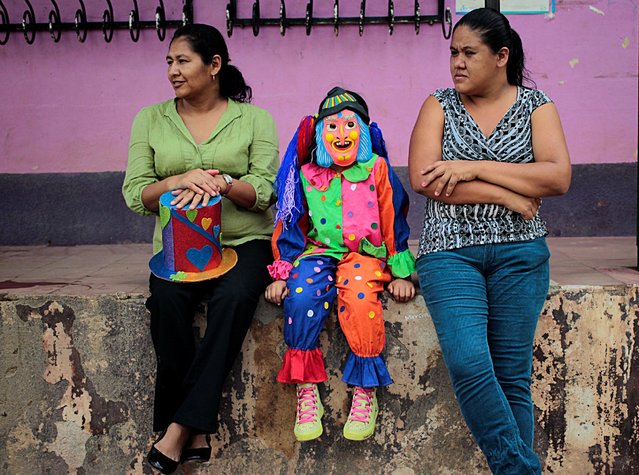
A child dressed as a clown takes part in the celebration of the Virgen de los Desamparados, or Our Lady of the Abandoned, at Diria town, Nicaragua May 14, 2016. (Photo by Oswaldo Rivas/Reuters)
Yuliya Levchenko, of Ukraine, celebrates during qualifying for the women's high jump at the World Athletics Championships on Saturday, July 16, 2022, in Eugene, Ore. (Photo by Ashley Landis/AP Photo)
An exhibition staff member looks over artworks by Polish artist Magdalena Abakanowicz on display during a preview of the exhibition “Magdalena Abakanowicz: Every Tangle of Thread and Rope” at the Tate Modern in London, Britain, 15 November 2022. The large-scale Abakan sculptures have been brought together for the first time in the UK. The exhibit opens on 17 November 2022 and runs until 21 May 2023. (Photo by Andy Rain/EPA/EFE/Rex Features/Shutterstock)
A security guard tries to separate a boy who hugs India's captain Rohit Sharma, right, after invading the field of play during the second one-day international cricket match between India and New Zealand in Raipur, India, Saturday, January 21, 2023. (Photo by Aijaz Rahi/AP Photo)
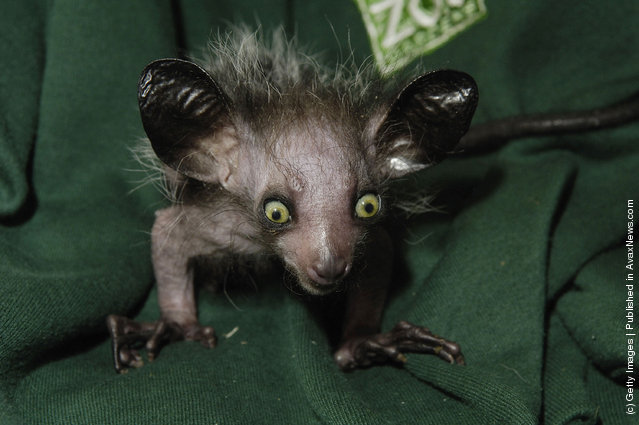
“The aye-aye (Daubentonia madagascariensis) is a lemur, a strepsirrhine primate native to Madagascar that combines rodent-like teeth and a special thin middle finger to fill the same ecological niche as a woodpecker. It is the world's largest nocturnal primate, and is characterized by its unusual method of finding food; it taps on trees to find grubs, then gnaws holes in the wood and inserts its narrow middle finger to pull the grubs out. The only other animal species known to find food in this way is the striped possum. From an ecological point of view the aye-aye fills the niche of a woodpecker as it is capable of penetrating wood to extract the invertebrates within”. – Wikipedia
Photo: In this handout image from Bristol Zoo is seen the first captive bred aye-aye in the UK named “Kintana” (meaning star in Malagasy) April 15, 2005 at Bristol Zoo Gardens, England. The zoo announced today only the second baby aye-aye to be hand-reared in the world (the first was in Jersey Zoo) and has now made his first public appearance since his birth on 11 February 2005. (Photo by Rob Cousins/Bristol Zoo via Getty Images)