Loading...
Done
A man runs after he tried to put himself on fire during a protest at a makeshift camp at the Greek-Macedonian border near the village of Idomeni on March 22, 2016. Greece will not be able to start sending refugees back to Turkey from March 20, 2016, the government said, as the country struggles to implement a key deal aimed at easing Europe's migrant crisis. The numbers are daunting: officials said as of Saturday there were 47,500 migrants in Greece, including 8,200 on the islands and 10,500 massed at the Idomeni camp on the Macedonian border. (Photo by Andrej Isakovic/AFP Photo)

A man runs after he tried to put himself on fire during a protest at a makeshift camp at the Greek-Macedonian border near the village of Idomeni on March 22, 2016. Greece will not be able to start sending refugees back to Turkey from March 20, 2016, the government said, as the country struggles to implement a key deal aimed at easing Europe's migrant crisis. The numbers are daunting: officials said as of Saturday there were 47,500 migrants in Greece, including 8,200 on the islands and 10,500 massed at the Idomeni camp on the Macedonian border. (Photo by Andrej Isakovic/AFP Photo)
Details
23 Mar 2016 12:25:00
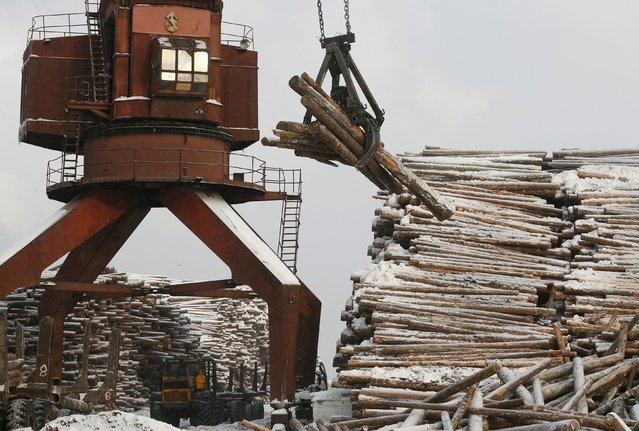
A crane loads logs at the Novoyeniseisk wood processing plant, with the air temperature at about minus 20 degrees Celsius (minus 4 degrees Fahrenheit), in the town of Lesosibirsk in Krasnoyarsk Region, Siberia, Russia, February 16, 2016. The plant exports timber to Europe, Northern Africa and Asia. The Taiga, also known as the boreal forest, on the coast of the Angara River and Yenisei River is one of the main areas for the industrial cutting of wood thanks to the high quality of the Angara pine. (Photo by Ilya Naymushin/Reuters)

A crane loads logs at the Novoyeniseisk wood processing plant, with the air temperature at about minus 20 degrees Celsius (minus 4 degrees Fahrenheit), in the town of Lesosibirsk in Krasnoyarsk Region, Siberia, Russia, February 16, 2016. The plant exports timber to Europe, Northern Africa and Asia. The Taiga, also known as the boreal forest, on the coast of the Angara River and Yenisei River is one of the main areas for the industrial cutting of wood thanks to the high quality of the Angara pine. Open air work continues all year around regardless to temperatures which can drop to minus 52 degrees Celsius (minus 61.6 degrees Fahrenheit), according to employees. (Photo by Ilya Naymushin/Reuters)
Details
18 Feb 2016 13:10:00
The underbelly of fetish parties has been exposed in photographs captured by Belgian photographer MagLau. The photographer dedicated three years to capturing the obsession with leather and chains, visiting fetish parties through Europe and Japan. The photographer told: “I just took pictures, always finding some beauty in the dark side”. He said that most people were happy to be photographed for the project, with the images included in a new book Fetish Ballad. Aiming to capture the candid moments, he said he never judged but instead wanted to simply observe and understand. Here: Picture from Fetish Ballad book. (Photo by MagLau/Laurent Muschel)

The underbelly of fetish parties has been exposed in photographs captured by Belgian photographer MagLau. The photographer dedicated three years to capturing the obsession with leather and chains, visiting fetish parties through Europe and Japan. The photographer told: “I just took pictures, always finding some beauty in the dark side”. He said that most people were happy to be photographed for the project, with the images included in a new book Fetish Ballad. Aiming to capture the candid moments, he said he never judged but instead wanted to simply observe and understand. Here: Picture from Fetish Ballad book. (Photo by MagLau/Laurent Muschel)
Details
16 Oct 2016 10:49:00
28 year old Rupa has her hair shaven to donate to the Gods at the Thiruthani Murugan Temple November 10, 2016 in Thiruttani, India. Rupa donated her hair with the wish that her daughter's illness is cured. The process of shaving ones hair and donating it to the Gods is known as tonsuring. It is common for Hindu believers to tonsure their hair at a temple as a young child, and also to celebrate a wish coming true, such as the birth of a baby or the curing of an illness. The “temple hair”, as it's known, is then auctioned off to a processing plant and then sold as pricey wigs and weaves in the US, Europe and Africa. (Photo by Allison Joyce/Getty Images)

28 year old Rupa has her hair shaven to donate to the Gods at the Thiruthani Murugan Temple November 10, 2016 in Thiruttani, India. Rupa donated her hair with the wish that her daughter's illness is cured. The process of shaving ones hair and donating it to the Gods is known as tonsuring. It is common for Hindu believers to tonsure their hair at a temple as a young child, and also to celebrate a wish coming true, such as the birth of a baby or the curing of an illness. The “temple hair”, as it's known, is then auctioned off to a processing plant and then sold as pricey wigs and weaves in the US, Europe and Africa. (Photo by Allison Joyce/Getty Images)
Details
21 Nov 2016 10:30:00
Auto polo, Coney Isl. Between ca. 1910 and ca. 1915. (Photo by George Grantham Bain Collection)

“Automobile polo or Auto polo was a motorsport invented in the United States with rules and equipment similar to equestrian polo but using automobiles instead of horses. The sport was popular at fairs, exhibitions and sports venues across the United States and several areas in Europe from 1911 until the late 1920s; but it was dangerous and carried the risk of injury and death to the participants and spectators”. – Wikipedia. Photo: Auto polo, Coney Isl., between ca. 1910 and ca. 1915. (Photo by George Grantham Bain Collection)

P.S. All pictures are presented in high resolution. To see Hi-Res images – just TWICE click on any picture. In other words, click small picture – opens the BIG picture. Click BIG picture – opens VERY BIG picture (if available; this principle works anywhere on the site AvaxNews).
Details
01 Mar 2013 13:23:00
The container ship MSC Fabiola (R) is seen docked at the Port of Oakland on March 22, 2012, in Oakland, California

“MSC Fabiola is a container ship owned by Mediterranean Shipping Company (MSC), the largest such vessel ever to dock in North America. In March 2012 the ship shifted from its initial Asia-to-Europe service to begin trans-Pacific service. On March 19, 2012, Fabiola docked at the Port of Long Beach, breaking earlier records for the largest container ship at a US port, and at any North American port”. – Wikipedia

Photo: The container ship MSC Fabiola (R) is seen docked at the Port of Oakland on March 22, 2012, in Oakland, California. The MSC Fabiola is the largest container ship ever to dock at any seaport in North America with an overall length of nearly one quarter mile long. (Photo by Justin Sullivan/Getty Images)
Details
23 Mar 2012 11:18:00
Albertus in the church of St George in Burgrain, Germany. Incredibly, some of the skeletons, which took up to five years to decorate, were even found hidden away in lock-ups and containers. (Photo by Paul Koudounaris/BNPS)

A relic hunter dubbed “Indiana Bones” has lifted the lid on a macabre collection of 400-year-old jewel-encrusted skeletons unearthed in churches across Europe. Art historian Paul Koudounaris has hunted down and photographed dozens of gruesome skeletons in some of the world's most secretive religious establishments. Photo: Albertus in the church of St George in Burgrain, Germany. Incredibly, some of the skeletons, which took up to five years to decorate, were even found hidden away in lock-ups and containers. (Photo by Paul Koudounaris/BNPS)
Details
08 Sep 2013 07:20:00
Performers wearing 19th century French military uniforms fire their weapons as they attack Allied forces during a reenactment of the Battle of the Nations, in a field in the village of Markkleeberg near Leipzig October 20, 2013. (Photo by Fabrizio Bensch/Reuters)

Performers wearing 19th century French military uniforms fire their weapons as they attack Allied forces during a reenactment of the Battle of the Nations, in a field in the village of Markkleeberg near Leipzig October 20, 2013. The east German city of Leipzig commemorated the 200th anniversary of the largest battle of the Napoleonic Wars on Sunday by reenacting the Battle of the Nations, with 6,000 military-historic association enthusiasts from all over Europe. The decisive encounter in which tens of thousands of soldiers were killed, took place from October 17-19, 1813, just outside of Leipzig. At the height of the hostilities Napoleon fielded more than 200,000 men against an Allied force of some 360,000 soldiers which included troops from Russia, Austria, Prussia and Sweden. (Photo by Fabrizio Bensch/Reuters)
Details
21 Oct 2013 11:19:00