Loading...
Done
Labourers work at the installation site of Liquefied Petroleum Gas (LPG) pipeline on May Day or Labour Day in Chandigarh, India, May 1, 2015. (Photo by Ajay Verma/Reuters)

Labourers work at the installation site of Liquefied Petroleum Gas (LPG) pipeline on May Day or Labour Day in Chandigarh, India, May 1, 2015. (Photo by Ajay Verma/Reuters)
Details
11 May 2015 11:44:00
“Dancers Among Us”: Macys, NYC – Annmaria Mazzini. (Photo by Jordan Matter)

“The inspiration for this book came to me one afternoon as I watched my son, Hudson, playing with his toy bus. I was trying to keep pace with his three-year-old mind as he got deeper and deeper into a fantasy involving nothing more than a yellow plastic box and armless figurines. At least that’s what I saw. He saw frantic commuters rushing to catch the 77 local bus to Australia. He jumped in place, mouth open and slapping his knees, joyously reacting to a world I couldn’t see, but one powerfully present for him...”. – Jordan Matter

Photo: “Dancers Among Us”: Macys, NYC – Annmaria Mazzini. (Photo by Jordan Matter)
Details
12 Nov 2012 11:17:00
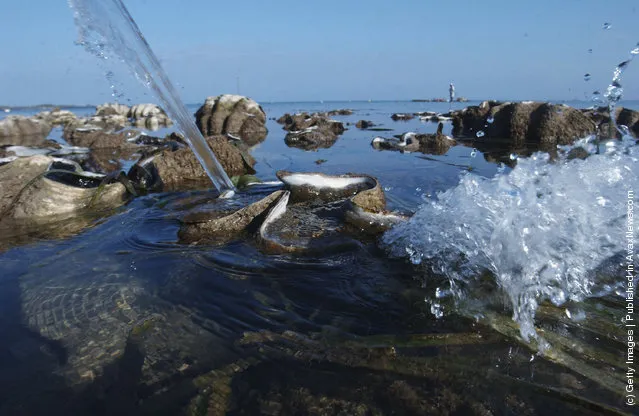
Tridacna Gigas, or Giant Clams

“The giant clam, Tridacna gigas (known as pā’ua in Cook Islands Māori), is the largest living bivalve mollusc. T. gigas is one of the most endangered clam species. It was mentioned as early as 1825 in scientific reports. One of a number of large clam species native to the shallow coral reefs of the South Pacific and Indian oceans, they can weigh more than 200 kilograms (440 lb) measure as much as 120 cm (47 in) across, and have an average lifespan in the wild of 100 years or more”. – Wikipedia

Photo: Tridacna Gigas, or Giant Clams spew water as a traditional fisherman passes by a small sanctuary on January 23, 2004 near Bolinao in the Northern Philippines. The clams, prime builders for coral reefs and providing shelter for spawning fish and other marine life, are exposed by low tides in the sanctuary. Overfishing and pollution throughout the country are not only threatening food security, but are also starting to choke one of the few working clam sanctuaries in the world. (Photo by David Greedy/Getty Images)

Details
01 Oct 2011 13:10:00
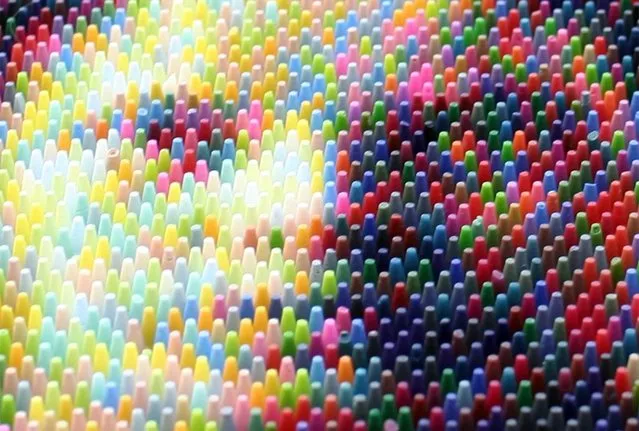
Art by Christian Faur

Christian Faur is an artist based in Granville, Ohio. Looking for a new technique, he experimented with painting with wax, but he didn’t feel the results were satisfactory.Then, at Christmas in 2005, his young daughter opened a box of 120 Crayola crayons he’d bought her, and everything clicked into place. Faur decided he would create pictures out of the crayons themselves, packing thousands of them together so they become like the colored pixels on a TV screen. He starts each work by scanning a photo into a computer and breaking the image down into colored blocks He then draws a grid that shows him exactly where to place each crayon The finished artworks are packed tightly into wooden frames. He actually makes the crayons himself, hand-casting each one in a mould.
Details
28 Jul 2012 10:03:00
Russian-born Zlata is pictured in Fifties style glam while still managing to bend herself in half. (Photo by Barcroft Media)

For many of us, simply bending over to touch our toes can be a difficult. But it's not a problem for the world's bendiest woman Julia Günthel aka Zlata (27). Russian-born Zlata can twist herself like a snake into the most extreme poses imaginable – and has broken numerous world records for her flexibility. The former gymnast, who is 5ft 8in, is so flexible she can cram herself into a 50cm squared box. Photo: Russian-born Zlata is pictured in Fifties style glam while still managing to bend herself in half. (Photo by Barcroft Media)
Details
25 Oct 2013 08:21:00
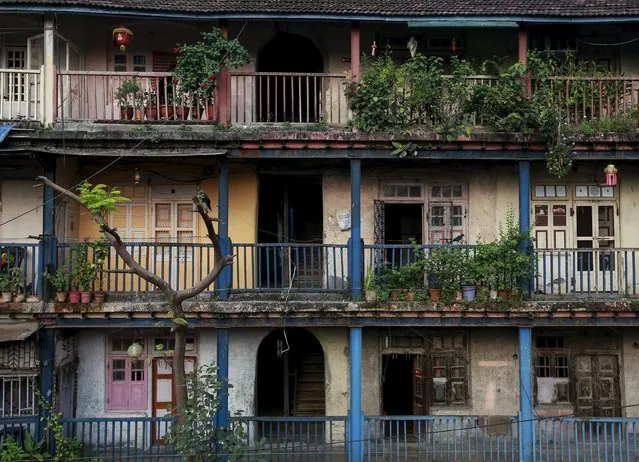
Windows and doors of an old residential building are pictured in central Mumbai October 10, 2014. The cost for buying a residential apartment in Mumbai close to the city centre ranges from 12,000 Indian rupees ($ 200) per square feet to 112,552 Indian rupees ($ 1800) per square feet. (Photo by Danish Siddiqui/Reuters)

In Mumbai, the windows of new high-rise apartment blocks, old low-rise residential buildings and shantytown shacks portray the disparity in living conditions and incomes in the Indian city. Rents for a place to live range from more than $2,000 to less than $5 a month. Here: Windows and doors of an old residential building are pictured in central Mumbai October 10, 2014. The cost for buying a residential apartment in Mumbai close to the city centre ranges from 12,000 Indian rupees ($ 200) per square feet to 112,552 Indian rupees ($ 1800) per square feet. (Photo by Danish Siddiqui/Reuters)
Details
23 Apr 2015 12:29:00
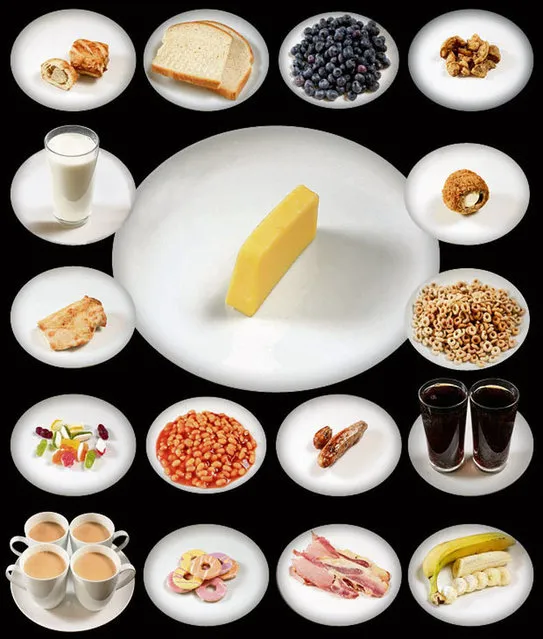
What 200 Calories Looks Like In Different Foods Part 3

Some foods have significantly more Calories than others but what does the difference actually look like. Each of the photographs below represents 200 Calories of the particular type of food; the images are sorted from low to high calorie density. When you consider that an entire plate of broccoli contains the same number of Calories as a small spoonful of peanut butter, you might think twice the next time you decide what to eat. According to the U.S. Department of Agriculture, the average adult needs to consume about 2000 – 2500 Calories to maintain their weight. In other words, you have a fixed amount of Calories to "spend" each day; based on the following pictures, which would you eat?


See Also: Ppart 1 _ Part 2
Details
02 Aug 2014 09:53:00
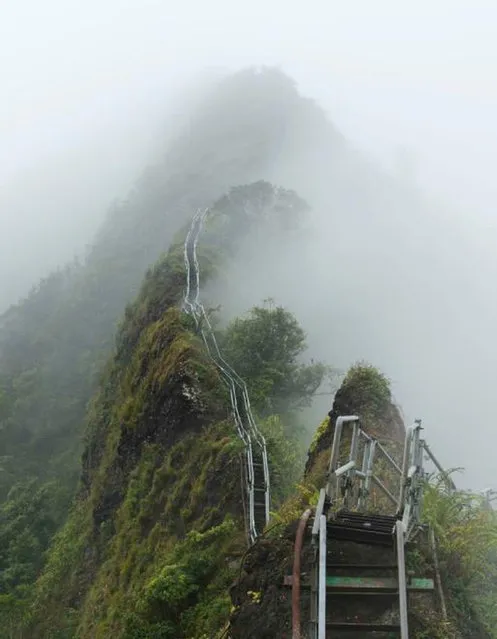
Stairway To Heaven In Hawaii

The Haʻikū Stairs, also known as the Stairway to Heaven or Haʻikū Ladder, is a steep hiking trail on the island of Oʻahu. The trail began as a wooden ladder spiked to the cliff on the south side of the Haʻikū Valley. It was installed in 1942 to enable antenna cables to be strung from one side of the cliffs above Haʻikū Valley to the other. A building to provide a continuous communication link between Wahiawā and Haʻikū Valley Naval Radio Station was constructed at the peak of Puʻukeahiakahoe, elevation about 2,800 feet (850 m). The antennae transmitted very low frequency radio signals from a 200,000-watt Alexanderson alternator in the center of Haʻikū valley. The signals could reach US Navy submarines as far away as Tokyo Bay while the submarines were submerged.
Details
30 Nov 2013 12:47:00