Loading...
Done
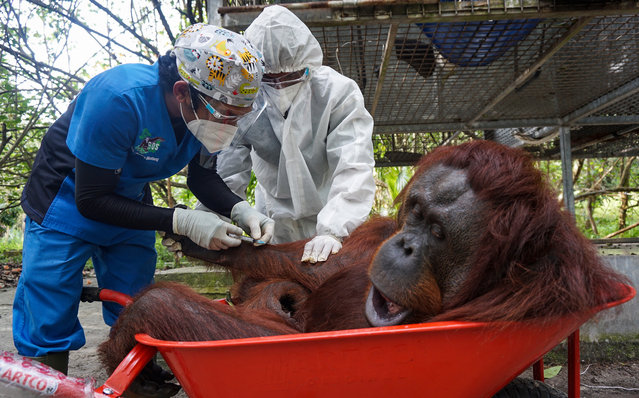
A handout photo made available by Borneo Orangutan Survival Foundation (BOSF) shows veterinarian wearing protective masks and suit, conducting anesthesia procedure on Nenuah, a nine year old Bornean Orangutan before being transported and released to the Bukit Batikap protection forest, at the Nyaru Menteng Orangutan Rehabilitation Center in Palangkaraya, Central Kalimantan, Indonesia, 15 February 2021. BOSF and the national nature conservation agency (BKSDA) released 10 orangutans back to the wild in Bukit Batikap Protection Forest in Central Kalimantan and the Kehje Sewen Forest in East Kalimantan amid the pandemic according to BOSF. (Photo by BOSF Handout/EPA/EFE)

A handout photo made available by Borneo Orangutan Survival Foundation (BOSF) shows veterinarian wearing protective masks and suit, conducting anesthesia procedure on Nenuah, a nine year old Bornean Orangutan before being transported and released to the Bukit Batikap protection forest, at the Nyaru Menteng Orangutan Rehabilitation Center in Palangkaraya, Central Kalimantan, Indonesia, 15 February 2021. BOSF and the national nature conservation agency (BKSDA) released 10 orangutans back to the wild in Bukit Batikap Protection Forest in Central Kalimantan and the Kehje Sewen Forest in East Kalimantan amid the pandemic according to BOSF. (Photo by BOSF Handout/EPA/EFE)
Details
07 Mar 2021 09:54:00
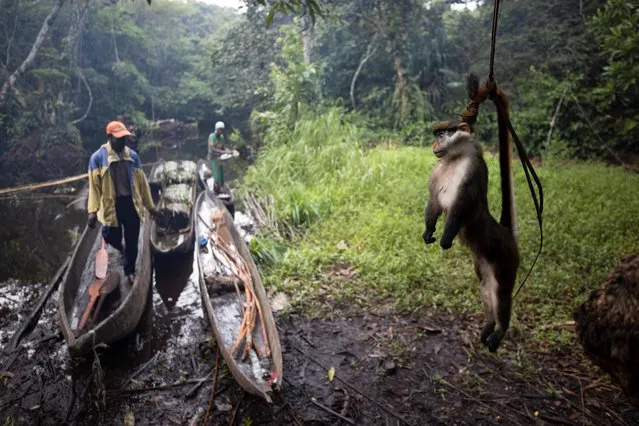
A dead red-tailed monkey hangs by its tail above the ground, in order to keep it away from ants, in the forest near the city of Mbandaka, Democratic Republic of the Congo, April 5, 2019. Bushmeat hunters are emptying Central Africa's forests at a high rate, researchers say. A growing appetite for wild meat in cities has ramped up the scale of hunting. Research shows around 6 million tonnes of bushmeat are sourced annually from the Congo Basin, whose forest spans across six countries and is second in size only to the Amazon. (Photo by Thomas Nicolon/Reuters)

A dead red-tailed monkey hangs by its tail above the ground, in order to keep it away from ants, in the forest near the city of Mbandaka, Democratic Republic of the Congo, April 5, 2019. Bushmeat hunters are emptying Central Africa's forests at a high rate, researchers say. A growing appetite for wild meat in cities has ramped up the scale of hunting. Research shows around 6 million tonnes of bushmeat are sourced annually from the Congo Basin, whose forest spans across six countries and is second in size only to the Amazon. (Photo by Thomas Nicolon/Reuters)
Details
14 Oct 2019 00:03:00
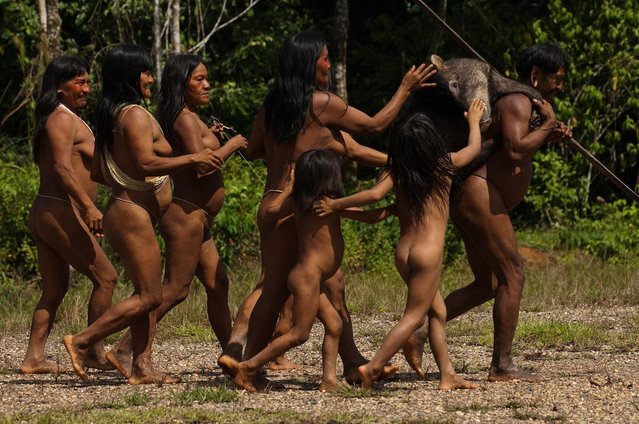
Spectacular images offering insight into the lives of the Huaorani people in the Ecuadorian Amazon have been revealed showing how they use traditional methods to hunt monkeys for food. The stunning pictures were taken by conservation photographer Pete Oxford from Torquay, Devon in the Ecuadorian Amazon. “The Huaorani Indians are a forest people highly in tune with their environment. Many are now totally acculturated since the 1950s by missionaries”, said Pete. “Today they face radical change to their culture to the proximity of oil exploration within their territory and the Yasuni National Park and Biosphere Reserve, they are vastly changed. Some still live very traditionally and for this shoot, through my Huaorani friend, a direct relative of those photographed he wanted to depict them as close to their original culture as possible. They still largely hunt with blow pipes and spears eating a lot of monkeys and peccaries”. The Huaorani are also known as the Waorani, Waodani or the Waos and are native Amerindians. Their lands are located between the Curaray and Napo rivers and speak the Huaorani language. Pete says that during his visit he was welcomed into the group and hopes that ancient cultures can be saved. Here: The tribe were seen celebrating after a hunter returned to camp with a wild pig. (Photo by Pete Oxford/Mediadrumworld.com)

Spectacular images offering insight into the lives of the Huaorani people in the Ecuadorian Amazon have been revealed showing how they use traditional methods to hunt monkeys for food. The stunning pictures were taken by conservation photographer Pete Oxford from Torquay, Devon in the Ecuadorian Amazon. Here: The tribe were seen celebrating after a hunter returned to camp with a wild pig. (Photo by Pete Oxford/Mediadrumworld.com)
Details
20 Jan 2017 07:58:00
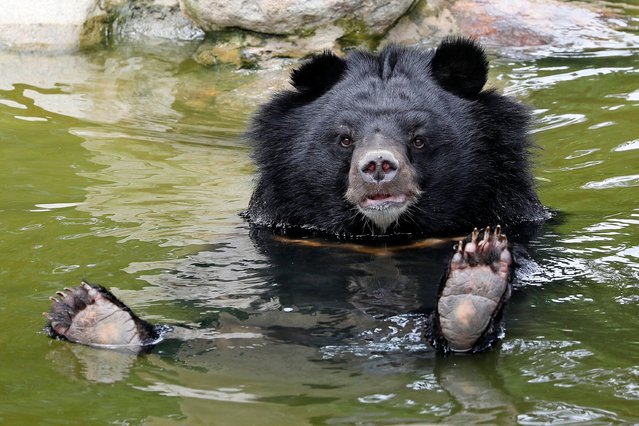
A moon bear rests in a pool inside an enclosure at the Vietnam bear rescue centre, in Tam Dao national park, Vinh Phuc, Vietnam, 09 July 2019. The center is operated by international organization Animals Asia. There are currently 184 bears living at the the Vietnam Bear Rescue Centre. It is estimated that there are less than a few hundred bears left in the wild in Vietnam. According to the latest data from the Ministry of Agriculture and Rural development, around 600 bears are still being kept on farms. In Vietnam, Animals Asia has rescued a total of 209 sun bears and moon bears. (Photo by Minh Hoang/EPA/EFE/Rex Features/Shutterstock)

A moon bear rests in a pool inside an enclosure at the Vietnam bear rescue centre, in Tam Dao national park, Vinh Phuc, Vietnam, 09 July 2019. The center is operated by international organization Animals Asia. There are currently 184 bears living at the the Vietnam Bear Rescue Centre. It is estimated that there are less than a few hundred bears left in the wild in Vietnam. According to the latest data from the Ministry of Agriculture and Rural development, around 600 bears are still being kept on farms. In Vietnam, Animals Asia has rescued a total of 209 sun bears and moon bears. (Photo by Minh Hoang/EPA/EFE/Rex Features/Shutterstock)
Details
14 Jul 2019 00:05:00
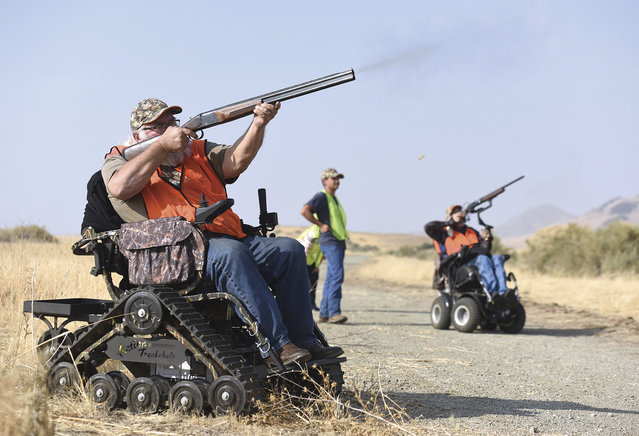
In this November 16, 2018, file photo, Duane Townsend, left, shoots a pheasant at Special Friday Pheasant Hunts, sponsored by Southern Tulare County Sportsman's Association, at Lake Success Recreation Area in Porterville, Calif. A Utah man who has been in a wheelchair for more than three decades has created a pheasant hunt for people like him who need help getting into the outdoors. The Daily Herald in Provo reports that Clint Robinson broke his neck after being thrown off a horse at a rodeo 32 years ago. The event called “Wheelchairs in the Wild” pairs people that have physical disabilities with hunters who help them with whatever they need. Many go in off-road vehicles. (Photo by Chieko Hara/The Porterville Recorder via AP Photo/File)

In this November 16, 2018, file photo, Duane Townsend, left, shoots a pheasant at Special Friday Pheasant Hunts, sponsored by Southern Tulare County Sportsman's Association, at Lake Success Recreation Area in Porterville, Calif. A Utah man who has been in a wheelchair for more than three decades has created a pheasant hunt for people like him who need help getting into the outdoors. The Daily Herald in Provo reports that Clint Robinson broke his neck after being thrown off a horse at a rodeo 32 years ago. The event called “Wheelchairs in the Wild” pairs people that have physical disabilities with hunters who help them with whatever they need. Many go in off-road vehicles. (Photo by Chieko Hara/The Porterville Recorder via AP Photo/File)
Details
19 Oct 2019 00:01:00


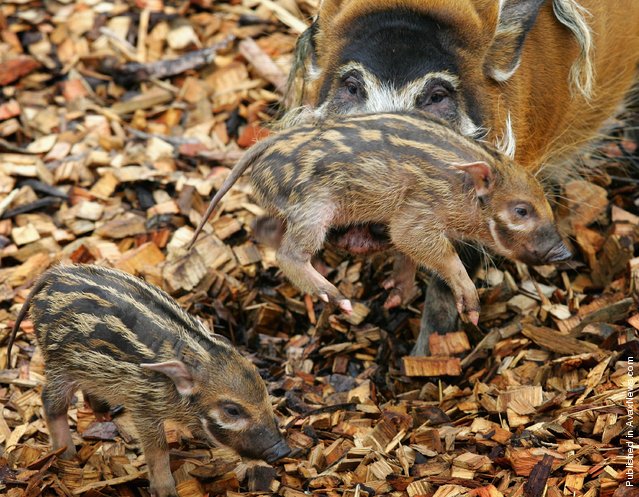
“The Red River Hog (Potamochoerus porcus), also known as the Bush Pig (but not to be confused with P. larvatus, common name “Bushpig”), is a wild member of the pig family living in Africa, with most of its distribution in the Guinean and Congolian forests. It is rarely seen away from rainforests, and generally prefers areas near rivers or swamps.

Red River Hogs eat grass, berries, roots, insects, molluscs, small vertebrates and carrion. They are capable of causing damage to plantations. Red River Hogs typically live in herds of 6-20 members led by a dominant boar. Sows rear 3-6 piglets at a time.”

Photo: Two 17 day old red river hoglet twins forage for food next to their mother Bahiti at London Zoo on August 23, 2007 in London, England. Red River hoglets inhabit the forests and swamps of West and Central Africa. The recent additions to the London Zoo pig pen have been eagerly awaited by zoo keepers. (Photo by Chris Jackson/Getty Images)
Details
18 Mar 2011 15:15:00
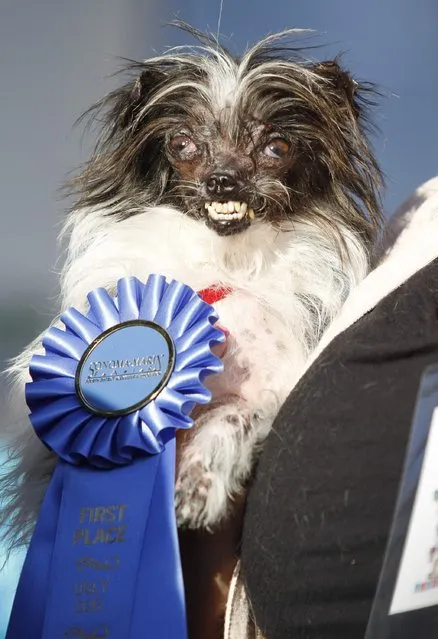
World's Ugliest Dog

It's that time of year again when dogs with unusually large heads, hairless bodies and other oddities compete to be the World's Ugliest Dog. This year's winner? A 2-year-old mutt named Peanut, whose wild white and brown hair, bulging eyes and protruding teeth belie his sweet, energetic personality. Peanut's owner, Holly Chandler of Greenville, North Carolina, says he was seriously burned as a puppy and she wants to use her pet to raise awareness about animal abuse. She plans to use the $1,500 prize to pay for other animals' veterinary bills. The contest, held at the Sonoma-Marin Fairgrounds in Petaluma, California, is in its 26 year. The dogs are scored by a three-judge panel in several categories, including special or unusual attributes, personality and natural ugliness.
Details
24 Jun 2014 10:04:00
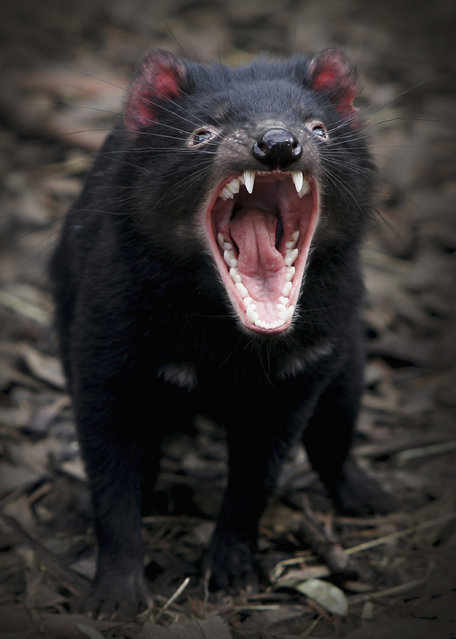
A Tasmanian Devil bears it's teeth at a quarantine facility August 31, 2005 in Hobart, Australia. The Devil, a native marsupial unique to Tasmania, is under threat from Devil Facial Tumor Disease (DFTD) which is decimating numbers throughout Tasmania. (Photo by Ian Waldie/Getty Images)

“The Tasmanian devil (Sarcophilus harrisii) is a carnivorous marsupial of the family Dasyuridae now found in the wild only in the Australian island state of Tasmania. The size of a small dog, it became the largest carnivorous marsupial in the world following the extinction of the thylacine in 1936. It is characterised by its stocky and muscular build, black fur, pungent odour, extremely loud and disturbing screech, keen sense of smell, and ferocity when feeding”. – Wikipedia. Photo: A Tasmanian Devil bears it's teeth at a quarantine facility August 31, 2005 in Hobart, Australia. (Photo by Ian Waldie/Getty Images)
Details
27 Jan 2014 09:45:00